1.
2.
3.
4.
Notes:
The total coverage capacity of a base station and one or more Repeaters is always limited to the
capacities of a base station.
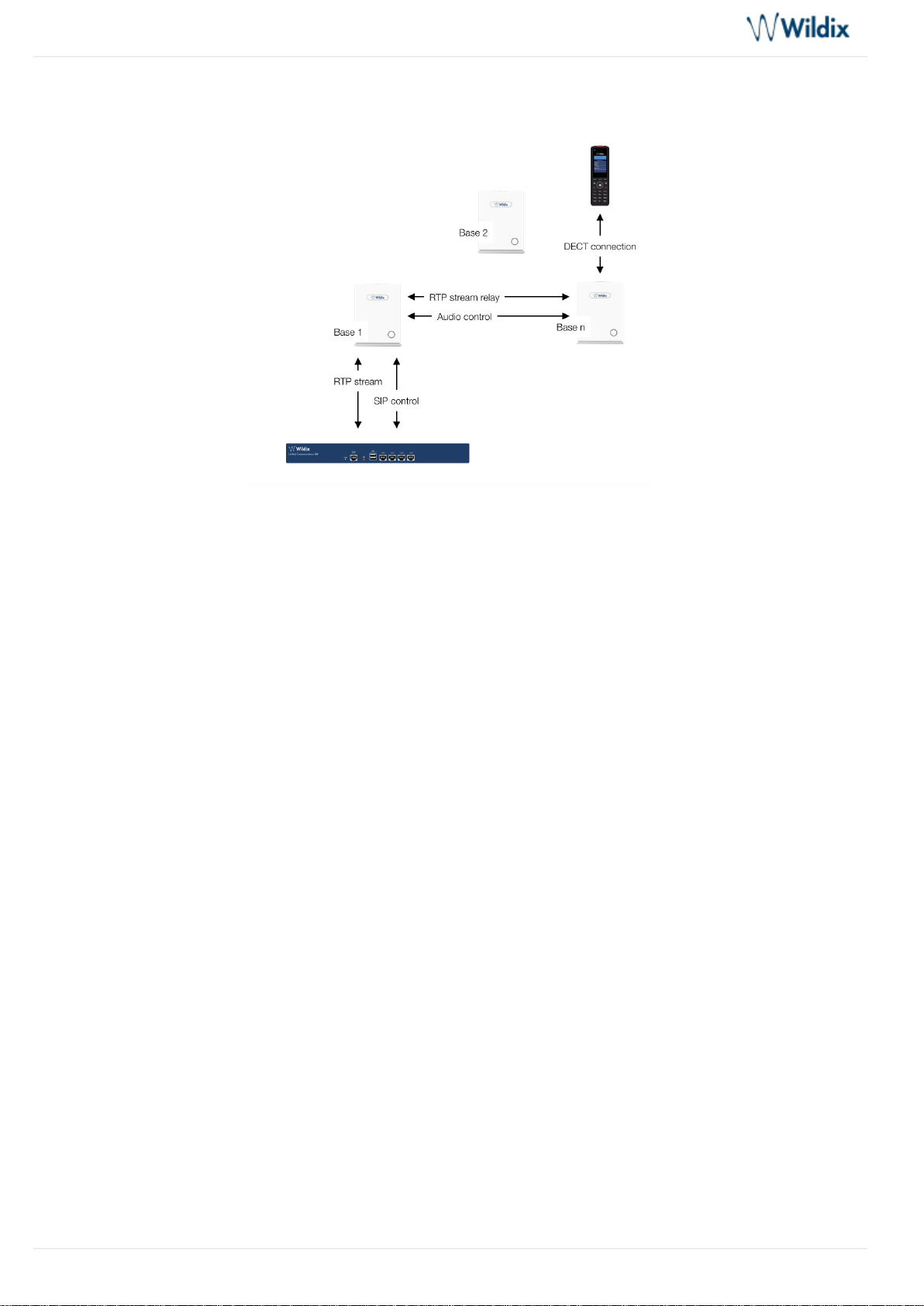
A W-AIR network uses an auto-balancing model to increase the number of simultaneous calls, distributing
the calls to 2 or more adjacent Base stations
Simulate the worst environmental conditions (close the doors, turn on the equipment, etc) to perform a
realistic test of configuration
Call 98 code (conference) on your W-AIR Handset to listen to the music on hold, to test an audio reception
quality.
If you enable PTT (push to talk) feature on W-AIR Handset, the number of available channels on each
base station is reduced to 6.
Call 76 code (echo) on your W-AIR Handset to test the voice quality
Site Survey
Requirements
PoE switches or a 48V PoE power injector. Site survey is possible without network connectivity.
A DHCP server. If you are using Wildix PBX as DHCP Server, go to andSettings System DHCP Server
search for the device among the DHCP leases.
A W-AIR base. Reset the base station to the default settings.
A W-AIR handset. Before getting started make sure the handset is fully charged. The handset does not
need to be pre-registered to a particular base. Connect the base station to the power injector and turn it on.
How to check RSSI level
Follow the steps below:
Press "Menu" key of the W-AIR handset
Type *ip* (*47*)
Use the cursor down/ up to select the base MAC address
Select the base station to view its RSSI level.
Placing the first base station
Follow the steps below:
place the W-AIR base station exactly at the desired position and power on the base.
Check RSSI level on the handset.
use the building plan drawing and check the base station coverage using the Site survey mode of the
phone. Mark up acceptable and unacceptable spots on the plan drawing. Take notes of the RSSI levels of
the base. Acceptable spots are the ones where the phone shows .RSSI levels better than -75 dBm
Follow the steps again to place more base stations.
Typically, when the system is installed in the office buildings, hotels or hospitals, there should be both Base
stations and Repeaters on several floors to create uniform and complete radio coverage. Open areas can be
covered by wide network of Base stations. In these applications, the Base stations and/ or Repeaters cover an
extended range due to the extended line-of-sight radio propagation capability.
Check the Radio Coverage