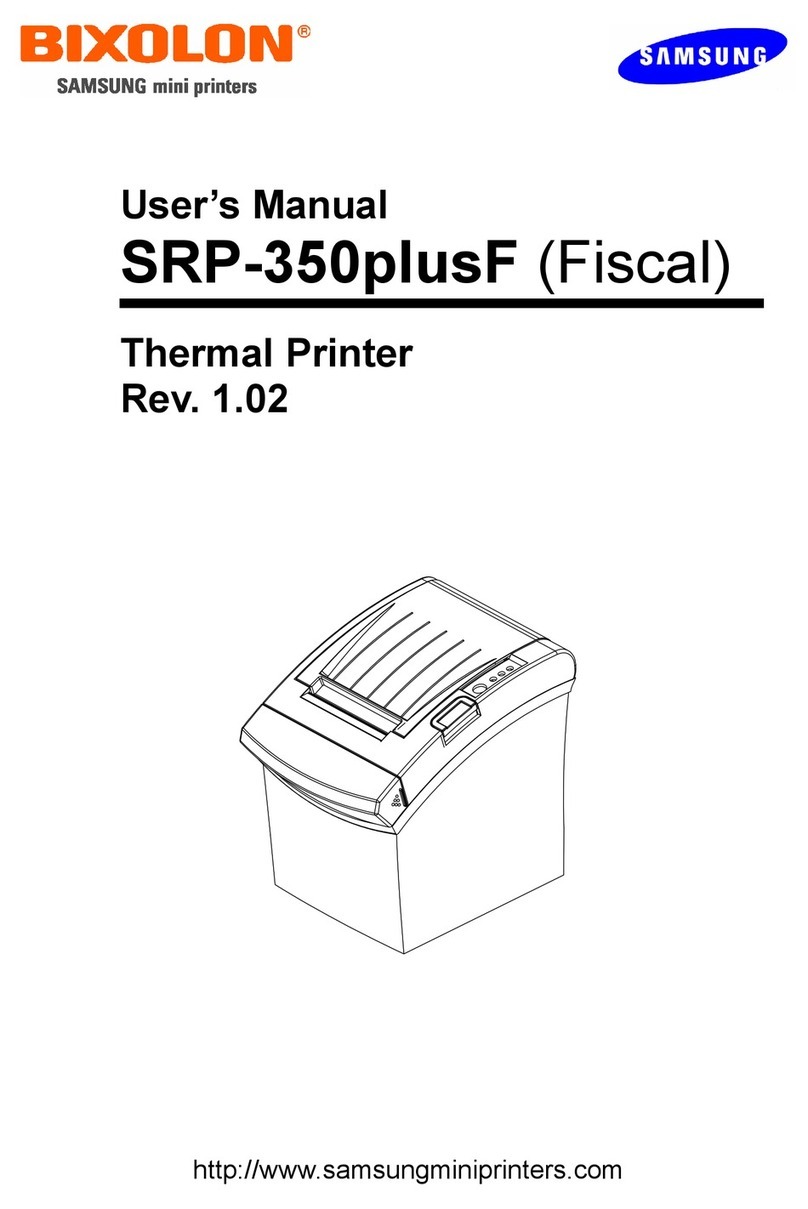
WP 80MM Series User manual

80MM SERIES THERMAL
RECEIPT PRINTER
-INSTRUCTION MANUAL

1 / 17
1. Safety Notice:
* Don't touch the printer head with anything.
* Don't touch the cutter blade.
* Don't bend the power cord excessively or place any heavy objects onto it.
* Don't use the printer when it is out of order. This can cause a fire or and electrocution.
* When connecting or disconnecting the plug, always hold the plug but not the cord.
* Keep the desiccant out of children's reach.
* Use only approved accessories and do not try to disassemble, repair or remodel it by yourself.
* Install the printer on the stable surface. Choose firm, level surface where avoid vibration.
* Don't let water or other foreign objects into the printer.
* Don't connect a telephone line into the peripheral drive connector.
* We recommend that you unplug the printer from the power outlet if no use it for a long period
.
2. Applications:
* POS system Receipts
* EFT POS system Receipts
* Gym, post, hospital, civil aviation system Receipts
* Inquiry, Service system Receipts
* Instrument test Receipts
* Tax, Tab Receipts
3. Unpacking
After unpacking the unit, check that all the necessary accessories are included in the package.
User's Manual 1 PCS
Printer 1 PCS
Data Cable 1 PCS
Power Adapter (include power cord) 1 SET
Windows driver CD disk 1PCS

2 / 17
4. Features
* 200-250mm/sec high-speed printing
* Support Kitchen Printing and Ethernet Printing
* High print quality
* Low working noise
* Support cashdrawer kick-out
* Easy maintenance
* Various interface available (Serial + USB + Ethernet + Bluetooth)
* Built-in data buffer
* Support character enlargement, bold, underline, line spacing and character spacing
* Support NV images download
* Low energy consumption and low operation cost
* Compatible with ESC/POS command set
* Character per line and character settings
* Support Ethernet Printing status monitor, multiple connection printing and OPOS printing
* Support printer identification, software binding and high-speed driver mode
* Support various character sets (include GB18030)
* Support paper end detection
* Support Win9X/Win2000//Win2003/Win Vista/ Win7/Window XP/win8/Win8.1/Win10/Linux/Android/IOS
device connection

3 / 17
5. Specifications
Model Thermal Printer
Print method Direct Thermal line
Print density 576dot/line
Print speed 250mm/sec
Print Resolution 8dots/mm(203DPI)
Print width 72mm
Paper thickness 0.06~0.08mm
Paper diameter 83mm
Print interface Serial + USB + Ethernet
Serial + USB + Ethernet + Bluetooth(optional)
Barcode type
UPC-A/UPC-E/JAN13(EAN13)/JAN8(EAN8)/
CODE39/ITF/CODEBAR/CODE93/CODE128 /
QRCODE
Buffer Data: 8K , NV Flash: 256K
Font type International fonts /Simplified Chinese GB18030 /
Traditional Chinese Big5
Font size ANK Character: Font A: 12x12dot,
Font B: 9x17dot; Chinese: 24x24dot
Print command ESC/POS compatible
Power supply AC 110V/220V, 50~60Hz
Power adapter DC 24V/2.5A
Cash drawer DC 24V/1A
Work environment Temperature: 5~45℃, Humidity: 10~80%
Storage environment Temperature: -10~50℃, Humidity: 10~90%
Dimension 175×138×124 mm(L×W×H)

4 / 17
6. Printer Connection
a. Plug the DC cord connector into the printer's power connector.
b. Plug the data cable connector into the printer's interface connector.
c. Plug the drawer cable into the drawer kick-out connector on the back of the printer next to the
interface connector.
6.1 Communication Ports
6.1.1 Universal Serial Bus (USB Port)
Connect the printer with the standard USB cable ( USB device types are automatically) ,once printer is
connected with the PC, install the driver , then choose the corresponding port accordingly.
6.1.2 RJ45 Ethernet Port (10M/100M)
With this port, we can use the network cable and connect the computer directly, communication and
the port number is 9100;
6.1.3 RS232 Serial Port
RS-232 is developed according to the EIA standard asynchronous transmission,
the specification as following:
Data transmission: serial interface
Synchronization: asynchronous
Signal Level: +5.4V Serial RS232 Level, logic 1:-5.4v, logic 0: +5.4V
Hardware Flow Control: Hardware
Baud Rate: 9600 bps , 19200 bps, 38400 bps, 115200bps( Optional )
Data Length: 8 Bits
1bit Stop Bit: 1Bit
Parity: None
Consumer can get the current default baud rate from “ Print Test Page ”and also can adjust the baud
rate via G80 Utility tool
Remarks: The same serial port is used by Bluetooth and RS232. If the installed Bluetooth module is
detected when starting up, the baud rate of the serial port is automatically set to 416500bps.If no
Bluetooth module is detected, the default baud rate for the serial port is 19200bps.The specific rate is
subject to the display on the self-check page.

5 / 17
7. Installing the roll paper
a. Open the printer cover.
b. Install the roller in the roll paper, and put them into the printer.
c. Pull out some paper outside the printer and then close the printer cover.
d. Close the top cover. Press the printer cover to avoid error position of roll paper.
8. Buttons and Indicators
a b
c
d

6 / 17
9. Functions of buttons and indicators
(1)FEED Button
Press to feed paper manually.
(2)PAPER Indicator
When this indicator is lighting as well as the ERROR indicator, printer is out of paper.
When this indicator is dim as well as the ERROR indicator, printer has paper.
When this indicator is lighting but the ERROR indicator is dim, roll paper is near end.
(3)POWER Indicator
When this indicator lights, the printer is turned on.
When this indicator dims, the printer is turned off.
(4)ERROR Indicator
When printer is in the status of paper out, cutter error or print head overheat, this indicator is
flashing according to user's defined setting.
7
10. Cutter Maintenance
Step(1)
a. Turn off then on the printer, the printer will initialize and reset the cutter.
Step (2)
a. Open the front cover.
b. Wheel the gear on the cutter to make the cutter back to initial position. Open the printer
cover and install roll paper correctly, then the printer works normally.

7 / 17
11. Printer view
12. Connect the Bluetooth
The high edition can be connected to the mobile phone APP via Bluetooth to print Recipe. After installing the
Android APP, the software itself has built-in standard printing formats of various Recipe.
a. Start the printer and press the function button of the printer. The printer prints out the interface
information. In the receiving message, the printer's Bluetooth address can be checked.
b. Download the APP software and install it on the phone.
c. Connect printer and set Bluetooth in the APP
Open APP click Settings, and then click "setup Bluetooth";
Click "scan Bluetooth", and then select the corresponding printer connection.
Note: The printer Bluetooth Name can be viewed by printing the self-check test page Bluetooth
Name
Select the pairing code for the input device then enter “0000”
Display is connected, after connection, can push the back button of device to the graphic, edit the
printer.
Note: The Bluetooth name and password should be changed according to the actual requirements,
except for special requirements, it is generally not recommended to change.

8 / 17
13. Driver Installation
Insert the bundled CD disk into the CD-ROM drive, click Thermal Receipt Printer Driver v1.0 file to
begin driver installation .
a. Click Next b. Select the operation system that you’re using
c. Select the driver POS Printer 203DPI Series and
click next d. Select the corresponding printer port
e. Complete the setup
f. Finish the driver installation

9 / 17
13.1 USB Port Connection ( If your desired port is USB )
a. Open “ Properties “ then choose “ Ports”
We can see many USB ports if there is other USB printer
used in this PC. Select the unoccupied USB port and click
“Apply”
Remarks: Ensure the printer is power on & cable connects
to the computer for the 1st time use. Or we can not find
“ USB00x” ; check if we can find “ USB Print supporting ”in
below location :
Path: My Computer - Properties - Management - Devices
Manager - Universal Serial Bus Controller ), if not, please
recheck the cable and printer connecting way.
If the print test page works well, that mean all setting is ok.
Remarks: If “ Printer Error “ , we should back to “ Ports”
and try the USB ports one by one until it is ok.
b. Click “ General ”and let back to this step then
“ Print Test Page
Table of contents