OPERATING INSTRUCTIONS
Power Up Procedure
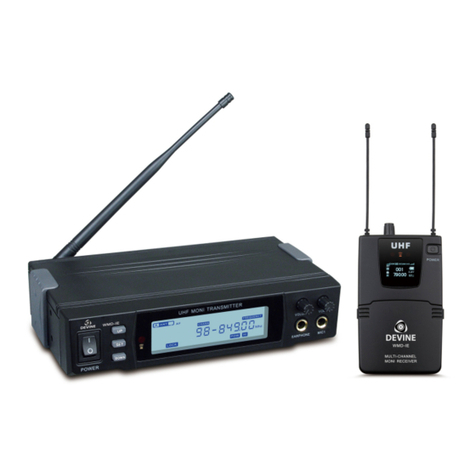
To power up the transmitter, slide the power switch to the on position, one of the channel select LEDS will light to indicate power is
on. To power on the receiver, first provide power to the unit using the wall adapter included with the system, then push the power
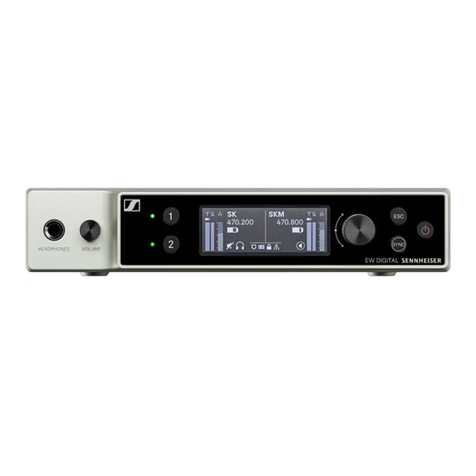
button on the front panel, the LCD display should light up indicating power is on.
Channel Selection
There are 5 different frequency channels which you can choose to transmit and receive data, they are labeled 1-5 on both transmitter
and receiver. In order to operate on any one of these channels, you must have both the transmitter and receiver on the same channel
number.To select a channel on the receiver, power up the receiver, the current channel selected will be shown on the LCD display
(ch=1-5).To change the channel, depress and release the channel selection button located on the front panel. The channel number
will advance one, indicating a new channel has been selected.After selecting a channel on the receiver, the transmitter frequency
channel must then be matched to the receiver's. To select a transmitter channel, power up the transmitter, the current channel selected
will be displayed by lighting the LED next to corresponding channel number(1-5).To advance the channel, push the channel select
button above the LEDS. When both transmitter and receiver have the same channel number selected, the receiver should then receive
data.To verify RF signal reception, the receiver LCD will display a percentage of correct data received on both A and B receivers. For
proper operation, the percentage of correct data should read between 95% and 100% on the display.
UsingYour Wireless
1) Place the receiver on or near the desired amplification system, FOR BEST RESULTS, PLACE RECEIVER HIGH ABOVE ANY OB-
STRUCTIONS, as the system works best when transmitter and receiver antennas are in line of sight.
2) Using the proper output connector on the receiver, the XLR for low impedance, or the 1/4" jack for high impedance, connect the
output of the receiver to the input of your amplification system. Power up the unit and select the desired frequency for receiving data.
3) Connect the output of your instrument into the input connector on the transmitter.
4) Power up the transmitter and select the proper frequency channel for data transmission. TRANSMITTER AND RECEIVER MUST BE
ONTHE SAME CHANNELTO OPERATE CORRECTLY. Attach transmitter to your instrument strap, for best operation keep antenna
away from your body and unobstructed.
(NOTE) Communication between transmitter and receiver can be checked by viewing the LCD display on the receiver. The LCD will
display the percentage of correct data received, frequency channel number, transmitter battery life, and audio signal strength. The data
received should be 95-100%, once data is being received, input an audio signal into the transmitter using your instrument, the audio
meter on the receiver should display audio signal strength. Once you have verified the unit is receiving data, and audio level is being
displayed, the unit is ready for operation.
Multi-system Operation
Up to five systems can operate simultaneously. In situations where it is necessary to have more than one person wireless, each transmit-
ter and receiver combination must be set to the same channel. Set the first system to transmit and receive on channel “one”, the second
system to transmit and receive on channel “two”... and so on.
Battery Replacement
The transmitter uses 4 AA alkaline batteries. DO NOT MIX OLD AND NEW BATTERIES. This will cause unpredictable battery life per-
formance and display readings. To remove and install batteries, hold down on the battery release button, and slide the cover open.
This will expose the battery compartment. For quick removal of batteries, it is okay to ‘slap’ transmitter to palm of hand. A sticker
showing the proper battery placement is on the bottom of the battery compartment. After installing the batteries, slide the cover over
the batteries until the release button locks (you should here a click when it locks). After the batteries have been installed power the
unit on, one of the channel LEDs should light to indicate power is on. Alkaline batteries should last about 11 hours, NiCad recharge-
able batteries will only last about 6 hours. Standard batteries may only last 3 to 6 hours. THE BATTERY HOUR DISPLAY WILL ONLY
BE ACCURATE FOR ALKALINE BATTERIES. The battery life is calculated inside the transmitter and sent to the receiver and then dis-
played on the LCD in 1 hour increments. Upon power up the battery info will take 1-5 minutes to stabilize, the battery gauge is accu-
rate within + or - 20 min. Within the one hour mark, LO BATT will be displayed informing you that the batteries currently installed in
the transmitter are nearly depleted.You may use batteries until they are completely drained without affecting the performance of the
unit in any way.