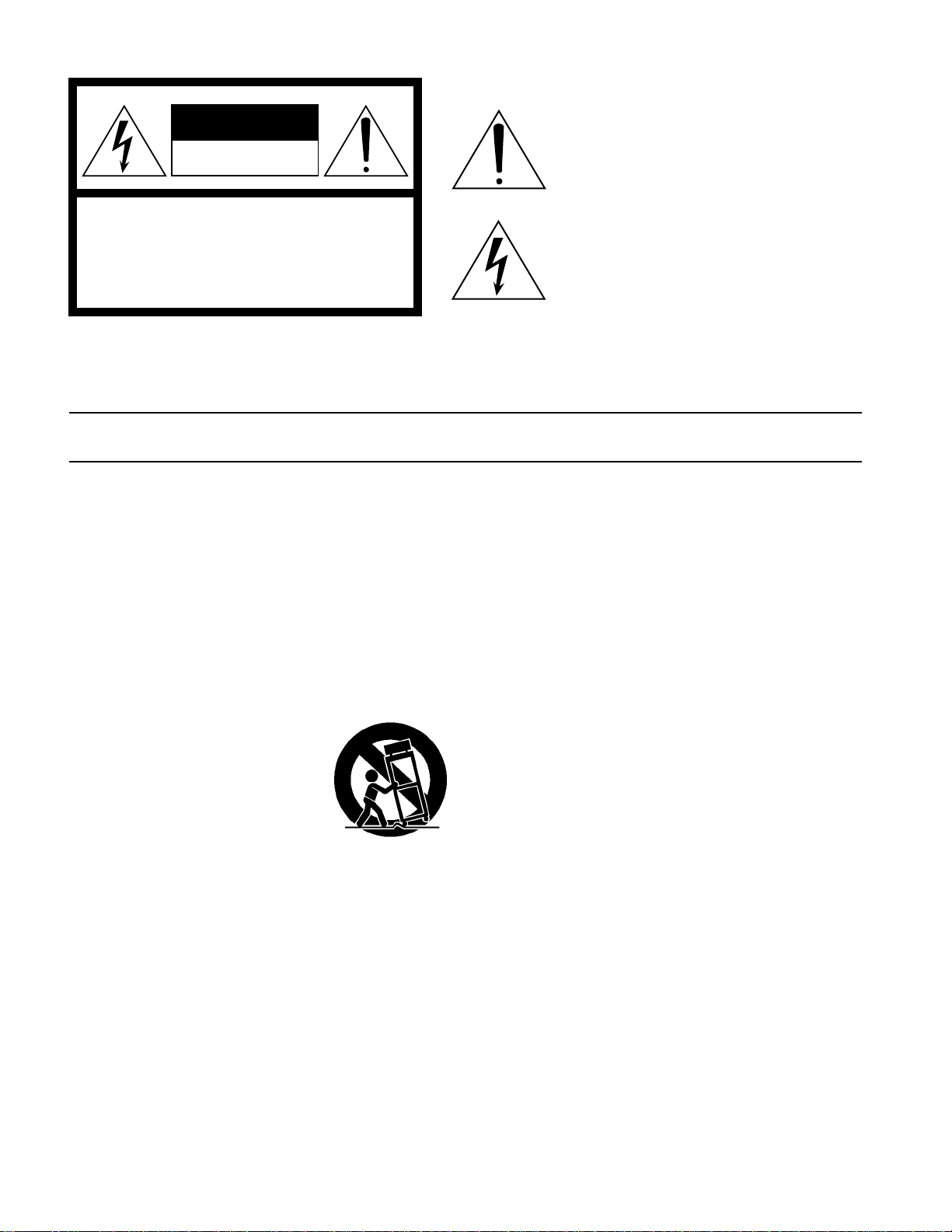
• Explanation of Graphical Symbols
The exclamation point within an equilateral tri-
angleisintendedtoalerttheusertothepresenceof
important operating and maintenance (servicing)
instructions in the literature accompanying the
product.
Thelightning flash witharrowhead symbol within
an equilateral triangle is intended to alert the user
to the presence of uninsulated “dangerous volt-
age”within theproduct’s enclosurethat may beof
sufficientmagnitude toconstitute arisk ofelectric
shock to persons.
CAUTION: TO REDUCE THE RISK OF
ELECTRIC SHOCK, DO NOT REMOVE
COVER (OR BACK). NO USER-SERVICEABLE
PARTS INSIDE. REFER SERVICING TO
QUALIFIED SERVICE PERSONNEL.
CAUTION
RISK OF ELECTRIC SHOCK
DO NOT OPEN
1. Read Instructions —All the safety and operating instructions
should be read before the appliance is operated.
2. Retain Instructions —The safety and operating instructions
should be retained for future reference.
3. Heed Warnings —All warnings on the appliance and in the
operating instructions should be adhered to.
4. FollowInstructions—Alloperatinganduseinstructions should
be followed.
5. Water and Moisture —The appliance should not be used near
water –for example, near a bathtub, washbowl, kitchen sink,
laundrytub,in awetbasement,ornearaswimming pool,andthe
like.
6. CartsandStands—Theapplianceshould
be used only with a cart or stand that is
recommended by the manufacturer.
6A An appliance and cart combination
should be moved with care. Quick
stops, excessive force, and uneven
surfaces may cause the appliance and cart combination to
overturn.
7. Wall or Ceiling Mounting —The appliance should be mounted
to a wall or ceiling only as recommended by the manufacturer.
8. Ventilation —The appliance should be situated so that its
locationorpositiondoesnotinterferewithitsproperventilation.
Forexample,theapplianceshould not be situated on a bed, sofa,
rug, or similar surface that may block the ventilation openings;
or, placedinabuilt-ininstallation,such asa bookcaseorcabinet
thatmayimpedetheflowofairthroughtheventilationopenings.
9. Heat—Theapplianceshouldbesituatedawayfromheatsources
such as radiators, heat registers, stoves, or other appliances
(including amplifiers) that produce heat.
10. PowerSources—Theapplianceshouldbe connectedto apower
supplyonly of the type described in the operating instructions or
as marked on the appliance.
11. Grounding or Polarization —The precautions that should be
takensothatthegroundingorpolarizationmeansofanappliance
is not defeated.
12. Power-CordProtection —Power-supply cords should be routed
so that they are not likely to be walked on or pinched by items
placedupon or against them, payingparticularattentionto cords
at plugs, convenience receptacles, and the point where they exit
from the appliance.
13. Cleaning —The appliance should be cleaned only as recom-
mended by the manufacturer.
14. Nonuse Periods —The power cord of the appliance should be
unplugged from the outlet when left unused for a long period of
time.
15. Object and Liquid Entry —Care should be taken so that objects
do not fall and liquids are not spilled into the enclosure through
openings.
16. DamageRequiring Service —The appliance shouldbe serviced
by qualified service personnel when:
A. The power-supply cord or the plug has been damaged; or
B. Objects have fallen, or liquid has been spilled into the
appliance; or
C. The appliance has been exposed to rain; or
D. The appliance does not appear to operate normally or exhib-
its a marked change in performance; or
E. The appliance has been dropped, or the enclosure damaged.
17. Servicing —The user should not attempt service the appliance
beyond that described in the operating instructions.
SAFETY INSTRUCTIONS