ACL 800 Operation Manual Rev. 04/19/18 MKB
ACL Incorporated Tel: 847-981-9212
Chicago, IL 60609 USA www.aclstaticide.com
ANOTE ABOUT VOLTAGE
In previous years, those desiring to measure resistivity or resistance followed the ASTM
D264, ASTM 991, NFPA 56A or NFPA 99 test standards. These procedures required one
to test at either 500 or 1000 volts. This caused concern regarding safety to the person
performing the tests. The ESDA standardized the test procedures so that lower voltages
could be used within specific ranges.
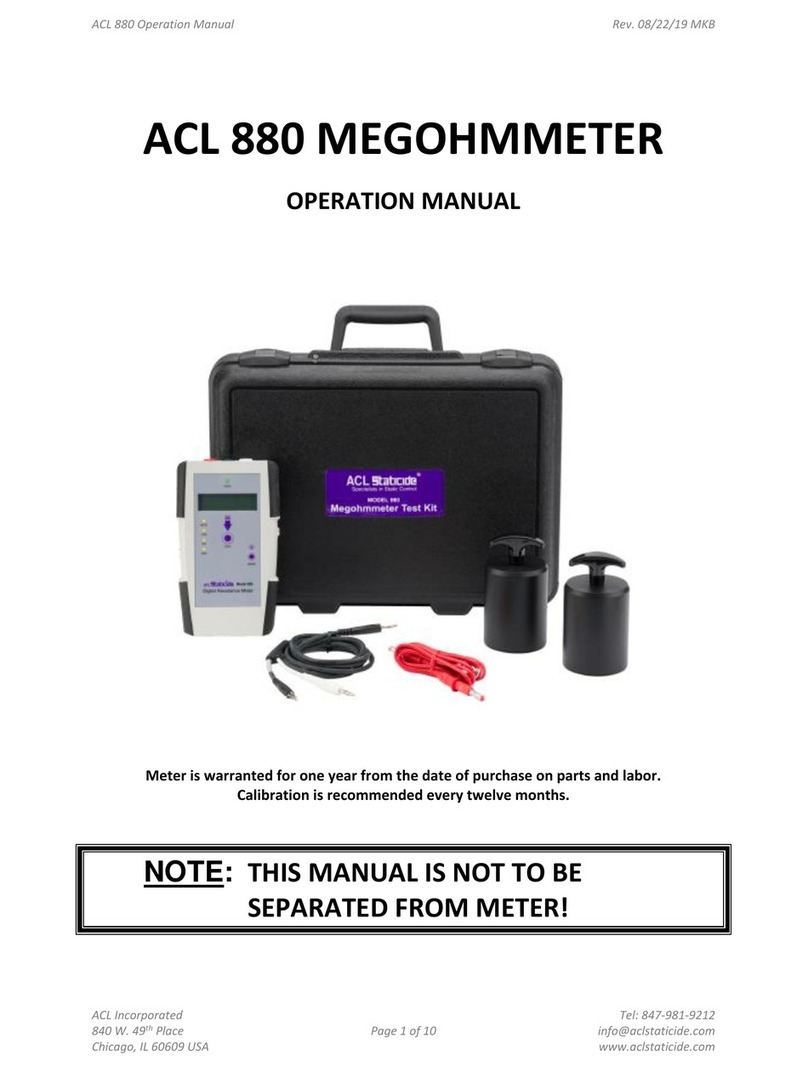
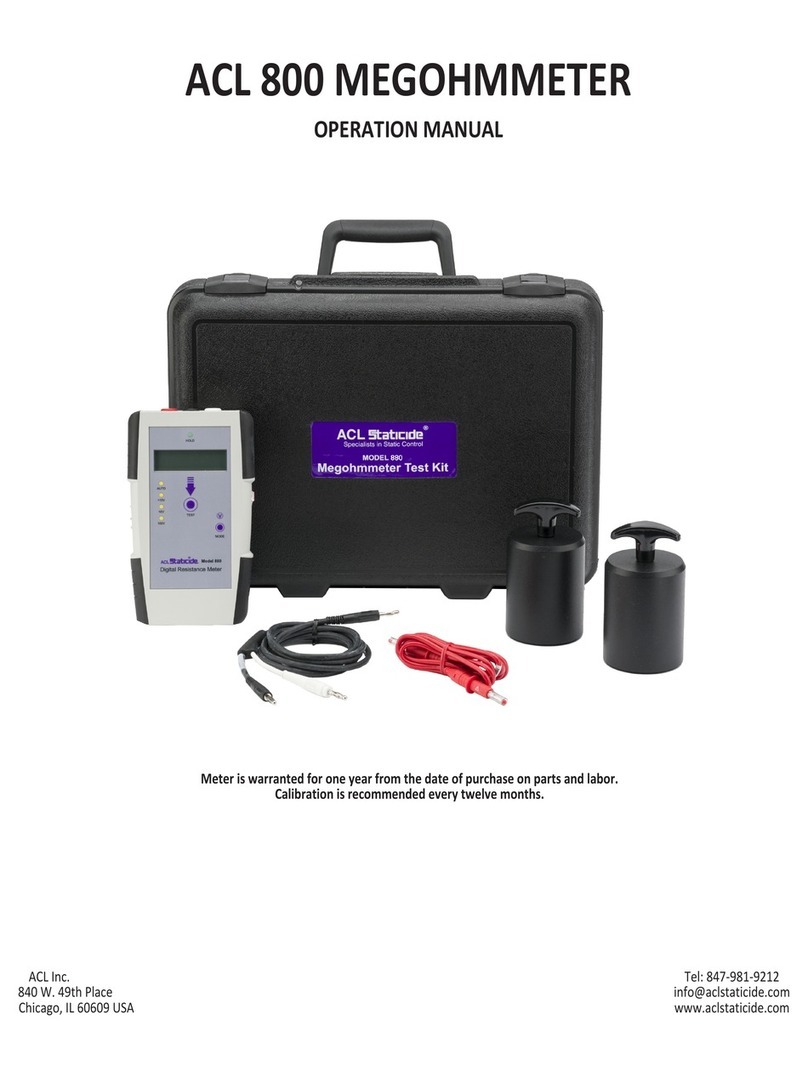
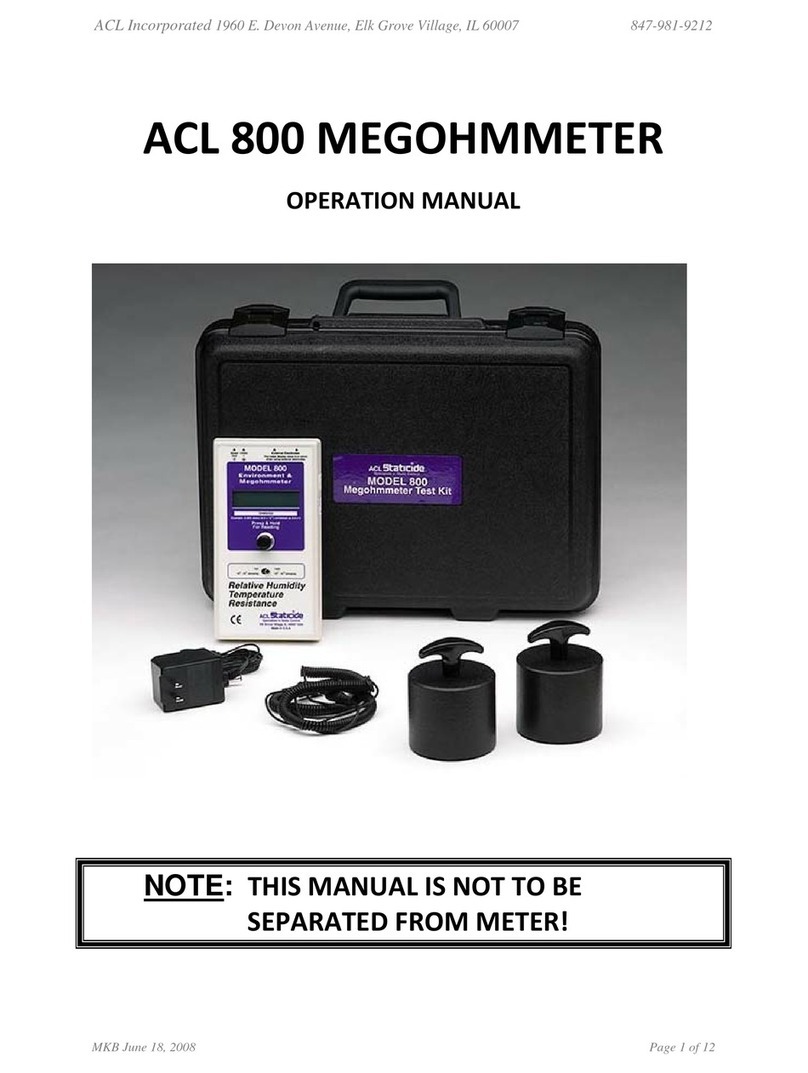
The ACL 800 meter uses a 9-volt battery. Some meters with 9-volt batteries do not give
the accuracy needed to perform the test, especially at values higher than 107. The ACL
800 is built with a transformer that converts the 9-volt charge from the battery to 10
volts or 100 volts (whichever value is selected). The meter applies a constant charge
over the complete voltage range. Accuracy depends on applied voltage, temperature,
and humidity.
TEMPERATURE AND HUMIDITY
Humidity and temperature affect the electrical properties of the material being tested.
The combination of low humidity and low temperature will give the highest electrical
resistance results and slowest dissipation times. At high humidity, a thin layer of water is
condensed on or absorbed into the material being tested. This is true of hydroscopic
additives that are incorporated into a material in order to increase the electrical
conductivity. These additives will allow moisture to be absorbed into the materials to
which they are added.
At elevated temperatures, the mobility of free electrons increases, thereby also
increasing a material’s conductivity. This is especially true for carbon black, metallic
oxides, metals, and other substances. When the material is at a lower temperature,
built-in stresses occur which may increase the resistance due to increased distance
between the conductive additives. Thus, humidity and temperature must be known.
RECORDING DATA
ANSI/ESD Association and European CECC recognize the effect environmental conditions
have on test measurements and specify in their standards that they are measured and
recorded. It is possible to test or manufacture a material at high humidity and pass all
the test specifications, but when the customer receives the material and uses it at a
lower humidity or temperature the material fails to pass the specifications. This can
cause rejections and loss of product.
Both ESD S4.1 ESD Protective Worksurface sections 6.2.4 and ESD S7.1-1994 Resistive
Characterization of Materials Floor Materials sections 5.2.4 and 5.3.3 require reporting
of temperature and humidity at the time of testing. ANSI/EOS/ESD-S11.11-1993 Surface
Resistance Measurement of Static Dissipative Planar Materials section 11.0 B states,
“report the conditioning period, relative humidity, and temperature.”