1 INTRODUCTION
1.1 General
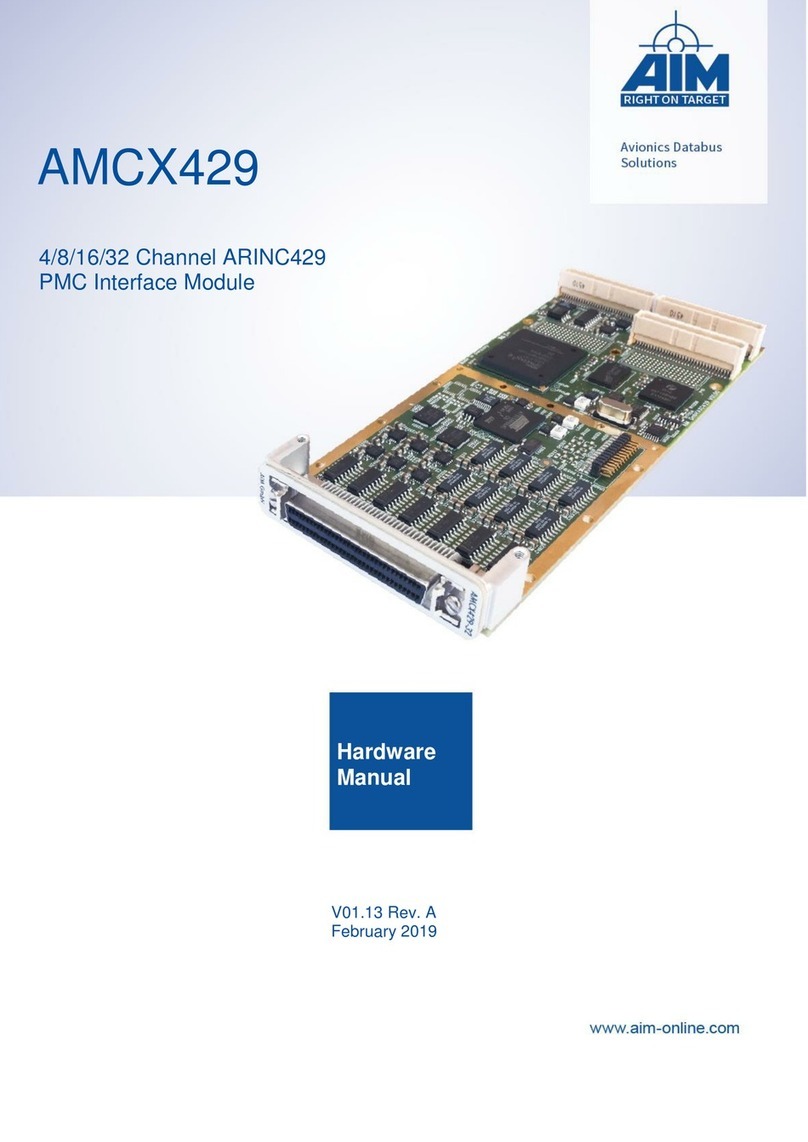
This document comprises the Hardware User’s Manual for the AMCX1553-n and AMCX1553-n-
CC Mezzanine Cards. The document covers the hardware installation, the board connections
the technical data and a general description of the hardware architecture. For programming
information please refer to the documents listed in the ‘Applicable Documents’ section.
The AMCX1553 modules are members of AIM's family of advanced PCI mezzanine cards for
analyzing, simulating, monitoring and testing of avionic databus systems. The PMC module is
designed to be plugged on a host carrier board to adapt to busses like standard PCI or cPCI, or
on an embedded host computer with PMC ports.
The AMCX1553 modules are used to simulate, monitor and inject protocol errors of MIL-STD-
1553A/B based databus systems. The mezzanine card is available as air cooled AMCX1553-n
or conduction cooled AMCX1553-n-CC variant. The functionality of both variants is nearly equal,
except that the Conduction Cooled Mezzanine Card does not implement any Frontpanel
Interface provisions rather than the Rear IO interface functionality. That means all interface
signals of the AMCX1553-n-CC module are routed to the Rear-IO connectors P14. The
Conduction Cooled Thermal Interface is in conformance with the CCPMC specification. To
simplify the explanation, the further description uses only the AMCX1553-n expression, even if
both variants (AMCX1553-n/ AMCX1553-n-CC) are referenced.
The index n in AMCX1553-n stands for the bus channel quantity (AMCX1553-1/2/4) and offers
an interface for up to four dual-redundant MIL-STD-1553 bus channels. Furthermore the
interface implements trigger IN/OUT functions for Bus Controller (BC), Remote Terminal (RT)
and Bus Monitor (BM), as well as 8 user definable Discrete I/O signals. An additional free
wheeling IRIG-B time code generator allows the user to synchronize to either the self generated
time code or the time code of an external board with a resolution of 1ppm.
Adjusted by assembly configuration, Transformer coupling and Direct coupling for one, two or
four dual redundant MIL-STD-1553A/B databus connections are available at the external
interface connector or at the back panel connector. A standard breakout cable is available,
which includes the primary and secondary transformer coupled MIL-STD-1553 signals for
single, dual and quad stream boards.
The hardware architecture provides ample resources (i.e. processing capability and memory) to
guarantee, that all specified interface functions are available concurrently and to full
performance specifications.
The advanced architecture uses up to two processors for the MIL-STD-1553A/B streams. A
powerful Memory Arbiter and PCI-Express Controller in combination with a external PCIe to PCI
bridge is implemented in a Field Programmable Gate Array (FPGA). This FPGA supports both,
the interface to the application and driver software tasks running on the host computer and
assists the communication for data transfer. This feature expands the capability of the
AMCX1553 module to that of a high level instrument.
To fulfill the real-time requirements of a typical avionic type databus system, a high performance
32bit RISC processor (BIP) is implemented for each Bus Interface Unit (BIU).
A free wheeling IRIG-B Time code Encoder/Decoder is implemented on the AMCX1553 to
satisfy the requirements of 'multi-channel time tag synchronization' on the system level. The