Bullen Removing the Noise-Balance circuit from early Ampex tape recorders
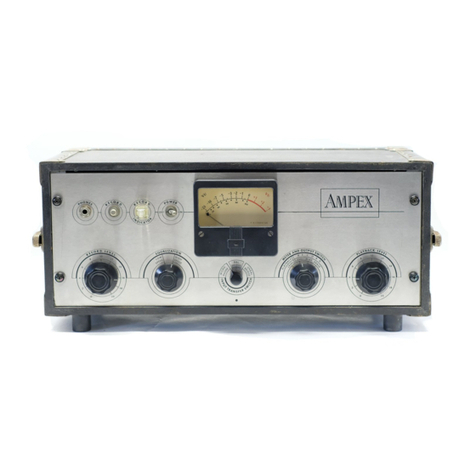
Applies to Ampex models 300, 400, 350
Date 2018 August 10
Revision 1
Total pages 3
Problem
Ampex 300, 400, and 350 recorders used a dc noise-balance adjustment circuit that is no longer required now that
modern low-leakage coupling capacitors are available. If you do not remove this noise-balance circuit, it is possible
to introduce low-frequency noise if you do not adjust the noise-balance control correctly.
Background
In the Ampex 300, 400, and 350 electronics, the record signal is coupled to the record head through a 1 uF / 400 volt
metalized paper capacitor. Until the late 1950s, Ampex used metalized paper coupling capacitors since they had gen-
erally good performance and were small enough to fit under the typical electronics chassis of that era. According to
former Ampex engineer Jay McKnight, the small amount of leakage current contributed by metalized-paper capaci-
tors was not identified as a concern when the earliest of these recorders (the Ampex model 300) was designed in the
late 1940s.
Today we know that metalized paper capacitors have much higher leakage than modern polyester or polypropylene
capacitors. In the older Ampex machines, a small amount of dc plate voltage from the record amplifier would leak
into the record head though this 1 uF coupling capacitor—this would add noise and over time, magnetize the record
head (which further contributed to noise). Additionally, record heads often became magnetized if they were tested
with an ohmmeter.
Once the record head becomes magnetized, then minor irregularities in the recording sensitivity of the blank tape
cause low-frequency noise—often called rocks, lumps and bumps, crackling, or grumbling (or more precisely,
dc noise or modulation noise). (1)
Beginning with the Ampex 300, the workaround to this problem was the addition of a circuit to inject a small dc-
offset into the record head (after the 1 uF coupling capacitor) to compensate for any dc leakage and record-head mag-
netization. The noise-balance pot controlled the amount (and polarity) of the introduced dc offset. Adjustment was
made by first demagnetizing the tape heads, then recording a tape (with no input) and listening to the playback output
with a sensitive speaker and setting the noise-balance pot for minimum crackling noise.
Ampex began using low-leakage coupling capacitors beginning in the mid-to-late 1950s with the introduction of the
model 600 and model 351. Consequently, there was no longer a need to introduce a dc offset using the older type of
noise-balance circuit. Instead, the later machines used a balance adjustment in the push-pull bias oscillator circuit to
adjust for the most symmetrical bias waveform.
Fix
The problem may be fixed by removing the noise-balance potentiometer and associated components. See specific
instructions for various models.
Acknowledgments
Full-Track Productions would like to thank Jay McKnight (Magnetic Reference Laboratory, Inc.
San Jose, California) for technical suggestions and review of the procedures outlined in this bulletin.
(1) This explanation courtesy of former Ampex engineer Jay McKnight (see hp://mrltapes.com/mcknight_demag.pdf).
IMPORTANT NOTICE AND TERMS OF USE
Full-Track Producons is not liable for any damage or injury that may result from inappropriate use of informaon in this document—always
refer service to qualied personnel. Contents of this document copyright © 2005-2018 by Full-Track Producons, all rights reserved.
This bullen may be distributed only if reproduced in its enrety (including this noce) without any alteraon whatsoever. No fee may be
charged for this bullen nor for any informaon detailed here.