P/N 1011598 Rev. A 11/20
8
RESIDENTIAL WATER SOFTENER
Drain Connection
The drain is for regenerating the softener
resin and for ushing particle buildup out
of the system during operation.
1. Apply pipe thread tape to threads
of the drain tting and attach the
drain tting to the control head at
the drain port. Do NOT overtighten
the tting into the control head.
2. Attach the 1/2” ID drain hose to
the barb of the drain tting, and
secure with a hose clamp.
3. Measure a sucient length of
hose from the drain outlet tting to
the drain.
When connecting the drain hose, pay
attention to the following guidelines:
yThe drain line plumbing must
be able support the ow rate
when the system regenerates.
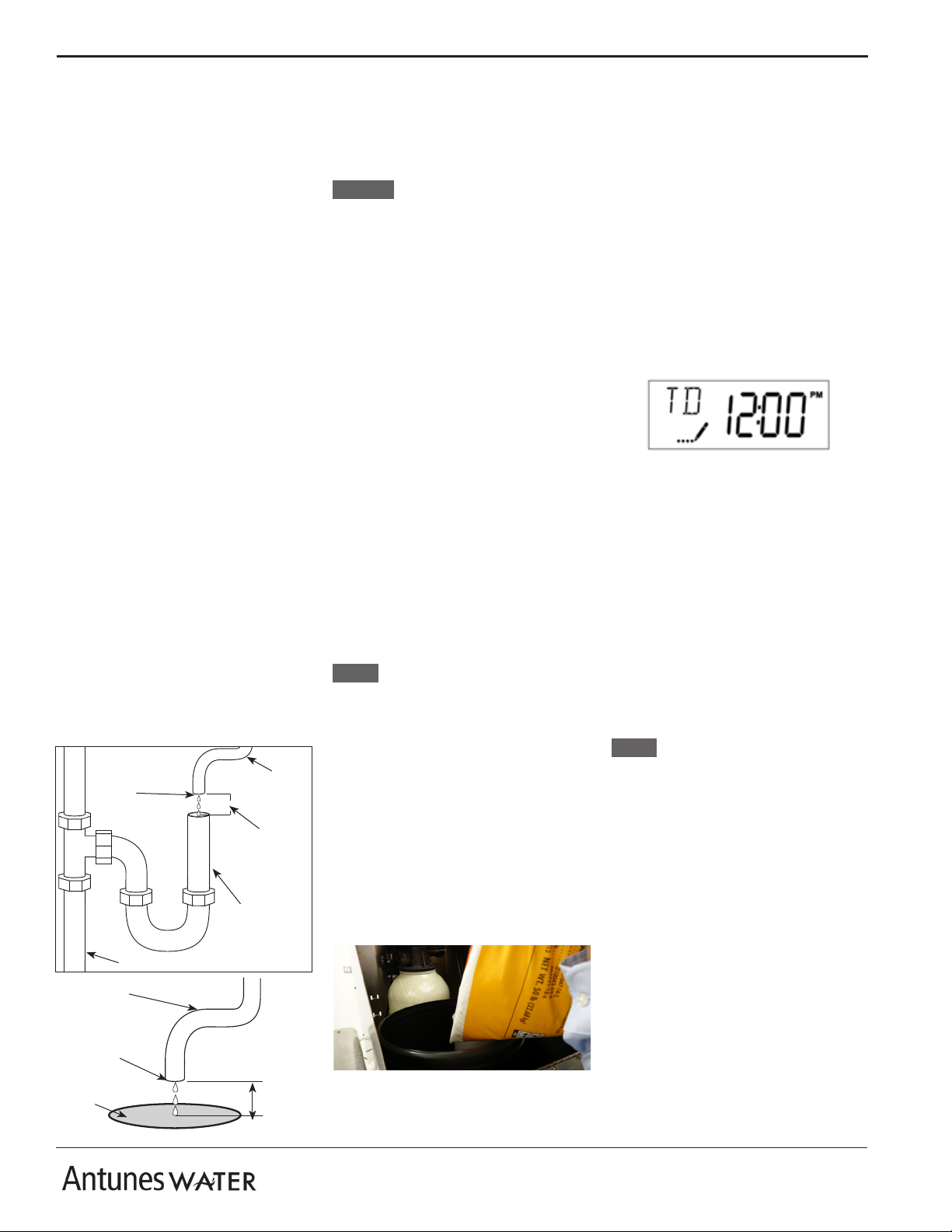
yThe drain line leading out of
the system must be as short as
possible and slope downwards
without any kinks or loops.
yThe drain line plumbing must
be positioned and secured at
least 2 inches above the drain
(Figure 3). This air gap protects
the system from contamination in
the event of a backed-up drain.
yThe drain used must not be
blocked or restricted.
yThe drain used must be as large or
larger than the drain line plumbing.
yThe drain line from the
system should be secured at
the drain using appropriate
mounting hardware.
4. Attach 3/8” OD brine tank tubing
to the control head using the brass
nut and sleeve provided. Do NOT
overtighten the brass nut.
5. Attach the other end of the brine
tank tubing to the brine tank oat
valve using the supplied nut and
sleeves.
OPTION: If desired, connect the brine
tank overow hose from the
overow tting to the oor
drain.
6. Attach Hi-Flo bypass valve to the
control head.
7. Attach the plastic yoke to the
bypass valve.
8. Turn o main water supply.
9. Remove a section of existing pipe
where the softener is going to
be installed. The pipe removed
should be large enough to allow
the ttings needed to connect to
the softener system.
10. Make sure to verify the inlet and
outlet water ow directions on the
softener and the existing plumbing
before making connections.
11. Connect the incoming untreated
water to the valve inlet. Connect
the outlet water connection to the
rest of the home plumbing.
12. Attach inlet and outlet ttings to
the plastic yoke. The yoke has 1”
NPT male threads. Use pipe tape
and/or pipe dope on the threads.
Use a backup wrench when mak-
ing pipe connections. Do NOT
overtighten ttings onto the plastic
yoke.
NOTE: Make sure that local plumbing
codes are followed when mak-
ing connections.
13. Before proceeding, make sure the
bypass valve is in bypass position.
Bypass position is when the valve
handles are across (perpendicular
to) the valve bodies.
14. Turn on the main water supply and
check all new ttings for leaks.
15. Secure the power transformer on
the power cord to the wall or other
location to remove the weight of
the transformer from the cord.
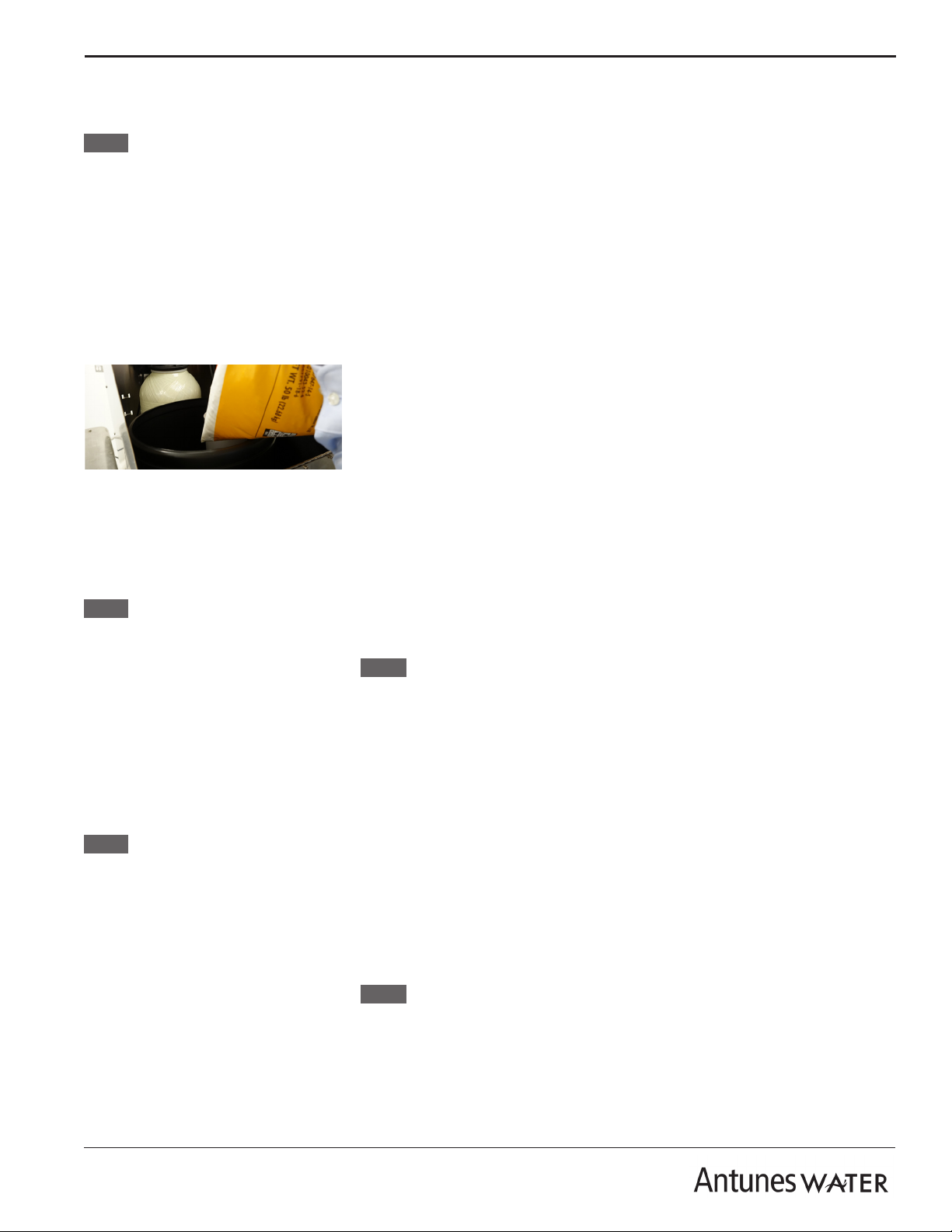
16. Remove the lid of the brine tank
and ll the brine tank with softener
salt (at least 50 lbs.) Replace the
lid when nished.
17. Plug the power cord from the
control head into a grounded GFCI
outlet. Make sure the control panel
is illuminated.
2” (5.1 cm)
minimum
Floor Drain
Secure End
Drain Line
from System
2” (5.1 cm)
minimum
Drain Line
from System
Secure
End
Drain
Standpipe
Figure 2. Drain Line Plumbing
Setting the Clock
Program the controller to set the time of
day.
1. Press and hold either the Up or
Down arrow button on the control-
ler until the programming icon
replaces the service icon and the
parameter display reads TD (Time
of Day).
2. Adjust the displayed time with the
Up and Down buttons.
3. When the correct time is set, press
the Extra Cycle button to lock in
the time and resume normal op-
eration. The unit will also return to
normal operation after 5 seconds if
no buttons are pressed.
Placing the System into
Service
1. After the time of day is set, open
the bypass valve. The open posi-
tion is when the valve handles are
in line with (parallel to) the valve
bodies.
2. Check for leaks at all connections
on the softener control head.
3. Activate a manual regeneration
by pressing and holding the extra
cycle button for 5 seconds. Air and
water will come out of the softener
drain line and water will ll the salt
brine tank.
NOTE: The regeneration will take
approximately an hour to
complete.
4. After the regeneration is complete,
the system is operational.
Operation Check
1. Make sure the water supply to the
softener is on.
2. Proper hardness reduction can be
checked by measuring a sample
of the outlet water for hardness.
3. Collect a water sample from any
tap leading from the softener
system. Run the water for several
minutes to make sure soft water is
at the tap.
4. Measure the hardness using any
test that measures total hardness.