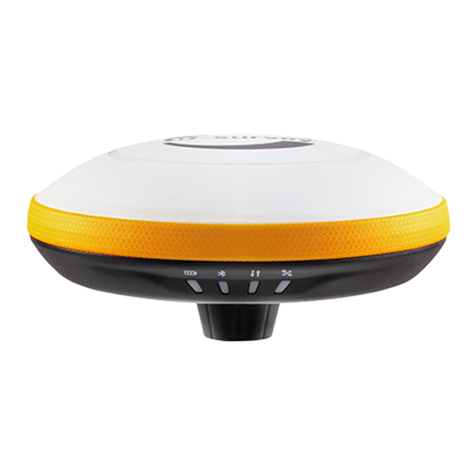
Bad Elf Flex User manual

Bad Elf Flex User Manual
Introduction
The Bad Elf Flex is an external GNSS receiver designed for field data collection when paired
with a mobile phone or tablet. The hardware supports several configurations including
multi-constellation, multi-frequency, and L-Band reception.
Product Overview

What’s in the box
The following items are included in the standard Flex configuration:
● Rugged carrying case
● Bad Elf Flex
● Wall charger
● Vehicle charger
● 1m USB charging cable
● USB OTG adapter cable
● Pole mount adapter
● Quick start guide
Supported devices
You can connect a Flex receiver to a handheld device, phone, or tablet powered by the
following
operating systems:
● iOS version 11 or newer
● Android versions 4.1x or newer
● Windows 10.x or newer
● Mac OS X 10.4 or newer
Using the Bad Elf Flex
We’ve designed the Flex to be as simple and intuitive as possible.
Charging the Bad Elf Flex
● How to charge & charge indicators
● Operation while charging
● Compatible chargers
● Temperature - charge limitations
● Low battery - device behavior
Turning on and off the receiver
To turn the receiver on, press and hold the power button for 3 seconds. The Flex will take
approximately 20 seconds to start up and begin looking for satellites.
To turn the receiver off, press and hold the power button for 3 seconds.

Status information (LCD & LEDs)
The LCD display is the primary user interface of the Flex accessory
The LEDs are used to display information at-a-glance. Their function changes depending on
what mode you are in. The LCD screen will usually have a label or key that indicates what each
LED represents.
By default, the LEDs are configured to show the following status information:
Left LED
Power status
Center LED
User configurable.
Default: shows GNSS navigation status
Right LED
User configurable.
Default: shows Bluetooth connection status
The power status LED is used to indicate the battery, charging, and operating status.
Color
Meaning
Solid Green
Fully charged
Flashing Green
Charging
Red
Battery Low
Flashing Red
Battery critically low
Connecting your mobile device via Bluetooth
The following steps will help you connect your mobile phone or tablet to the Flex receiver via
Bluetooth.
Start by making sure you Flex is turned on, and within range of your phone or tablet. Then
follow the instructions below:
For iPhone and iPad devices running iOS
● On your iOS Device, open the Settings app and navigate to the Bluetooth screen.
● If needed, turn Bluetooth on.

● If you have not previously paired with this Bad Elf Flex, it will appear in the “Other
Devices” section. Tap the Flex in the list to start the pairing process. You may be
prompted to confirm the pairing on both your mobile device and
● Once you are paired, the Flex will appear in the My Devices section. If the status shows
as Disconnected, you can tap the Flex name to initiate a connection.
● Once the pairing and connection succeeds, you should see it listed as Connected in the
list of devices on your iOS device.
For Android phones and tablets
To pair the Flex with your Android device:
1. On your Android device, go to Settings > Wireless & Networks. Make sure Bluetooth is
turned on.
2. Go to Settings > Wireless & Networks > Bluetooth Settings and tap Scan for devices.
3. After a few seconds, the Flex should appear in the list of available Bluetooth devices.
4. Tap the name in the list and to start the pairing process. You may be prompted on both
your Android device and Flex to confirm the pairing.
5. Once paired, you usually see the Flex show up in the list as Connected for a few
seconds, before switched to Disconnected. This is normal. The Bluetooth connection
will be opened/closed by whatever apps are using it.
For Windows
To pair the Flex with your Windows computer please follow the instructions below. This process
will only have to be done once and does not need to be repeated in the future.
1. Select Bluetooth Devices from the icon list in the lower right hand portion of your
desktop.
2. Note, the Bluetooth option may not be displayed. If not click the up arrow.
3. If your Bad Elf accessory is turned on, you should see something like BE5500-12345678
(with your unit's serial number) in the list.
4. Select your Bad Elf receiver from the list, and tap the Pair button.
5. Within 5-10 seconds, you should see a prompt from windows showing pairing is
complete. Once this action is completed, the message “Ready to pair” will change to
“Paired” as shown below.
At this point you have successfully paired your Bad Elf receiver with your Windows computer.
Next, you will need to determine the COM port assigned by the operating system. To
accomplish this:
1. Click on the icon to the left of the Bad Elf GPS #XXXXXXX
2. Click on “More Bluetooth Options”

3. A Bluetooth settings dialog will open
4. Click on the “COM Ports” tab
5. The COM port with your device serial number labeled as “Outgoing” is the COM port you
should use for your application.
Connecting your computer via USB
Use the supplied Micro-USB cable to connect the Bad Elf Flex to your desktop or laptop
computer. Once properly connect you will see the charging indicator come on if the Flex is not
fully charged.
Install companion app
From your phone or tablet, visit http://bad-elf.com/app-flex to download the correct Bad Elf Flex
companion app for your operating system. This app is used to check the health of your
hardware, perform firmware upgrades, change settings, and stream correction data to your Bad
Elf Flex.
Using 3rd party apps
Any location-based app on iOS or Android can be used with the Bad Elf Flex. You can visit
http://bad-elf.com/apps for a list of compatible apps that we’ve either tested or have been
recommended by other customers.
Connecting an external GNSS antenna
Only use an external antenna that is designed to be used with the Flex receiver. Ensure the
antenna being connected does not exceed the voltage and current limits defined in the Flex
product specifications.
To connect an external antenna, remove the top cover by leaning it towards the back of the unit.
With the top cap removed, unscrew the helical antenna by rotating it counterclockwise as seen
from the top.
The top connector utilizes a standard SMA connector. Attach an antenna using 50 ohm cable.
Specifications
COMMUNICATIONS
USB
USB 2.0 device via Mini-USB receptacle
USB 2.0 host OTG via supplied adapter

Bluetooth
Bluetooth V4.2
Wi-Fi
Client and access point (AP) modes
802.11b/g/n
POSITIONING ENGINE
GPS
L1CA/L1P/L1C/L2P/L2C/L5
GLONASS
G1/G2/P code (P1/P2)
BeiDou
B1/B2/B3 (separate variant without L5)
Galileo
E1BC/E5a/E5b
QZSS
L1CA/L1C/L2C/L5
NOTE: constellations and frequencies are dependent on receiver configuration and subscriptions.
POSITIONING PERFORMANCE
Horizontal accuracy
RMS (67%)
2DMRS (95%)
RTK
8 mm + 1 ppm
15 mm + 2 ppm
SBAS (WAAS)
0.3 m
0.6 m
Autonomous
1.2 m
2.4 m
L-Band via Atlas
????
????
Timing (1PPS) accuracy
20 ns
Cold start time
< 60 s typical (no almanac or RTC)
Warm start time
< 30 s typical (almanac and RTC)
Hot start time
< 10 s (almanac, RTC, and position)
Maximum speed
1,850 kph (999 kts)
Maximum altitude
18,288 m (60,000 ft)

Differential options
SBAS, Autonomous, External RTCM v2.3, RTK v3, L-band
(Atlas), and DGPS
Correction I/O protocol
Hemisphere GNSS’ ROX, RTCM v2.3 (DGPS), RTCMv3 (RTK),
CMR, CMR+, Atlas
Antenna input impedance
50Ω
Antenna gain input range
10 to 40 dB
Antenna Voltage
5VDC
Antenna Current
Up to 500mA, with short circuit protection
BATTERY AND POWER
Internal Battery
Non-replaceable 3.7VDC, 12000mAh, Lithium-ion
Battery Life
11hrs in RTK, SBAS, or autonomous modes
7hrs with L-Band corrections enabled
External Power
Mini-USB power input from 10W or greater USB power source
MECHANICAL
User interface
Transflective LCD
Buttons
LEDs
Audible tones
Dimensions
10.0” x 2.75” / 254mm x 70mm
Weight
29oz / 854g
Helical Antenna Phase
Center
22cm above base of Flex unit without adapter installed
Add 1.5cm with adapter installed

ENVIRONMENTAL
Temperature
Operating: –20°C to +55°C (–4°F to +131°F)
Storage: –40°C to +75°C (–40°F to +167°F)
Humidity
100% condensing
Waterproof
IP65
BLUETOOTH RF CHARACTERISTICS
Frequency band
2402MHz ~ 2480MHz
Number of channels
79 channels
Modulation
GFSK, Pi/4DQPSK, 8DPSK
Sensitivity @ BER=0.1%
for GFSK (1Mbps)
-86 dBm (typical)
Sensitivity @
BER=0.01% for
π/4-DQPSK (2Mbps)
-86 dBm (typical)
Sensitivity @
BER=0.01% for 8DPSK
(3Mbps)
-80 dBm (typical)
Maximum Input Level
GFSK (1Mbps):-20dBm
π/4-DQPSK (2Mbps) :-20dBm
8DPSK (3Mbps) :-20dBm
Antenna
Internal antenna (shared with Wi-Fi)
WI-FI RF CHARACTERISTICS
WLAN Standard
IEEE 802.11b/g/n, WiFi compliant
Frequency range
2.4120 GHz ~ 2.462 GHz (2.4 GHz ISM Band)

Number of channels
2.4GHz:Ch1 ~ Ch11
Modulation
802.11b : DQPSK, DBPSK, CCK
802.11 g/n : OFDM /64-QAM,16-QAM, QPSK, BPSK
Receive Sensitivity (11n)
@10% PER
MCS=0 PER @ -85 dBm, typical
MCS=1 PER @ -84 dBm, typical
MCS=2 PER @ -82 dBm, typical
MCS=3 PER @ -80 dBm, typical
MCS=4 PER @ -77 dBm, typical
MCS=5 PER @ -73 dBm, typical
MCS=6 PER @ -71 dBm, typical
MCS=7 PER @ -68 dBm, typical
Receive Sensitivity (11g)
@10% PER
6Mbps PER @ -86 dBm, typical
9Mbps PER @ -85 dBm, typical
12Mbps PER @ -85 dBm, typical
18Mbps PER @ -83 dBm, typical
24Mbps PER @ -81 dBm, typical
36Mbps PER @ -78 dBm, typical
48Mbps PER @ -73 dBm, typical
54Mbps PER @ -71 dBm, typical
Receive Sensitivity (11b)
@8% PER
1Mbps PER @ -90 dBm, typical
2Mbps PER @ -88 dBm, typical
5.5Mbps PER @ -87 dBm, typical
11Mbps PER @ -84 dBm, typical
Data rate
802.11b : 1, 2, 5.5, 11Mbps
802.11g : 6, 9, 12, 18, 24, 36, 48, 54Mbps
802.11n (20MHz, long GI, 800ns): 6.5, 13, 19.5, 26, 39, 52, 58.5,
65Mbps
802.11n (20MHz, short GI, 400ns) : 7.2, 14.4, 21.7, 28.9, 43.3,
57.8, 65,72.2Mbps
Maximum input level
802.11b : -10 dBm
802.11g/n : -20 dBm
Antenna
Internal Antenna (shared with Bluetooth)

RF Disclosures
Class B Statement – Notice to Users: This equipment has been tested and found to comply
with the limits for a Class B digital device, pursuant to Part 15 of the FCC rules and Part 90.
These limits are designed to provide reasonable protection against harmful interference in a
residential installation. This equipment generates, uses, and can radiate radio frequency
energy and, if not installed and used in accordance with the instructions, may cause harmful
interference to radio communication. However, there is no guarantee that interference will not
occur in a particular installation. If this equipment does cause harmful interference to radio or
television reception, which can be determined by turning the equipment off and on, the user is
encouraged to try to correct the interference by one or more of the following measures:
● Reorient or relocate the receiving antenna.
● Increase the separation between the equipment and the receiver.
● Connect the equipment into an outlet on a circuit different from that to which the
receiver is connected.
● Consult the dealer or an experienced radio/TV technician for help.
Changes and modifications not expressly approved by the manufacturer or registrant of this
equipment can void your authority to operate this equipment under Federal Communications
Commission rules.
To maintain compliance with FCC’s RF Exposure guidelines, This equipment should be
installed and operated with minimum distance between 20cm the radiator your body: Use only
the supplied antenna.
Battery Safety
Charge and use the rechargeable Lithium-ion battery only in strict accordance with the
instructions. Charging or using the battery in unauthorized equipment can cause an explosion
or fire, and can result in personal injury and/or equipment damage. To prevent injury or
damage:
● Do not charge or use the product if it appears to be damaged or leaking.
● Charge the product only with an approved USB power source that can provide at least
2.0 amp of charging current at 5VDC.
● Discontinue charging a battery that gives of extreme heat or a burning odor.
● Use the product only for its intended use and according to the instructions found in this
document.
Limited Warranty Terms and Conditions
Warranty
Bad Elf products are warranted to be free from defects in materials or workmanship for one year
from the date of purchase. Within this period, Bad Elf will, at its sole option, repair or replace
any components that fail in normal use. Such repairs or replacement will be made at no charge
to the customer for parts or labor.
Other manuals for Flex
1
Table of contents