7
English
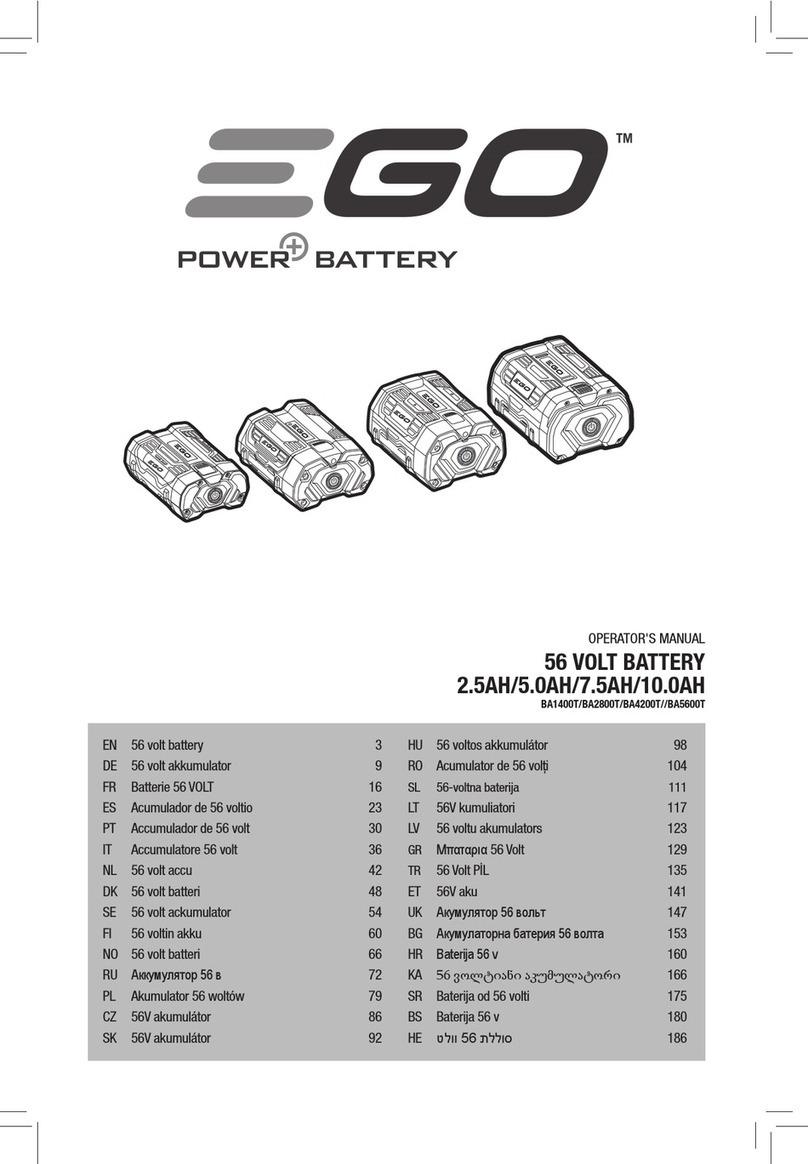
1. Plug the charger plug into an electrical outlet. The green LED indicator
(4) on the charger (3) will lighten up.
2. Slide a battery (1) onto the battery charger (3).
3. Once charging commences, the red LED (5) will illuminate.
4. When the battery is fully charged, the green LED (4) will illuminate.
Note: Make sure the battery and battery charger are lined up correctly. If
the Battery does not slide onto the battery charger easily, don’t force it.
Instead, remove the battery; check the top of battery and the battery
charger slot are clean and undamaged and that the contacts are not bent.
IMPORTANT: When a low charge level is indicated be aware the tool may
stop operating while using the tool. In some instances this may be danger-
ous. It is recommended to always ensure the battery pack has a good
charge level.
Notes about Battery Charging
• Let a hot battery cool down before charging it.
• The battery should be charged at ambient temperatures between
10°C and 40°C (ideally around 20°C).
• After charging, allow 15 minutes for the battery to cool before use.
• Ensure that the charger is disconnected from the mains supply after
use, and is stored correctly.
• Do not leave batteries on charge for extended periods and never store
batteries on charge.
• The battery charger monitors battery temperature and voltage while
charging. Remove the battery once charging has been completed to
maximise charge cycles of the battery and not waste power.
• Do not store Lithium-Ion battery packs in a discharged state long term.
This can damage the Lithium-Ion cells. For long-term storage, store
batteries in a high charge state disconnected from the power tool.
• The capacity of batteries will reduce over time. After 100 charge cycles,
the battery’s operation time and the maximum torque performance of
the tool will slightly reduce. This decline will continue until the battery
7064221-Battery-Ma-A6-EN-2203-07.indb 77064221-Battery-Ma-A6-EN-2203-07.indb 7 16/03/2022 16:4416/03/2022 16:44