Assembling the upper handle (fig. A)
Make sure that the cable restraint loop is fitted to the
upper handle prior to assembly.
Fit the lower handlepart (7) to the upperhandle (6)
using the knobs (10), washers (9) and screws (8)
as shown.
Fitting the lower handle (fig. C)
Insert the ends of the lower handle (7) into the
corresponding holes in the raker.
Press the handle down as far as it will go.
Secure the handle using the screws (12).
Fixing the cable (fig. B)
The motor cable has to be fixed using the cable restraints.
Clip the one restraint (11) onto the cable leading from
the switchbox (3) to the motor. Secure the restraint to
the lower handle (7).
Clip the other restraint (11)onto the cable leading from
theswitchbox(3)tothemotorplug.Securetherestraint
to the upper handle (7).
Warning! Make sure the cable is secured using the cable
restraints prior to connecting the plug to the mains outlet.
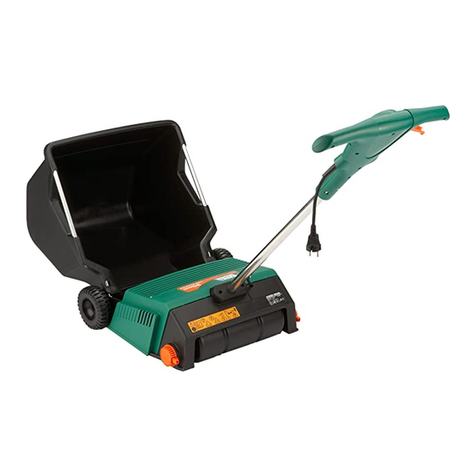
Fitting the grass box (fig. D)
With your lawnraker in its working position, place the
grass box (1) over thelugs at the front ofthe lawnraker.
Height of rake adjustment (fig. E)
There are three raking height positions on your raker; low,
medium and high. These are selected by altering the
position of the three-position height adjuster located on the
rear roller (13).
Press the lock button on the three-position height
adjuster and rotate the adjuster to any of the three
availablepositions asshown inFig. E. Onreaching the
requiredposition,releasethe lock button and allow itto
engage in your raker body (2).
The three positions are identified by markings on the
side of your raker body as shown in Fig. E.
The three raking height positions are as follows:
Lowest setting (1). This setting should be used when
youwish to give thelawnaparticularlyvigorousraking.
Onthissetting,yourrakerwillremoveallthedebrisand
thatchthathascollectedatthebaseofyourgrass.Itwill
also remove moss and weeds on this setting.
Medium setting (2). This setting should be used when
you wish to give your lawn a moderate raking. This
setting will be suitable for the majority of lawns.
Highest setting (3). This setting will lightly rake and
sweep your lawn. Your raker can also be used on this
setting to ‘lift’ flattened grass and stolons (thecreeping
stemsofgrassesandweedslikeclover)sothatyoucan
mow them. The sweep/light rake setting is ideal for
fallen leaves and for collecting grass cuttings which
have been left on the lawn after mowing.
Residual risks
Additionalresidualrisksmayarisewhenusingthetoolwhich
maynotbeincludedin theenclosedsafetywarnings.These
risks can arise from misuse, prolonged use etc.
Even with the application of the relevant safety regulations
and the implementation of safety devices, certain residual
risks cannot be avoided. These include:
Injuries caused by touching any rotating/moving parts.
Injuries caused when changing any parts, blades or
accessories.
Injuriescausedby prolongeduse of a tool.Whenusing
any tool for prolonged periods make sure you take
regular breaks.
Impairment of hearing.
Health hazards caused by breathing dust developed
when using your tool (example:- working with wood,
especially oak, beech and MDF).
Use
Switching on and off
Switching on
Hold the handle with both hands and tilt it slightly
downwards to raise the front of the appliance.
Pressthelock-offbutton(4)andpulltheswitchlever(5)
towards you.
Release the lock-off button (4).
Let the appliance return to its working position.
Switching off
Toswitchtheapplianceoff,release the switchlever (5).
Never attempt to lock a switch in the on position.
Warning! Let the appliance work at its own pace. Do not
overload.
Tolookaftera lawnproperly,youneed to domore than just
mow it once a week throughout the Summer. The lawn will
benefit from a vigorous raking ofthe grass to remove the
dead matter, moss and weed which disfigures a lawn. The
build up of dead grass provides a mat of absorbent fibres
which prevents water getting through to the ground and
if this mat is kept waterlogged, it can encourage grass
diseases and prevent healthy grasses taking root.
Place the bulk of the extension cable on the lawn close
to the starting point (Fig. F, position 1).