6
WARNING
•Never use your stove without leak testing all gas connections and hoses. See the section on
"Leak Testing" in this manual for proper procedures.
The pressure regulator and hose assembly supplied with your gas stove is designed to work with an
LP gas supply cylinder.
•DO NOT attempt to connect it to any other fuel supply source such as a natural gas line.
•DO NOT use any other pressure regulator/hose assembly other than the one supplied with your stove.
•DO NOT attempt to adjust or repair the regulator. A replacement regulator can be supplied by
contacting the manufacturer. The regulator is designed to operate at an output pressure of 11
inches of water column (2.74 kPa).
During assembly and/or replacement of the gas cylinder, keep the gas supply hose free of kinks and/or
damage.
Visually inspect the hose assembly prior to each use for evidence of damage, excess wear, or deterioration.
If found, replace the assembly before using your stove. Only the manufacturers supplied replacement
should be used.We recommend you replace the hose and regulator every two years.
CONNECTING HOSE AND REGULATOR TO AN LP GAS CYLINDER
•Insure the tank valve is CLOSED prior to connecting the LP gas cylinder to your stove. Turn the
valve knob clockwise to properly close the valve. Read and follow all instructions and warnings
on the supply hose safety tags. Read and follow all warnings in this manual concerning the safe
use of LP gas cylinders and the hose and regulator before connecting cylinder to stove. Read
and follow all warnings on the LP cylinder.
1. Check that the cylinder valve is closed by turning the knob
clockwise.
2. Check that the stove’s burner knobs are in the proper “OFF”
positions.
3. Remove the protective plastic cap from the cylinder valve and the
connection device.
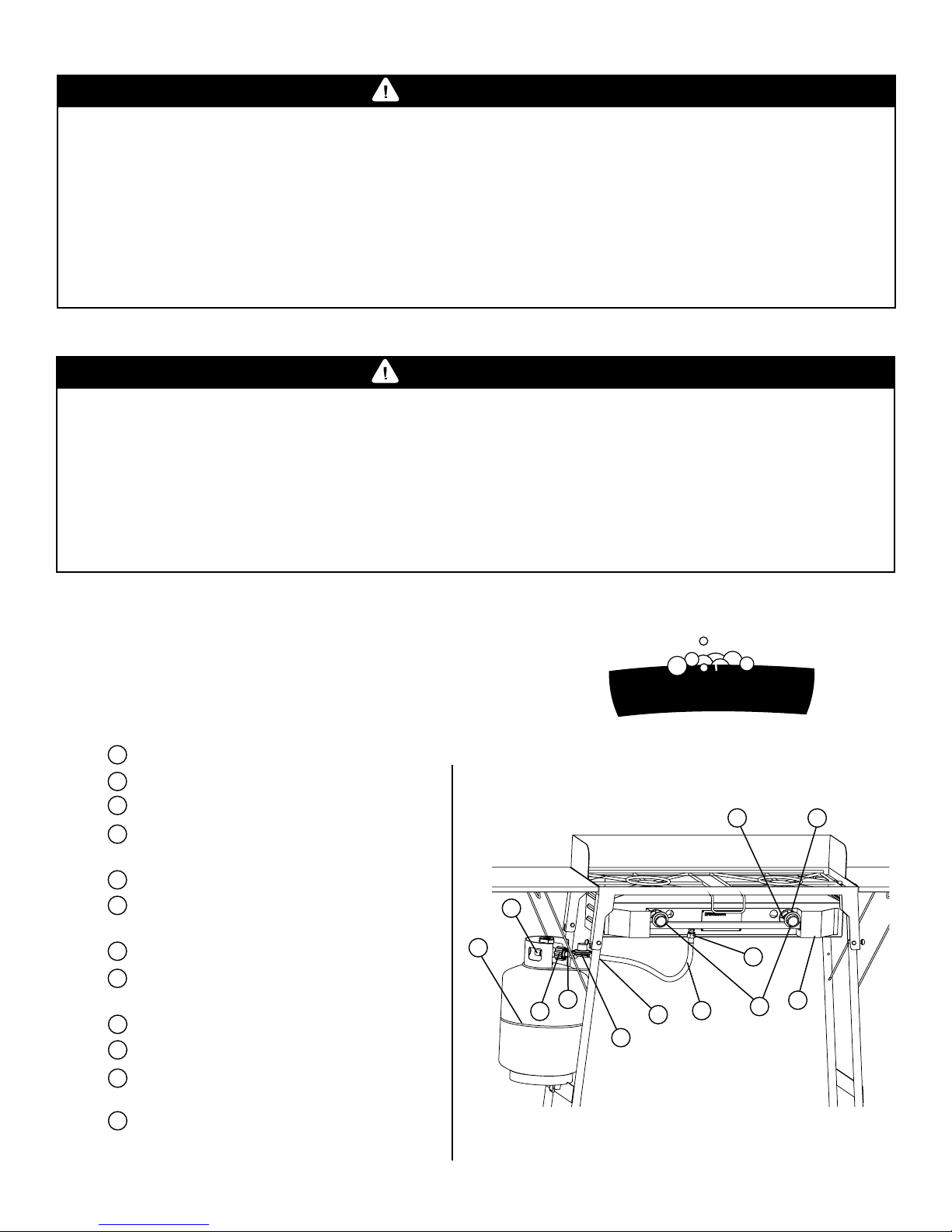
4. Feed hose and regulator connection between side legs. Insert the
nipple of connection device into the valve outlet. Insure that the
device is centered properly as illustrated in diagram.
5. Turn the large coupling nut clockwise by hand and tighten to a full
stop. Take care not to cross thread the coupling nut onto the cylinder valve.
Do not over-tighten the knob onto the valve. Do not use tools to tighten connection.
NOTE: If you are unable to make the connection, repeat steps 4 and 5.
6. Check that the hose does not contain kinks, does not contact sharp edges, and does not contact
surfaces that may become hot during use.
7. Leak check all fittings before lighting your stove. See section on "Leak Testing" in this manual.
WARNING
WARNING
Coupling Nut
(Turn clockwise
to connect)