Page 2
Buckleys (UVRAL) Ltd. Range Road, Hythe, Kent. United Kingdom. CT21 6HG.
Tel:- +44 (0) 1303 260127/8 Fax:- +44 (0) 1303 262115
1.0 Unpacking
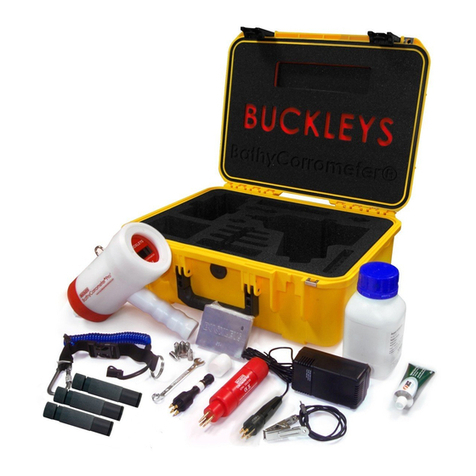
1. Check that the following are in the case:-
-Bathycorrometer unit, White with Red nose cone.
-Charger, oblong box with a lead coming out of each end.
-6 Stainless Steel pointed Probe Tips.
-A spanner to fit the Probe Tips.
-A 5 pinned rubber Plug with White Locking Ring.
-A small tube of Silicone Grease.
-This Instruction Manual
If any of these are missing, contact your supplier immediately.
2. Keep the packaging in case the unit needs to be sent back for repair in the future,
or needs to be stored.
2.0 General Description
The Bathycorrometer® (BCM) is an underwater corrosion volt meter, powered by a
rechargeable battery. This current model has been developed from the original model
and on the very successful Bathycorrometer® MkV. The unit is fitted with a 3½ digit
high impedance (10 megohms) LCD Volt Meter which is backlit for operation in murky
conditions. The unit can read voltages as low as 0.001V up to 1.999V D.C.. The
corrosion potential is detected by a Silver/Silver Chloride (Ag/AgCl) reference
electrode of extremely robust and proven construction, mounted in the protective nose
cone and sited only 5cm from the probe tip.
2.1 Probe Tips
Six standard probe tips are supplied with the instrument. They are provided with a
standard point, suitable for use on steel work with coatings of either paint or tape etc., as
used on steel piles, under sea pipelines and through thicker coatings, marine growth and
the like.
The probe tip is fitted to the front of the instrument by screwing it onto the stainless
steel stud and tightened with the spanner provided. A definite bottoming should be felt
when the probe has been screwed fully home. Silicone grease smeared on the outside of
the probe will assist fitting through the “O” ring seal.
2.2 Blanking Plug
The unit is switched ON by using the 5 pinned Blanking Plug provided. This should be
disconnected when the instrument is out of the water in order to conserve battery life.
Silicone grease smeared on the plug will greatly facilitate its insertion. The plug is NOT
underwater pluggable and must be inserted before the instrument is immersed,
otherwise spurious readings and damage to the socket will occur.