10
A. Vent Guidelines Due to Removal of an
Existing Boiler
For installations not involving the replacement of an
existing boiler, proceed to Step B.
When an existing boiler is removed from a common
venting system, the common venting system is likely to
be too large for proper venting of the remaining
appliances. At the time of removal of an existing boiler,
the following steps shall be followed with each appli-
ance remaining connected to the common venting
system placed in operation, while the other appliances
remaining connected to the common venting system are
not in operation:
1. Seal any unused openings in the common venting
system.
2. Visually inspect the venting system for proper size
and horizontal pitch and determine there is no block-
age or restriction, leakage, corrosion, and other
deciencieswhichcouldcauseanunsafecondition.
3. Insofar as is practical, close all building doors and
windows and all doors between the space in which
the appliances remaining connected to the common
venting system are located and other spaces of the
building. Turn on clothes dryers and any appliance
not connected to the common venting system. Turn
on any exhaust fans, such as range-hoods and
bathroom exhausts, so they will operate at maximum
speed. Do not operate a summer exhaust fan. Close
replacedampers.
4. Place in operation the appliance being inspected.
Follow the Lighting (or Operating) Instructions.
Adjust thermostat so appliance will operate continu-
ously.
5. Test for spillage at the draft hood relief opening after
ve(5)minutesofmainburneroperation.Usethe
ameofamatchorcandle,orsmokefroma
cigarette, cigar or pipe.
6. After it has been determined that each appliance
remaining connected to the common venting system
properly vents when tested as outlined above, return
doors,windows,exhaustfans,replacedampersand
any other gas burning appliance to their previous
conditions of use.
Table 4: Vent/Air Intake Length
7. Any improper operation of the common venting
system should be corrected so the installation
conforms with the National Fuel Gas Code, NFPA
54/ANSI Z223.1. When resizing any portion of the
common venting system, the common venting
system should be resized to approach the minimum
size as determined using the appropriate tables in
Part II in the National Fuel Gas Code, NFPA 54/
ANSI Z223.1.
B. General Guidelines
1. Vent system installation must be in accordance with
National Fuel Gas Code, NFPA 54/ANSI Z221.3 or
applicable provisions of local building codes.
Contactlocalbuildingorreofcialsaboutrestric-
tions and installation inspection in your area.
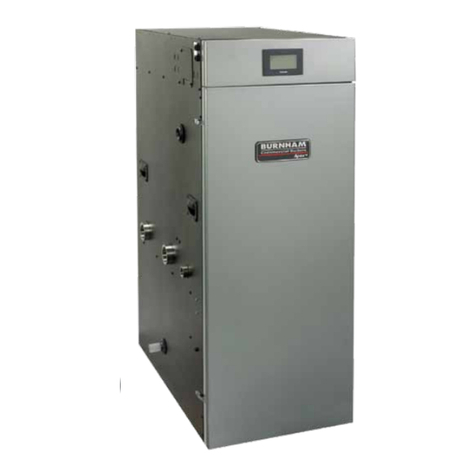
2. The Revolution is designed to be installed as either a
Direct Vent boiler or Power Vent boiler. In the
DirectVentcongurationalloftheairforcombus-
tion is supplied directly to the burner enclosure from
outdoorsanduegasesareventeddirectlyoutdoors
(throughwallorroof).InthePowerVentcongura-
tion, room air provides air for combustion and
ventilation. Flue gases are still vented directly
outdoors (through wall or roof).
Note: Venting requirements change if indoor air is
used.
3. Refer to the appropriate drawings in this section of
thismanualtodeterminethepropercongurationof
venting system. See Table 1.
4. This appliance requires a Special Gas Vent. The
product is designed to use supplied AL 29-4C®
Stainless Steel vent system components. The
following manufacturers offer similarAL 29-4C®
components and are approved for use with this
product. Heat-Fab Inc. - Saf-T-Vent (800-772-0739);
Flex-L International Inc. - Star-34 (800-561-1980);
Z-Flex U. S., Inc. - Z-Vent (800-654-5600); and
Protech Systems, Inc.- FasNSeal™ (800-766-3473)
or equivalent. The use of these alternate manufac-
turer’s venting systems will require adapters to
connect to the supplied vent connector and vent
terminal. These adapters are not supplied with this
unit and should be obtained from the supplier of the
alternate manufacturer’s venting system. See Table
3 for complete list of U.S. Boiler Vent System
Components.
Model 3” Air Intake Pipe (Equiv. Ft.) 4” Air Intake Pipe (Equiv. Ft.) 3” Vent Pipe (Equiv. Ft.)
Min. Max. Min. Max. Min. Max.
RV3 & RV4 10 52 --- --- 850
RV5, RV6 & RV7 --- --- 10 52 850