5.1 Product Features
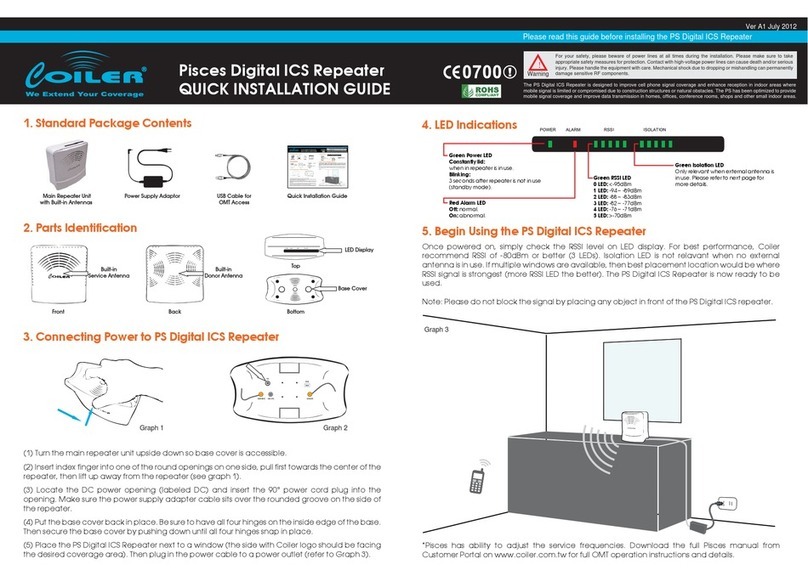
The PS Digital ICS Repeater represents some of the most innovative technologies from Coiler. The key
technology that defines the PS is the Isolation Cancellation System (ICS). In addition, the Pisces also
feature technologies such as Automatic Gain Adjustment (AGA), Automatic Gain Control (AGC), Auto
Shut Down (ASD) and Auto Turn On (ATO). Each feature is described in details below.
A. Isolation Cancellation System
Isolation Cancellation System (ICS) is a complex technology. However, the over function can be simply
to the following definition:
All RF signal has three parameters: amplitude (A), phase (Ø), and time delay (T). ICS repeater has a
digital engine that differentiates the real input and feedback signal, then controls and reduces the
amplitude, phase and time delay of feedback signal. Hence echo is cancelled and antennas can be
much closer than repeaters without ICS technology. The formulas below illustrate a 25dB isolation
improvement comparing repeaters without ICS technology and Pisces Digital ICS Repeater.
Repeater without ICS technology: Isolation ≥Gain + 15dB
Pisces Digital ICS Repeater: Isolation ≥Gain – 10dB
B. Automatic Gain Adjustment
Working hand in hand with the ICS technology within the Pisces is the Automatic Gain Adjustment
(AGA) with 25dB range. This is a dynamic function that adjusts the gain of the Pisces whenever
isolation becomes insufficient. The full gain of Pisces repeater is 70dB when isolation is 60dB or higher.
When a situation causes the isolation to be lower than 60dB, AGA would reduce the gain immediately
to avoid oscillation. For example, if an object is placed directly in front Pisces repeater on the service
side, this would cause the service signal to feedback to donor and reduce the isolation value. In this
case if isolation becomes 50dB, then AGA would reduce the gain of the repeater by 10dB to avoid
oscillation. Maximum attenuation of AGA is 25dB, which means the Pisces repeater would adjust
automatically for best performance as long as isolation is high than 35dB.
C. Automatic Gain Control
Automatic Gain Control (AGC) is also a dynamic gain adjustment feature with 25dB of range. AGC
adjust the gain of Pisces whenever the input power is higher than -60dBm. Since the maximum gain of
Pisces is 70dB and the maximum output power +10dBm on the DL, whenever input RSSI is higher
than -60dBm, AGC would make the appropriate attenuation to keep the output power consistent at the
max output power level of +10dBm. Maximum attenuation of AGC is 25dB, which means Pisces
repeater can adjust to any circumstance with RSSI of -35dBm or lower. Pisces would shut down when
input power is -35dBm or higher. The use of repeater should not be required when signal level is that
strong.
D. Auto Shut Down and Auto Turn On
When the input power exceeds AGC range on the DL or UL by 3dB, Pisces would activate its
advanced set safety mechanism: Auto Shut Down (ASD) and Auto Turn On (ATO). ASD is a stage that
temporarily stops the RF function of PS. On the UL it will continuously detect the input power and
resume RF function as soon as the input power reduces to a safe range. For the DL, it will make three
attempts to detect the input power in this temporary stage. If the input power reduces to a safe range
for the PS to operate, the ATO feature would power the repeater back on and restore all functions
promptly. However, if the input power remains too great and dangerous for the network, it will then shut
down completely. In such the signal is too strong for the usage of Pisces repeater.
Note: shutdown level of Pisces is at +13dBm (3dB higher than maximum output power), which
translates to an input power of -32dBm after full AGC attenuation).