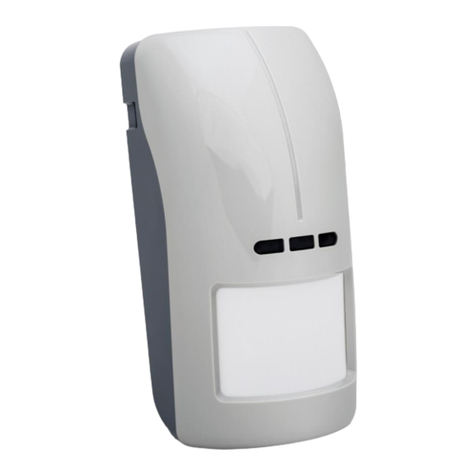
CTC Union MX333 Series User manual

MX333 Series MAXX BoxMX333 Series MAXX Box
16 Triaxial Sensor Inputs16 Triaxial Sensor Inputs
Product ManualProduct Manual

2
• Introduction...................................................................3
• Product Description...........................................................3
• Product Dimensions & Diagram................................................4
• Mounting Instructions .........................................................5
• Conduit Entry .................................................................6
• Grounding ....................................................................7
• Installation of Sensor / Signal Input Cable......................................8
• Post-Installation Testing..................................................... 11
• Warranty & Return Information .............................................. 13
T C

3
I
CTC MAXX Box solutions allow for the monitoring of remotely mounted vibration
sensors, which would otherwise be restricted to human access due to safety
considerations.
MX333 Series MAXX Box Overview: Sixteen triaxial sensor inputs (48
measurement channel outputs), fiberglass enclosure
The MX333 is a fiberglass enclosure designed for data collection of up to 16
triaxial accelerometers. The MX333 provides connection of the four-conductor
input wiring for a maximum of 16 triaxial accelerometers for portable data
collection. Data is collected via four, four-pin output connectors compatible
with Azima DLI Data Collector Cables. Input wiring from the sensors is wired to
the outputs via terminal blocks located behind the hinged output panel. Inputs
available on each terminal block include positive and negative for each axis or
sensor signal, and one input for the shield drain wire that is grounded via an
external ground stud mounted to the side of the fiberglass enclosure.
All MX333 enclosures feature a hinged cover with a mounted snap latch to
protect each four-pin connector when not in use. Rated for NEMA 4X (IP66), the
box is resistant to hose-directed fluid and corrosion and is rated for temperatures
ranging from -58°F to 180°F (-50°C to 82°C).

4
P D
Measurement
Location Card
Four-pin MIL
Output Connector
Figure 1. Dimensions
Figure 2. Diagram
Rear View Side View

5
M I
Note: if you have purchased a MAXX Box without cable entries provided, you
should add your own entry prior to mounting the enclosure. CTC does not
recommend drilling holes in the top of the enclosure due to access and moisture
concerns.
Mounting
Holes
0.33 in./8.38 mm
Figure 3. MAXX Box Rear View

6
C E
If you are running conduit to your enclosure, ensure the conduit cable entry is
located at the bottom of the enclosure when mounted.
Note: To ensure moisture will not flow into the enclosure, a hole should be drilled
at the lowest point in the conduit to provide drainage for any moisture.
Correct
Figure 4. Conduit Entry for MAXX Box
Incorrect
Drill Drain
Hole Here

7
G
Ensure the shield ground wire on the MX333 Series MAXX Boxes is grounded to
earth ground.
A. Mounting to Earth Ground
When mounting MX333 Series MAXX Boxes to earth ground (such as an I-Beam),
mount the shield ground wire using a mounting bolt through one of the mounting
brackets on the enclosure.
Figure 5. Proper Shield Grounding Technique

8
B. Mounting to Non-Grounded Structure
When mounting the termination box to a non-grounded structure, ensure the
shield ground wire or customer-supplied ground wire is tied to a source of earth
ground.
Figure 6. Ground Wire Placement
S W I
Installation of Sensors/Signal Input Cable
1. Feed blunt-cut end through the cable entry at the bottom of the enclosure.
Note: it is recommended that cables are marked on both ends.
For cord grip cable entry, take off the cord grip cover with bushing and run cable
into enclosure, hand-tighten cord grip cover to base to prevent damage of cord
grip.

9
1. Strip outer jacket of cable back 1¼ in. and remove all of the shielding.
2. Separate the internal wires from the shield and twist the shield.
3. Strip red and black insulation back ¼ in.
Figure 8. Bottom View
Figure 7. Front View
Figure 9. Stripped Wire
4. Locate the appropriate plug, identified by channel number, remove the plug and
install the wires using a small flathead screwdriver. Push plug back into location.
Orientation is as follows:
a. White insulated conductor wire (Z) is connected to the rst channel used.
b. Red insulated conductor wire (Y) is connected to the second channel used.
c. Green insulated conductor wire (X) is connected to the third channel used.
d. Black insulated conductor wire is connected to (-) common.
e. Shield drain wire is connected to ground (GND).
(-) Common
Shield / Drain Wire
(+) Channel Y
(+) Channel X
(+) Channel Z

10
5. Mark the Measurement Location Card located on the inside front cover with a
description of each measurement location.
Figure 10. Field Wiring for Four-Conductor Triaxial Sensor Inputs
E
NSIONS
E
SHEET
Sensor Inputs
White = Power/Signal Z Axis
Red = Power/Signal Y Axis
Green = Power/Signal X Axis
Black = Common
Grey = Shield (Ground)
SENSOR 1
SENSOR 2
SENSOR 3SENSOR 4
E
NSIONS
E
SHEET
Sensor Inputs
White = Power/Signal Z Axis
Red = Power/Signal Y Axis
Green = Power/Signal X Axis
Black = Common
Grey = Shield (Ground)
SENSOR 1
SENSOR 2
SENSOR 3SENSOR 4
E
NSIONS
E
SHEET
Sensor Inputs
White = Power/Signal Z Axis
Red = Power/Signal Y Axis
Green = Power/Signal X Axis
Black = Common
Grey = Shield (Ground)
SENSOR 1
SENSOR 2
SENSOR 3SENSOR 4
E
NSIONS
E
SHEET
Sensor Inputs
White = Power/Signal Z Axis
Red = Power/Signal Y Axis
Green = Power/Signal X Axis
Black = Common
Grey = Shield (Ground)
SENSOR 1
SENSOR 2
SENSOR 3SENSOR 4
E
NSIONS
E
SHEET
Sensor Inputs
White = Power/Signal Z Axis
Red = Power/Signal Y Axis
Green = Power/Signal X Axis
Black = Common
Grey = Shield (Ground)
SENSOR 1
SENSOR 2
SENSOR 3SENSOR 4
E
NSIONS
E
SHEET
Sensor Inputs
White = Power/Signal Z Axis
Red = Power/Signal Y Axis
Green = Power/Signal X Axis
Black = Common
Grey = Shield (Ground)
SENSOR 1
SENSOR 2
SENSOR 3SENSOR 4
Inputs Inputs
Table of contents
Other CTC Union Security Sensor manuals