manuals.online logo
Brands
  1. Home
  2. •
  3. Brands
  4. •
  5. DOEPFER
  6. •
  7. Control Unit
  8. •
  9. DOEPFER A-100 Series User manual

DOEPFER A-100 Series User manual

Other manuals for A-100 Series

10

This manual suits for next models

1

Other DOEPFER Control Unit manuals

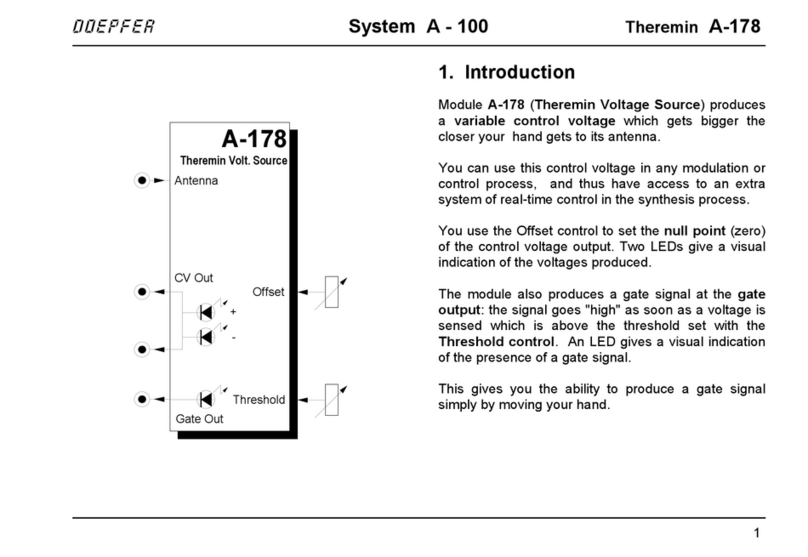
DOEPFER A-178 User manual

DOEPFER

DOEPFER A-178 User manual

DOEPFER A-100 Series User manual

DOEPFER

DOEPFER A-100 Series User manual

DOEPFER A-100 Series Quick start guide

DOEPFER

DOEPFER A-100 Series Quick start guide

DOEPFER Quad AD/LFO A-143-1 User manual

DOEPFER

DOEPFER Quad AD/LFO A-143-1 User manual

DOEPFER A-100 Series User manual

DOEPFER

DOEPFER A-100 Series User manual

DOEPFER A-100 Series User manual

DOEPFER

DOEPFER A-100 Series User manual

DOEPFER A-135-4C Quick start guide

DOEPFER

DOEPFER A-135-4C Quick start guide

Popular Control Unit manuals by other brands

Seitz 14A80 user manual

Seitz

Seitz 14A80 user manual

Wilo RS485 Installation and operating instructions

Wilo

Wilo RS485 Installation and operating instructions

Becker CentralControl CC41 Commissioning Instruction

Becker

Becker CentralControl CC41 Commissioning Instruction

SICK CDB650 operating instructions

SICK

SICK CDB650 operating instructions

Panduit NetKey NKP5E88M Series installation instructions

Panduit

Panduit NetKey NKP5E88M Series installation instructions

MX Options Concentric Petite Fitting instructions

MX

MX Options Concentric Petite Fitting instructions

Clean Water Systems Fleck 2510 Installation & start?up guide

Clean Water Systems

Clean Water Systems Fleck 2510 Installation & start?up guide

Fairchild FSB44104A user guide

Fairchild

Fairchild FSB44104A user guide

LEGRAND Wattstopper LMIN-104 installation instructions

LEGRAND

LEGRAND Wattstopper LMIN-104 installation instructions

PMK ATT10BNCS instruction manual

PMK

PMK ATT10BNCS instruction manual

Tektronix TDS3FFT user manual

Tektronix

Tektronix TDS3FFT user manual

Woodward easYgen Technical manual

Woodward

Woodward easYgen Technical manual

Balluff BNI EIP-502-105-R015 user guide

Balluff

Balluff BNI EIP-502-105-R015 user guide

NXP Semiconductors TWR-LS1021A Getting started

NXP Semiconductors

NXP Semiconductors TWR-LS1021A Getting started

Advantech PCM-3117 Startup manual

Advantech

Advantech PCM-3117 Startup manual

Danfoss MCO 101 manual

Danfoss

Danfoss MCO 101 manual

Moons' Lin Engineering R701P user manual

Moons'

Moons' Lin Engineering R701P user manual

Aventics RV1 operating instructions

Aventics

Aventics RV1 operating instructions

manuals.online logo
manuals.online logoBrands
  • About & Mission
  • Contact us
  • Privacy Policy
  • Terms and Conditions

Copyright 2025 Manuals.Online. All Rights Reserved.

DOEPFER System A-100 Synthesizer Voice A-111-5
1
Fig. 1: A-111-5 sketch
1. Introduction
Synthesizer Voice A-111-5 System A-100 DOEPFER
2
Module A-111-5 is a complete monophonic synthesizer
module that includes these components:
VCO
• manual tune control (with an internal jumper the range
can be set to ~ +/-1 half an octave or ~ +/-2.5 octaves)
• range switch -1 / 0 / +1 octave
• frequency range about 10Hz ... 12kHz
• FM (frequency modulation) control with modulation
source switch (LFO1 / off / ADSR)
• manual pulsewidth control for rectangle waveform
• PWM control with modulation source switch (LFO2 / off
/ ADSR)
• waveform switch (sawtooth / off / triangle)
• the sum of the waveform chosen by this switch and the
rectangle is fed into the VCF (to turn the rectangle off
the PW control has to be set fully CCW)
• external CV input for VCO frequency (1V/octave)
• external CV input for external PWM of the rectangle
• internal CV input for frequency (1V/octave) connected
to the A-100 bus via jumper, the jumper can be used to
interrupt this internal connection if not wanted
VCF
• 24 dB low pass
• ~ 12 octaves frequency range
• manual frequency control
• tracking switch half - off - full (internally connected to
the external frequency CV input of the VCO, i.e. the
VCF tracks to the VCO if the switch is set to "half" or
"full" position)
• XM: exponential FM (frequency modulation) control
with modulation source switch (LFO2 / off / ADSR)
• LM: linear FM (frequency modulation) control to
modulate the VCF by the triangle of the VCO in a linear
(!) manner
• manual resonance control (up to self oscillation)
• external audio input (this signal is added to the VCO
signal)
• external CV input for filter frequency
• 1V/octave tracking for usage of the VCF as a sine
wave oscillator (not as precise as the VCO but much
better than most of the other filters)
DOEPFER System A-100 Synthesizer Voice A-111-5
3
VCA
• manual amplitude control
• AM (amplitude modulation) control with modulation
source switch (LFO1 / off / ADSR)
• external CV input for VCA amplitude
• special control scale: exponential scale in the range from
about -20dB to -80/90dB, linear scale from about -20dB
to 0dB
Remark: this special control scale results in a loudness
behaviour that is a bit different from pure linear or
exponential VCAs
LFO1 and LFO2
• manual frequency control
• waveform switch (triangle / off / rectangle)
• range switch (low, audio, medium)
• LED display (dual green/red color for positive/negative
share of the signal)
• the inverted LFO1 signal is available as an additional
socket (to use the LFO1 signal for external modules)
• an internal jumper can be used to select between the
LFO1 signal or the inverted LFO1 signal
ADSR
• manual controls for Attack, Decay, Sustain, Release
• range switch (long, short, medium)
• blue LED display
• ADSR signal is available as an additional socket (to use
the ADSR signal for external modules)
• Gate input connected to the A-100 bus via jumper, the
jumper can be used to interrupt this internal connection if
not wanted
Synthesizer Voice A-111-5 System A-100 DOEPFER
4
Remarks:
• As the LFO frequencies can go up to moderate audio
range (~ 5kHz) even audio FM effects of VCO (pitch
and pulsewidth), VCF and ADSR are possible !
• If the VCO is turned off (waveform switch = center
position, pulsewidth control = fully CCW) and the VCF
resonance is set to maximum the module can be used
as a sine oscillator. The sine can be modulated in a
linear manner from the triangle wave of the VCO and
by LFO2 in an exponential manner at the same time !
• from the factory the socket labelled "LFO1" outputs the
inverted LFO1 signal. But as the module has several
internal pin headers available even another signal may
appear at this socket by changing the internal module
patch. These six pin headers are available: LFO1
output, LFO2 output, ADSR output, inverter input,
inverter output, output socket. The internal default
patch is LFO1 -> inverter input, inverter output ->
output socket (i.e. socket = inverted LFO1). But even
another signal can be patched to this socket (e.g.
inverted ADSR, non-inverted LFO1, inverted or non-
inverted LFO2). It is also possible to add a blind panel
next to the A-111-5 with a couple of sockets that are
connected to the corresponding pins of the A-111-5 pc
board. The in- and outputs of the VCO, VCF and VCA
are not available as pin headers because the VCO,
VCF and VCA are internally connected in the circuit
which is used in this module.
Additional specifications:
• Front panel width: 24 HP / 121.6 mm
• Module depth: 40 mm (measured from the rear side of
the front panel)
• Current: 80 mA
DOEPFER System A-100 Synthesizer Voice A-111-5
5
2. Overview
Fig. 2:
Front Panel
(full view)
Synthesizer Voice A-111-5 System A-100 DOEPFER
6
1
Fig. 2a: Front Panel
(VCO and VCF)
1 VCO Tune
2 VCO Range Switch (Octave Switch)
3a VCO FM Source Switch
3b VCO FM Level
4 VCO Waveshape Switch
5 VCO Rectangle Pulsewidth
6a VCO Pulsewidth Modulation Source
6b VCO Pulsewidth Modulation Level
7 VCF Frequency
8 VCF Tracking Switch
9a VCF exponential FM Source Switch
9b VCF exponential FM Level
10 VCF linear FM Level
11 VCF Resonance
2
3b
3a
5
4
6b
6a
7
9a
8
9b
10
11
DOEPFER System A-100 Synthesizer Voice A-111-5
7
16 17
12
13a 18
13b
14c 19
14a
14b
15c 20
15a
Fig. 2b: Front Panel
(VCA, LFO, ADSR)
12 VCA Amplitude (Manual Gain)
13a VCA AM Source Switch
13b VCA AM Level
14a LFO1 Frequency
14b LFO1 Frequency Range Switch
14c LFO1 Waveform Switch
15a LFO2 Frequency
15b LFO2 Frequency Range Switch
15c LFO2 Waveform Switch
16 ADSR Range Switch
17 ADSR Attack Time
18 ADSR Decay Time
19 ADSR Sustain Level
20 ADSR Release Time
15b
Synthesizer Voice A-111-5 System A-100 DOEPFER
8
1
Fig. 2c: Frontpanel (Inputs and Outputs)
1 VCO Frequency Control Input (1V/Octave)
2 VCO Pulsewidth Control Input
3 VCF Frequency Control Input (1V/Octave)
4 VCA Amplification Control Input
5 ADSR Gate Input
6 VCF External Audio Input
7 Inverted LFO1 Output
8 ADSR Output
9 Audio Output
23456789
DOEPFER System A-100 Synthesizer Voice A-111-5
9
3. In- / Outputs
1 VCO Frequency Control Input (1V/Octave)
This input is used to control VCO frequency from the socket
at the front panel. It works in addition to the control voltage
that is applied to the CV line of the A-100 bus – provided
that the corresponding jumper JP2 is set (details in the
appendix) – and the internal frequency settings and
modulations (controls 1, 2, 3a and 3b). Both CV inputs can
be used simultaneously (e.g. bus CV controlled by the Midi
interface A-190-2, front panel CV connected to the output of
a A-155 sequencer or vice versa). For precise 1V/octave
characteristic a buffered CV source is recommended (e.g.
A-185-1, A-185-2, A-190-2).
Both CV inputs can be used to "play" the VCO by means of
a control voltage that uses the 1V/octave standard or to
modulate the VCO e.g. by an LFO or another VCO. To
adjust the level of an external frequency modulation an
attenuator (e.g. A-183-1) or amplifier (Ae.g. -183-3) can be
used.
2 VCO Pulsewidth Control Input
This is an external input that can be used to control the
pulsewidth of the rectangle by an external control voltage. It
works in addition to the manual control of the pulsewidth
(control 5) and the internal PWM source (controls 6a and
6b). The external PW voltage is not processed by the
attenuator 6b. A voltage difference of about 5V is required to
cover the complete pulsewidth range (e.g. 0…+5V or –
2.5…+2.5V according to the setting of the manual
pulsewidth control 5). If a smaller range is required an
external attenuator module has to be used (e.g. A-183-1).
3 VCF Frequency Control Input (1V/Octave)
This input is used to control VCF frequency from the socket
at the front panel. It works in addition to the internal
frequency settings and modulations (controls 7, 8, 9a and
9b). The socket can be normalled to the bus CV line
provided that the corresponding socket JP12 is installed
(details in the appendix). For precise 1V/octave
characteristic a buffered CV source is recommended (e.g.
A-185-1, A-185-2, A-190-2). The external VCF control
voltage is not processed by the attenuator 9b. To reduce the
sensitivity of this CV input an external attenuator module
has to be used (e.g. A-183-1).
4 VCA Amplification Control Input
This input is used to control VCA amplification (or loudness)
from the socket at the front panel. It works in addition to the
internal amplification settings and modulations (controls 12,
13a and 13b). The external VCA control voltage is not
processed by the attenuator 13b. A voltage of about +5V is
required to obtain the maximum amplification (provided that

Synthesizer Voice A-111-5 System A-100 DOEPFER
10
controls 12 and 13b are fully CCW). To reduce the
sensitivity of this CV input an external attenuator module
has to be used (e.g. A-183-1).
5 ADSR Gate Input
This input is used to trigger the envelope generator (ADSR).
A trigger voltage between +5V and +12V is required to
trigger the envelope. The socket can be normalled to the
bus gate line provided that the corresponding socket JP3 is
installed (details in the appendix).
6 VCF External Audio Input
This is an external audio input that is added to the internal
VCO signal. E.g. a noise generator, a second VCO or any
other audio source can be used. The signal is processed by
the VCF and the VCA of the A-111-5 module. The input
sensitivity is about 1V. If the signal distorts the usage of an
attenuator is recommended (e.g. A-183-1). If the external
audio signal is too small an additional amplifier can be used
(e.g. A-183-3) to increase the level.
7 Inverted LFO1 Output
By default the inverted LFO1 signal is available at this
socket. It can be used to control other A-100 modules or
other inputs of the A-111-5 (e.g. controlling the PW or the
VCF frequency by LFO1). The internal jumpers (JP7, JP8,
JP9, JP10) of the module can be set in another way so that
a different signal appears at this socket (details in the
appendix). They can be used to control other A-100
modules.
8 ADSR Output
This socket outputs the ADSR signal. It can be used to
control other A-100 modules.
9 Audio Output
This is the audio output of the module. The typical output
level is 1V.