Page 4 RPA-1 User Manual
Specifications
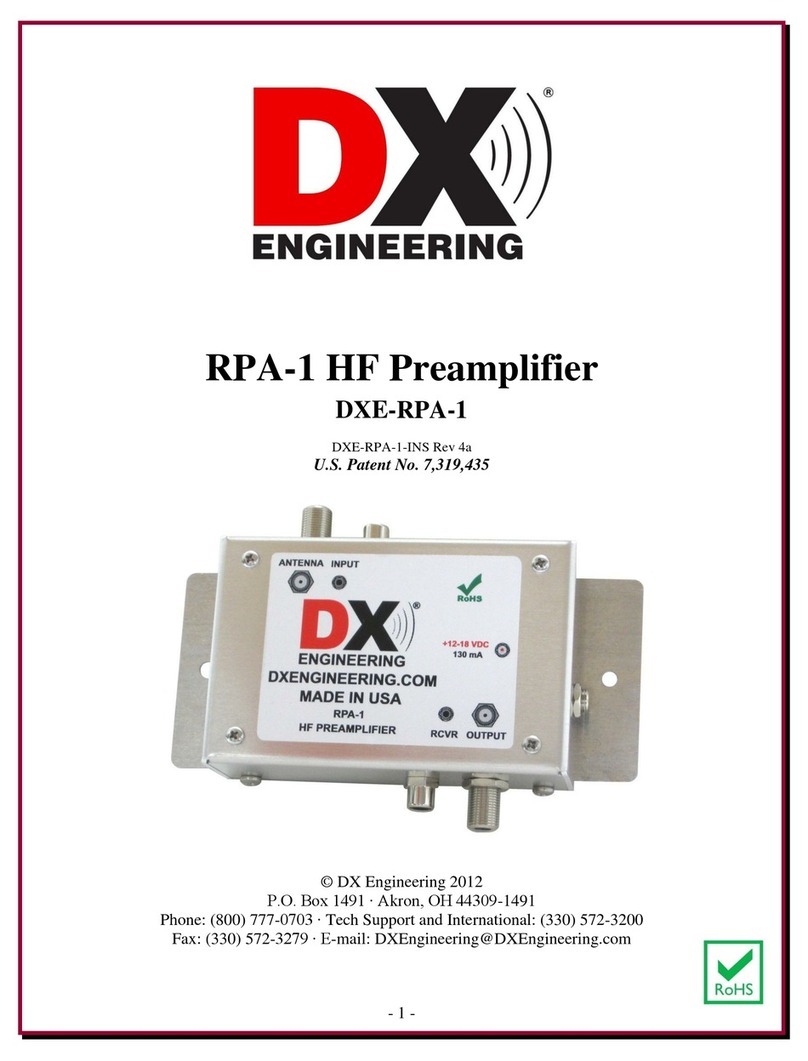
he specifications in the table below represent typical performance from the RPA-1
preamplifier:
Specifications Glossary
The following are simplified explanations of the specifications highlighted in the table above.
Third Order Intercept A standard measure of how well a receiving system performs in the
presence of strong nearby signals. The higher the third order intercept (TOI), the less likely
adjacent strong signals will cause interference. The RPA-1 offers substantially improved TOI over
competitive preamplifiers and communication receivers.
Noise Figure The ratio of equivalent noise power developed at the input to that generated by
thermal noise in the source resistance, usually expressed in decibels. If it were possible, a perfect
amplifier would have a noise figure of 0 dB. The RPA-1 is extremely quiet, and does not
contribute noticeable noise to receiving systems.
Dynamic range The ratio of the faintest signal detected to the loudest signal amplified without
significant distortion, typically expressed in decibels. The RPA-1 allows you to hear faint signals
in the presence of adjacent strong signals.
Gain The ratio of signal input to output. The RPA-1feautures a high gain that is easily reduced if
not needed.
Power Requirement: 10-18 Vdc @ 140 mA maximum
Output TOI (Third Order Intercept): +43 dBm @ 13 Vdc
Noise figure: 3.5 dB
One dB Compression: +26 dBm (~ .4 watts output)
Gain: 16 dB from 300 kHz to 35 MHz (+1.5 to −1.5 dB over this range)
500 Hz BW IM3 Dynamic range: 110 dB or greater
T
2
Page 9
RPA-1 User Manual
The RPA-1 power connector uses a standard 2.1mm barrel type plug. (included) A
traditional 500 mA, or larger “wall wart” with 12 Vdc negative-to-shell plug wiring, is
generally adequate for powering the RPA-1. You can also use a larger, regulated supply
provided it supplies 10-18 Vdc negative ground, has the power plug shell connected to
negative, and has an inline 1A fuse. WARNING! Be sure the supply polarity and voltage are
correct.
Powering through the coax
The external power connector is normally active, but components are inside the RPA-1 to allow
powering through the coaxial feedline. To change the power feed, refer to Figure 3 at the top of
next page, and do the following:
Caution: Do not nick, scratch, or break the fine wires on the choke. Do not grab the choke body
with pliers.
1. Unsolder the 100 uH RF choke lead that connects to the power jack.
2. Connect the free choke lead to the PC board indicated by the choke outline.
NOTE:
A 12-18-Vdc positive power source must be inserted in the feedline center conductor through a
similar 100 uH choke and the voltage must be blocked from appearing at the receiver. A DX
Engineering FVI-1 voltage injector. which includes a power supply, can also be used.
Reducing gain
If signals are overloading your receiver or if background noise is excessively high, there are two
solutions. The first solution involves adding a conventional attenuator pad either leading or
following the RPA-1. Addition of a pad on the input will reduce noise figure roughly by the
amount of the attenuation. This is usually not a problem with modest antenna efficiency. At the
same time noise figure decreases, input intercept (overload limits) will increase. Addition of an
attenuator pad on the RPA-1output reduces output intercept. Input intercept and noise figure
remain essentially unchanged.
As a general rule, reduction of gain with a pad at either spot will not compromise system
performance. This is because the RPA-1 design has a very large performance margin in both noise
figure and intercept. You can also reduce gain about 3 dB, from 17 to 14 dB, by cutting one lead
of C3 and C6. (Since this is a push-pull circuit, both capacitors must be removed. See Figure 3 on
next page). If additional gain reduction is still necessary, solder a 1500-ohm 1/4 watt resistor in
parallel with R1 and another in parallel with R6 to reduce the gain to 10 dB. Be aware internal
gain reduction modifications will cause the upper frequency performance to fall off at
approximately 15 MHz or higher.