Visit www.ensalife.com for support 3
1.2.1 Solar Light Components
1.2.2 Operation Process
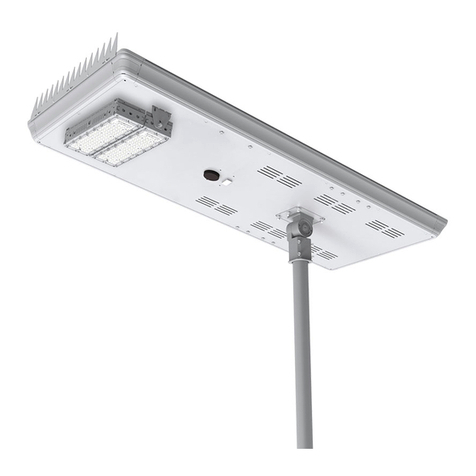
Solar Panel Assembly: This includes all solar panel
components including the panel itself, battery,
controllers, chassis & mounting arm.
The solar panel acts an ambient light sensor,
controlling dusk/dawn switch functions when it no
longer generates an adequate voltage from the sun.
This setting can be congured in Section 4.
The battery is Lithium Iron Phosphate (LiFePO4),
which has superior expected lifetime and temperature
tolerance compared to standard Lithium Polymer
batteries. It is also immune from thermal runaway
conditions to prevent res like standard LiPo batteries.
The mount arm of the solar panel offers 120° of tilt
on a Ø50~60mm pole, with an angle compass for
precise adjustment. It also has a spiked bird guard
vof the panel & a safety wire rope.
Sensor Assembly: The dark circle on the underside
of the panel, the sensor assembly houses the infrared
receiver for the remote control for light conguration.
It also houses the microwave motion detector. This
detects motion in a circular area under the Solar Light
in a total diameter of Ø15m (at 10m away from the
ground).
Light Assembly: This comprises of two high efciency
LED arrays mounted on a 60° tilt-adjustable bracket
to control light distribution. The array’s mount
positioned can be moved to better orient the light for
use.
SSL-B Series Solar Lights feature three main components that govern the function of the system. They are the solar panel
assembly (includes battery & solar controllers), the sensor assembly including infrared remote receiver & microwave
motion detector, and the LED light assembly with adjustable bracket. They are tightly integrated in the operation of the
entire system. This is further explained by component below.
The SSL-B Series Solar Light is highly customisable solar system, but how it operates is simple. The following details
the operation process of the SSL-B Solar Light after mounting.
1. During the day, the solar panel charges the battery. The LED light is off.
2. The solar panel detects that the sun has set. The LED light turns on.
3. The light is congured to be at set brightness at different time periods during the night.
4. The light is congured to use the motion sensor to control brightness before & after movement is detected.
5. The solar panel detects that the sun has rise. The LED light turns off.
6. The panel begins charging the battery during the day.
7. The cycle repeats.
1.2 Function Overview
Fig. 1.2a
Underside of panel with detail on solar panel mounting arm,
sensor assembly and LED light assembly.