5
Dishwasher detergent is corrosive!
Take care to keep it out of reach of children.
IF THE WATER ISN'T TOO HARD, YOU MAY ALSO PREVENT THE FORMATION OF DEPOSITS BY ADDING
DETERGENT.
The amount of detergent needed can vary due to differences in water hardness. To determine the water hardness in
you r area, contact your local water utility or area water softening company. The harder the water, the more detergent
you may need. Remember, you should adjust the amount of detergent you use by small amounts until you find the
correct amount.
To remove hard water spots, try the following:
Run dishes through a normal wash program.
Remove all metal dishware, such as cutlery, pans, etc.,
from the dishwasher.
Do not add detergent.
Pour two cups of vinegar into a bowl and set the bowl face
up on the lower rack of the dishwasher.
Run the dishes through a normal wash program.
If this doesn't work, try the same process with 1 / 4 cup of
citric acid crystals instead of vinegar.
Use only detergent specifically made for use in dishwashers.
Keep your detergent fresh and dry. Don't put powder detergent
into the dispenser until You're ready to wash dishes.
The rinse aid is released during the final rinse to prevent
water from forming droplets on your dishes that can leave
spots and streaks. It also improves drying by allowing
water to "sheet" off the dishes.
Your dishwashers are designed to use liquid rinse aids.
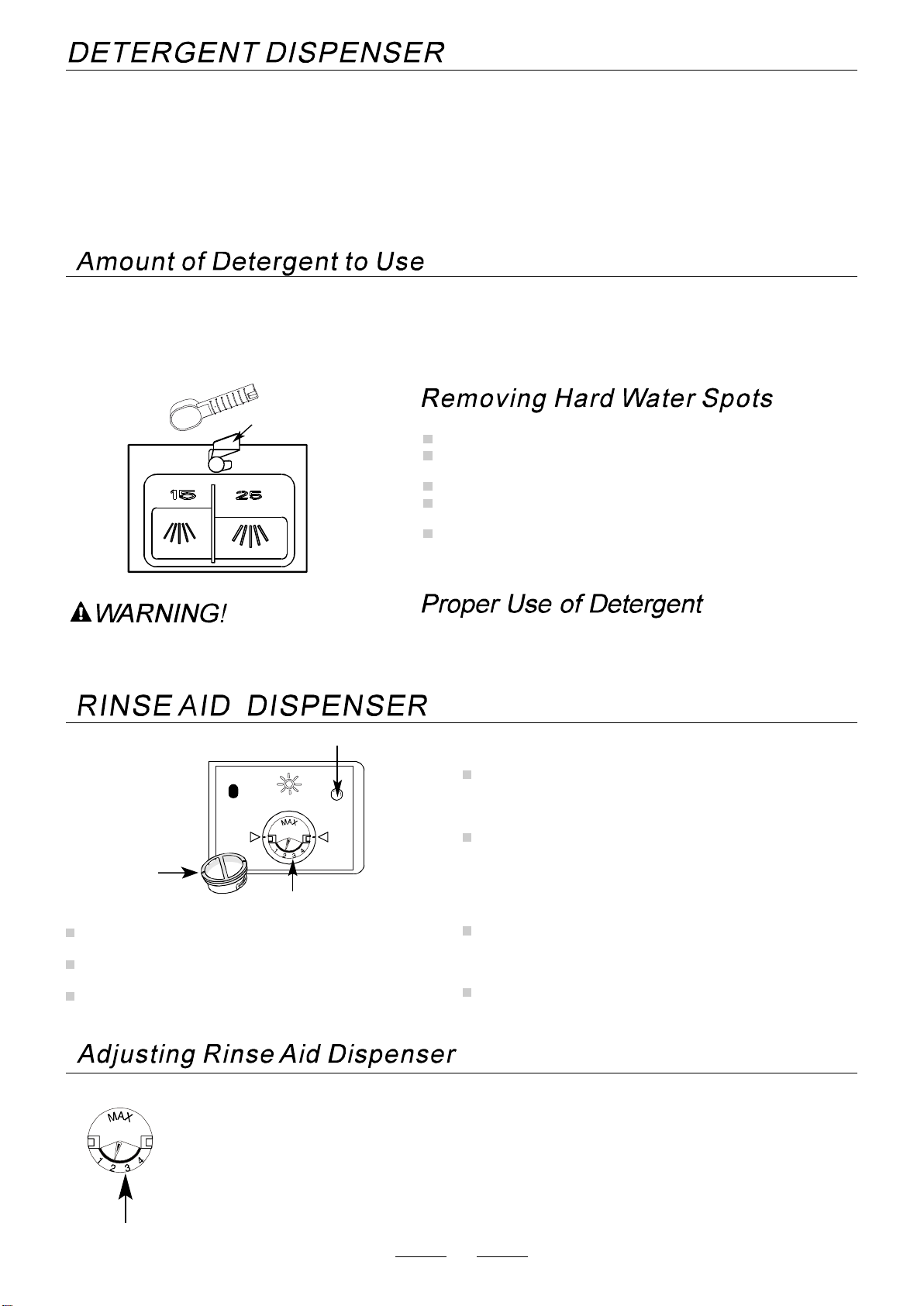
The rinse aid dispenser is located inside the door next to
the detergent dispenser. To fill the dispenser, open the
cap and pour the rinse aid into the dispenser until the level
indicator turns completely black. The dispenser holds
about 100 ml of liquid rinse aid.
Be careful not to overfill the dispenser, because this could
cause over sudsing. Wipe away any spills with a damp cloth.
Don't forget to replace the cap before you close the
dishwasher door.
If you have soft water, you may not need rinse aid for it may
cause a white film to develop on your dishes.
The dispe nser must be refilled before the start of each wash c ycle following the instructions provide d in the " Wa sh
Cycle
Ta b le". Your dishwas her s th an co nve ntion al di shw asher s. Gen eral ly, o nly o ne
tablespoon of
deterge nt is needed for a normal wash lo ad. Also, mo re heavil y soiled item s need more detergent. Always add the
det erge nt ju st
bef ore starting di shwasher, othe rw is e it cou ld get d amp a nd w ill not di ssol ve p rope rly.
us e les s de terg en t and rin se aid
To open the dispenser, turn the cap to the "open" (left)
arrow and lift it out.
Pour the rinse aid into the dispenser, being careful
not to overfill.
Replace the cap by inserting it aligned with "open"
arrow and turning it to the closed (right) arrow.
A measured amount of rinse aid is released during the final rinse. As with detergent, the amount
of rinse aid needed for your dishes depends on the hardness of the water in your area. Too much
rinse aid can result in lather of foaming and cause cloudiness or steaks on your dishes. If the
water in your area is very soft, you may not need rinse aid. If you do,you can dilute the rinse aid
with an equal amount of water.
The rinse aid dispenser has four settings. Always start with the dispenser set on " 2 ". If spots and
poor drying are problems, increase the amount of rinse aid dispensed by removing the dispenser
lid and rotating the dial to "3". If the dishes still are not drying properly or are spotted, adjust the
dial to"4".. We suggest you to set on "2" .
Button
Indicator
Dispenser cap
Adjustable setting
Adjustable setting
YOU SHOULD NOT ADD TOO MUCH DETERGENT TO PREVENT THE FORMATION OF DEPOSITS
BECAUSE YOUR DISHWASER HAS SPECIFICALLY DESIGNED WATER SOFTENERS