8
EN
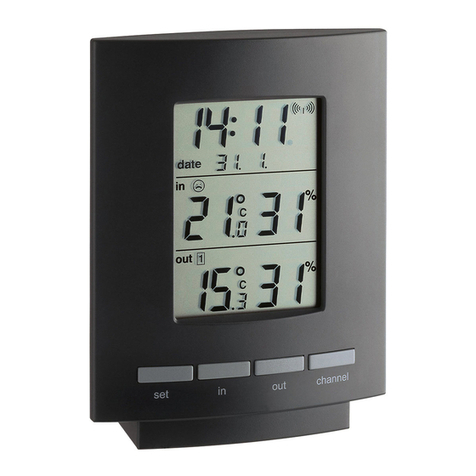
To stop the alarm sound, press any button (expect [ MEM ]
& [ CHANNEL ] buttons).
If the [ SNOOZE ] button is pressed, the snooze function
will be triggered. The alarm sound will stop and the alarm-on
icon will blink for eight minutes. After that the alarm will go
off again.
To deactivate the SNOOZE function, press the [ ]
button.
PRE-ALARM FUNCTION FOR
CHANNEL 1 REMOTE SENSOR
The alarm function also has a pre-alarm feature which can
be set to sound early when weather conditions change.
During the pre-alarm operating period, if the temperature
recorded at Channel 1 remote sensor falls to or below
2.0°C, the pre-alarm will be triggered. For example, if the
daily alarm is set to go off at 7:00 am and the pre-alarm
operating time interval is set to 45 minutes, the pre-alarm
will start to operate at 6:15 am (45 minutes before 7:00 am).
The Pre-Alarm icon will flash. An alarm sound will also go off
for 2 minutes as that of the daily alarm and the snooze
function will also be activated if the [ SNOOZE ] button is
pressed.
To enable this function:
1. First activate the alarm function. Then enter the
Pre-Alarm mode by pressing the [ ] button twice. The
"PRE-AL" icon will be displayed.
2. Press and hold the [ ] button for 3 seconds to set the
operating time interval for this pre-alarm function. Use
the [ ] or [ ] button to select from the 4 time-intervals:
15, 30, 45 or 60 minutes.
3. Press the [ ] button to confirm and exit. The
pre-alarm function will be enabled automatically which is
indicated by the appearance of the [ ] symbol.
4. To disable this function, press the [ ] button in the
Pre-Alarm mode. The [ ] symbol will disappear and
[ - : -- ] will show to indicate it is disabled.
The pre-alarm will operate during the selected time interval
before the daily alarm time.
Note: The daily alarm will NOT function until the next day if
the pre-alarm has been triggered beforehand. Deactiating
the alarm automaticaly disables the pre-alarm.
NOTE ON REMOTE READINGS
Once batteries are in place in the remote unit, it will start
transmitting samplings at 40-second intervals. If no signals
are received when the remote sensor display is selected,
"--- " will be displayed. To force the main unit to search for
remote sensor signals, press [ MEM ] and [ CHANNEL ]
simultaneously.
If that fails, check that the remote sensor is still in place.
Make sure the transmission is within range and the path is
clear of obstacles and interference. Repeat this procedure
whenever you find discrepancies between the display on
the main unit and the display on the remote sensor.