manuals.online logo
Brands
  1. Home
  2. •
  3. Brands
  4. •
  5. Frigidaire
  6. •
  7. Dryer
  8. •
  9. Frigidaire Gas & Electric Dryer User manual

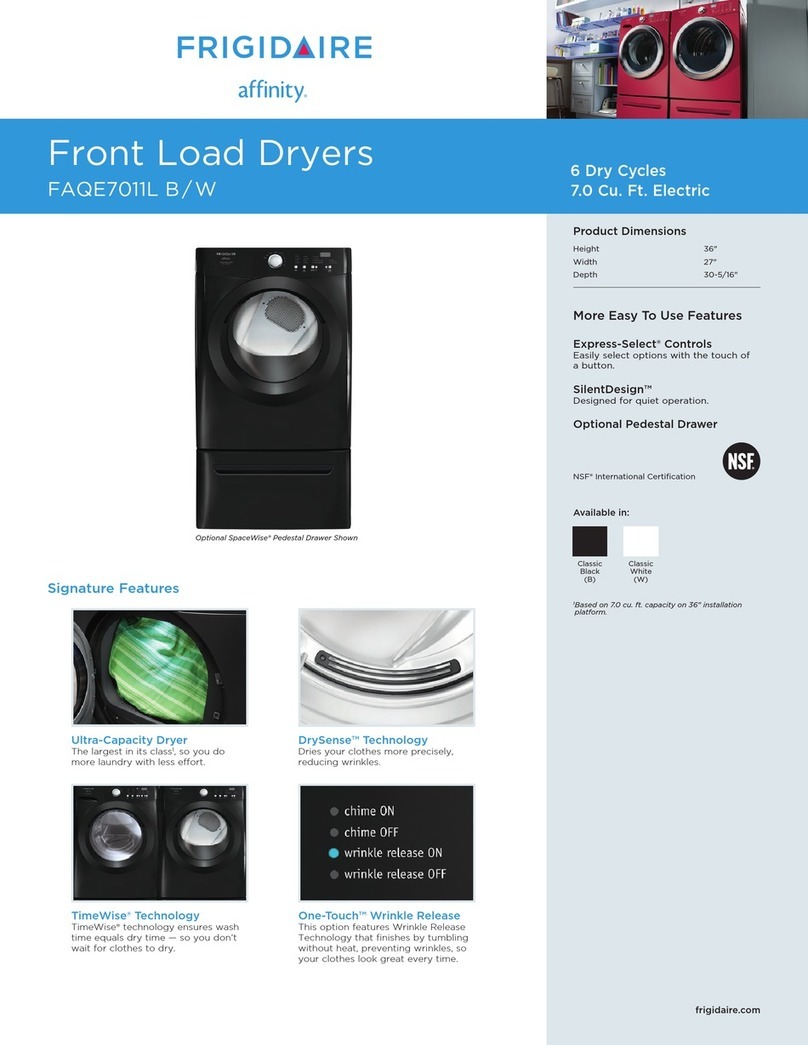
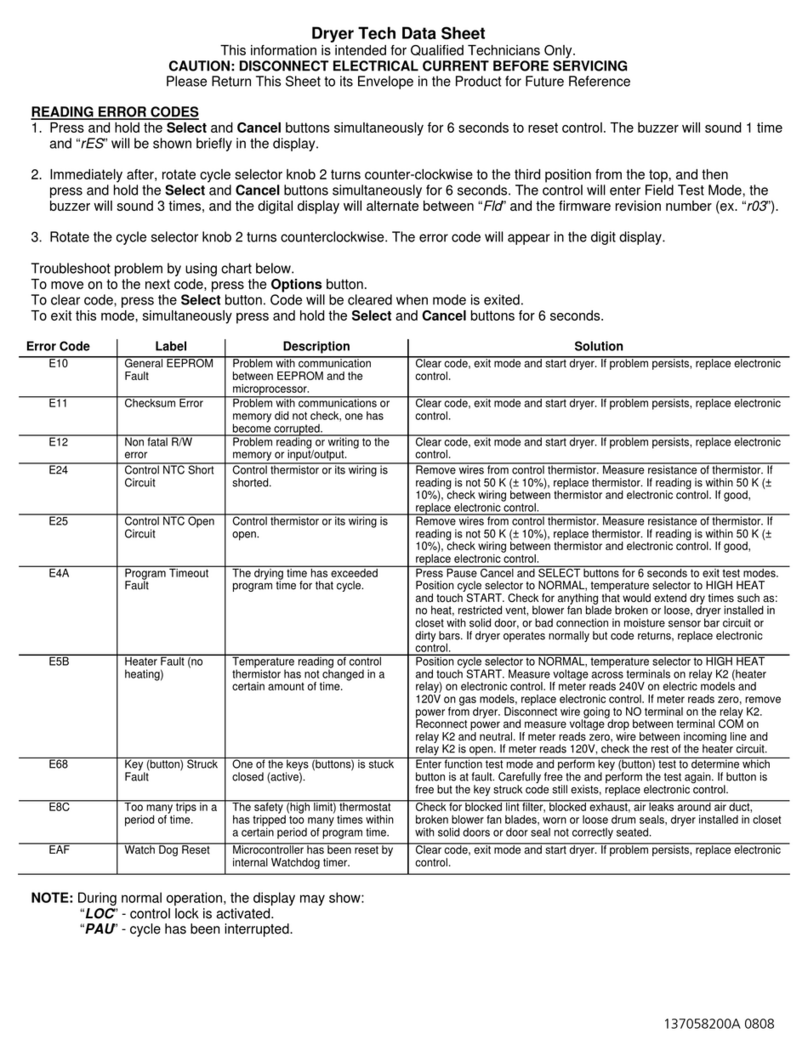
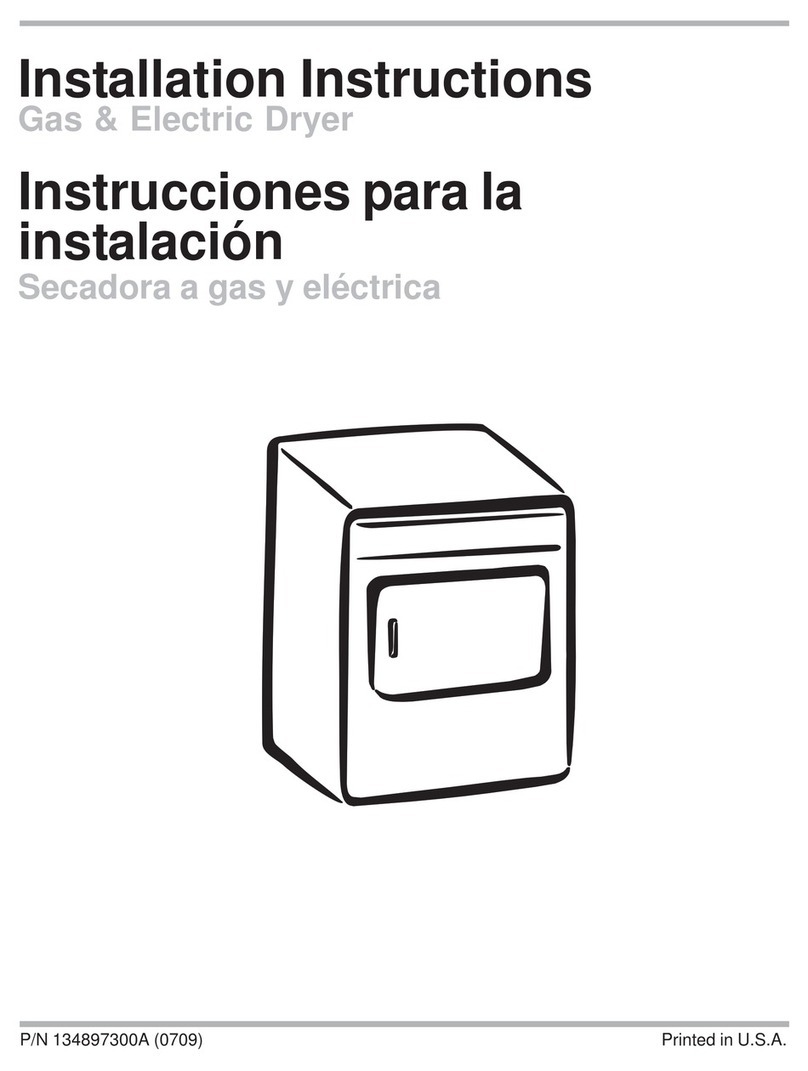
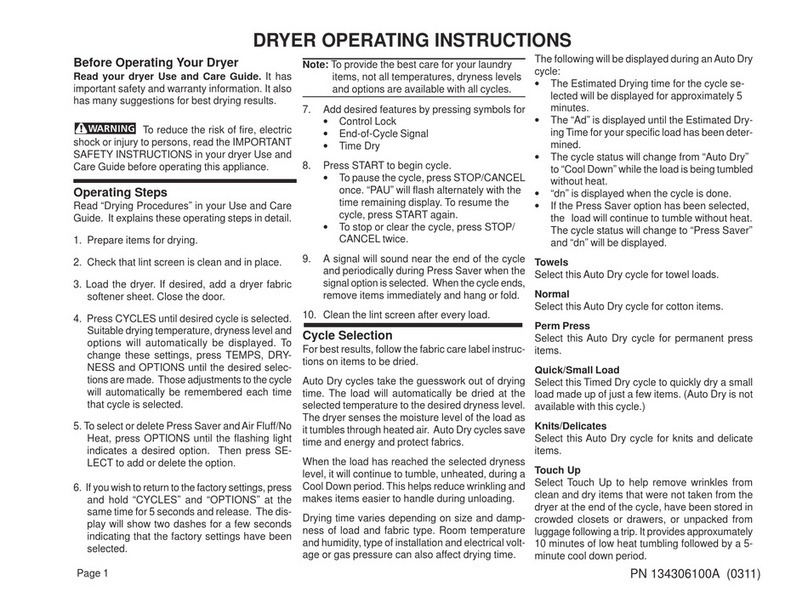
Frigidaire Gas & Electric Dryer User manual

Other manuals for Gas & Electric Dryer

2

This manual suits for next models

1

Other Frigidaire Dryer manuals

Frigidaire FASG7021NW User manual

Frigidaire

Frigidaire FASG7021NW User manual

Frigidaire AGQ7000EE - 5.8 cu.ft. Affinity Gas Dryer User manual

Frigidaire

Frigidaire AGQ7000EE - 5.8 cu.ft. Affinity Gas Dryer User manual

Frigidaire FFQG5000QW Owner's manual

Frigidaire

Frigidaire FFQG5000QW Owner's manual

Frigidaire FRQG7000LW Installation instructions

Frigidaire

Frigidaire FRQG7000LW Installation instructions

Frigidaire AEQ7000CES1 User manual

Frigidaire

Frigidaire AEQ7000CES1 User manual

Frigidaire FASE7021NW0 Owner's manual

Frigidaire

Frigidaire FASE7021NW0 Owner's manual

Frigidaire WCI Series User manual

Frigidaire

Frigidaire WCI Series User manual

Frigidaire Affinity FASE7074LA Installation instructions

Frigidaire

Frigidaire Affinity FASE7074LA Installation instructions

Frigidaire CASE7074NW0 Owner's manual

Frigidaire

Frigidaire CASE7074NW0 Owner's manual

Frigidaire FARG1011MW User manual

Frigidaire

Frigidaire FARG1011MW User manual

Frigidaire FSE848RHS0 User manual

Frigidaire

Frigidaire FSE848RHS0 User manual

Frigidaire FGQ1452H User manual

Frigidaire

Frigidaire FGQ1452H User manual

Frigidaire GLEQ2152EE0 User manual

Frigidaire

Frigidaire GLEQ2152EE0 User manual

Frigidaire FARG4044MW Owner's manual

Frigidaire

Frigidaire FARG4044MW Owner's manual

Frigidaire Affinity FAQG7017K W User manual

Frigidaire

Frigidaire Affinity FAQG7017K W User manual

Frigidaire FEQ1442E User manual

Frigidaire

Frigidaire FEQ1442E User manual

Frigidaire FEQ332 User manual

Frigidaire

Frigidaire FEQ332 User manual

Frigidaire FARG4044MW User manual

Frigidaire

Frigidaire FARG4044MW User manual

Frigidaire FRE5711KW0 User manual

Frigidaire

Frigidaire FRE5711KW0 User manual

Frigidaire 137410100A User manual

Frigidaire

Frigidaire 137410100A User manual

Frigidaire AGQ6700FE2 User manual

Frigidaire

Frigidaire AGQ6700FE2 User manual

Frigidaire FFRE1001PW Owner's manual

Frigidaire

Frigidaire FFRE1001PW Owner's manual

Frigidaire FARE4044MW User manual

Frigidaire

Frigidaire FARE4044MW User manual

Frigidaire Dryer User manual

Frigidaire

Frigidaire Dryer User manual

Popular Dryer manuals by other brands

Bosch WTA79200GB Installation and operating instructions
Bosch

Bosch WTA79200GB Installation and operating instructions

Amana W10233410A Use and care guide

Amana

Amana W10233410A Use and care guide
Asko T760 user guide

Asko

Asko T760 user guide

Bosch Logixx 10 WTB76556GB Instruction manual and installation instructions

Bosch

Bosch Logixx 10 WTB76556GB Instruction manual and installation instructions
Electrolux EW2H328R2 user manual

Electrolux

Electrolux EW2H328R2 user manual

Beko DS8433RX1M user manual

Beko

Beko DS8433RX1M user manual

Dawlance Spinner DS 6000 C owner's manual

Dawlance

Dawlance Spinner DS 6000 C owner's manual

Electrolux TP5080TW user manual

Electrolux

Electrolux TP5080TW user manual

AEG TR838P4OB user manual

AEG

AEG TR838P4OB user manual

Indesit IDV 75 instruction manual

Indesit

Indesit IDV 75 instruction manual

Infiniton SD-DG85C manual

Infiniton

Infiniton SD-DG85C manual

BOMANN WT 5019 instruction manual

BOMANN

BOMANN WT 5019 instruction manual

Alliance Laundry Systems TMB795C Installation

Alliance Laundry Systems

Alliance Laundry Systems TMB795C Installation

Asko T793C operating instructions

Asko

Asko T793C operating instructions

Kenmore 8041 - 5.8 cu. Ft. Capacity Electric Dryer installation instructions

Kenmore

Kenmore 8041 - 5.8 cu. Ft. Capacity Electric Dryer installation instructions

Bosch WTX8HKM9SN User manual and installation instructions
Bosch

Bosch WTX8HKM9SN User manual and installation instructions

Sharp KD-NHH9S7GW2-PL user manual

Sharp

Sharp KD-NHH9S7GW2-PL user manual

Samsung DV431AEPXAC user manual

Samsung

Samsung DV431AEPXAC user manual

manuals.online logo
manuals.online logoBrands
  • About & Mission
  • Contact us
  • Privacy Policy
  • Terms and Conditions

Copyright 2025 Manuals.Online. All Rights Reserved.

Installation
Instructions
Gas
&
Electric
Dryer
Instructions
d'Installation
Secheuse
a
Gaz
ou
Electrique
Instrucciones
para
la
instalacion
Secadora
a
Gas
y
Electrica
V
'
www.frigidaire.com
P/N
137101400(0806)
CONTENTS
Pre-lnstallation
Requirements
^
Electrical
Requirements
^
Gas
Supply
Requirements
•••j!
Exhaust
System
Requirements
d"j?
Location
of
Your
Dryer.
■?
Rough-In
Dimensions
°
Unpacking
'
General
Installation
'
Replacement
Parts
'
Mobile
Home
Installation
"■•°
Reversing
Door
Swing
\\
Electrical
Installation
y
Grounding
Requirements
Gas
Connection
' '
Electrical
Connections—3-wire
yt
Electrical
Connections—4-wire
■i'i'li
Francais
Ia'H
Espanol
24"34
SAFETY
INSTRUCTIONS
Clothes
dryer
installation
and
service
must
be
performed
by
a
qualified
installer,
service
agency
or
the
gas
supplier.
Install
the
clothes
dryer
according
to
the
manufacturer's
instructions
and
local
codes.
Before
beginning
installation,
carefully
read
these
instructions.
This
will
simplify
the
installation
and
ensure
the
dryer
is
installed
correctly
and
safely.
Leave
these
instructions
near
the
Dryer
after
installation
for
future
reference.
NOTE:
The
electrical
service
to
the
Dryer
must
conform
with
local
codes
and
ordinances
and
the
latest
edition
of
the
National
Electrical
Code,
ANSI/NFPA
70,
or
in
Canada,
the
Canadian
electrical
code
C22.1
part
1.
NOTE:
The
gas
service
to
the
Dryer
must
conform
with
local
codes
and
ordinances
and
the
latest
edition
of
the
National
Fuel
Gas
Code
ANSI
Z223.1,
or
in
Canada,
CAN/ACG
B149.1-2000
NOTE:
The
Dryer
is
designed
under
ANSI
Z21.5.1
or
ANSI/UL
2158
-
C
AN/CSA
C22.2
No.
112
(latest
editions)
for
HOME
USE
only.
This
Dryer
is
not
recommended
for
commercial
applications
such
as
restaurants
or
beauty
salons,
etc.
rYlYiWIIIfK]
risk
OF
FIRE.
For
your
safety
the
information
in
this
manual
must
be
followed
to
minimize
the
risk
of
fire
or
explosion
or to
prevent
property
damage,
personal
injury
or
loss
of
life.
SAVE
THESE
INSTRUCTIONS.
-
Do
not
store
or
use
gasoline
or
other
flammable
vapors
and
liquid
in
the
vicinity
of
this
or
any
other
appliance.
-
WHAT
TO
DO
IF
YOU
SMELL
GAS
•
Do
not
try
to
light
any
appliance.
•
Do
not
touch
any
electrical
switch;
do
not
use
any
phone
in
your
building.
•
Clear
the
room,
building or
area
of
all
occupants.
•
Immediately
call
your
gas
supplier
from
a
neighbor's
phone.
Follow
the
gas
supplier's
instructions.
•
If
you
cannot
reach
your
gas
supplier,
call
the
fire
department.
Installation
and
service
must be
performed
by
a
qualified
installer,
service
agency
or
the
gas
supplier.
Your
safety
and
the
safety
of
others
is
very
important.
We
have
provided
many
important
safety
messages
in
the
Use
&
Care
Guide,
Operating
Instructions,
Installation
Instructions
and
on
your
appliance.
Always
read
and obey
all
safety
messages.
S^
This
is
the
safety
alert
symbol.
This
symbol
alerts
you
to
hazards
that
can
kill
or
hurt
you
or
others.
All
safety
messages
ll
be
preceded
by
the
safety
alert
symbol
and
the
word
"DANGER"
or
"WARNING".
These
words
mean:
You
will
be
killed
or
seriously
injured
if
you
don't follow
instructions.
Adanger
A
WARNING
You
can
be
killed
or
seriously
injured
if
you
don't follow
instructions.
All
safety
messages
will
identify
the
hazard,
tell
you
how
to
reduce
the
chance
of
injury,
and
tell
you
what
can
happen
if
the
instructions
are
not
followed.
PRE-INSTALLATION
REQUIREMENTS
Tools
and
Materials
Required
for
Installation:
1
Phillips
head
screwdriver.
6.
Rigid
or
flexible
metal
4
inch
(10.2
cm)
duct.
2.
Channel-lock
adjustable
pliers.
7.
Vent
hood.
3.
Carpenter's
level.
8.
Pipe
thread
sealer
(Gas).
4.
Flat
or
straight
blade
screwdriver.
9.
Plastic
knife.
5.
Duct
tape.
L
ELECTRICAL
REQUIREMENTS
ELECTRICDryer
GAS
SUPPLY
REQUIREMENTS
CIRCUIT-
Individual
30 amp.
branch
circuit
fused
with
30
amp.
time
delay
fuses
or
circuit
breakers.
Use
separately
fused
circuits
for
washers
and
dryers,
and
DO
NOT
operate
a
washer
and
a
dryer
on
the
same
circuit.
POWER
SUPPLY
-
3
wire
or
4-wire,
240
volt,
single
phase,
60
Hz,
Alternating
Current.
POWER
SUPPLY
CORD
KIT
-
3
wire
-
the
dryer
/Wl/Sremploy
a
3-conductor
power
supply
cord
NEMA
10-30
type
SRDT
rated
at
240
volt
AC
minimum,
30
amp.,
with
3
open
end
spade
lug
connectors
with
upturned
ends
or
closed
loop
connectors
and
marked
for
use
with
clothes
dryers.
See
ELECTRICAL
CONNECTIONS
FOR
A
3-WIRE
SYSTEM.
4
wire
-
The
dryer
MUST
employ
a
4-conductor
power
supply
cord
NEMA
14-30
type
SRDT
or
ST
(as
required)
rated
at
240
volt
AC
minimum,
30
amp.,
with
4
open
end
spade
lug
connectors
with
upturned
ends
or
closed
loop
connectors
and marked
for
use
with
clothes
dryers.
See
ELECTRICAL
CONNECTIONS
FOR
A
4-
WIRE
SYSTEM.
(Canada
-
4-wire
power
supply
cord
is
installed
on
dryer.)
WARNING
-
Risk
of
Shock.
Appliance
grounded
to
neutral
conductor
through
a
link.
Grounding
through
the
neutral
link
is
prohibited
for
(1)
New
branch
circuit
installations
(2)
mobile
homes;
(3)
recreational
vehicles;
and
(4)
areas
where
local
codes
do
not
permit
grounding
through
the
neutral,
(1)
disconnect
the
link
from
the
neutral,
(2)
use
grounding
terminal
or
lead
to
ground
appliance
in
accordance
with
local
codes
and
(3)
connect
neutral
terminal
or
lead
to
branch
circuit
neutral
in
usual
manner
(if
the
appliance
is
to
be
connected
by
means
of a
cord
kit,
use
4-conductor
cord
for
this
purpose).
USE
COPPER
CONDUCTOR
ONLY.
OUTLET
RECEPTACLE
-NEMA
10-30R
receptacle
to
be
located
so
the
power
supply
cord
is
accessible
when
the
dryer
is
in
the
installed
position.
(Canada
-
NEMA
14-30R
receptacle.)
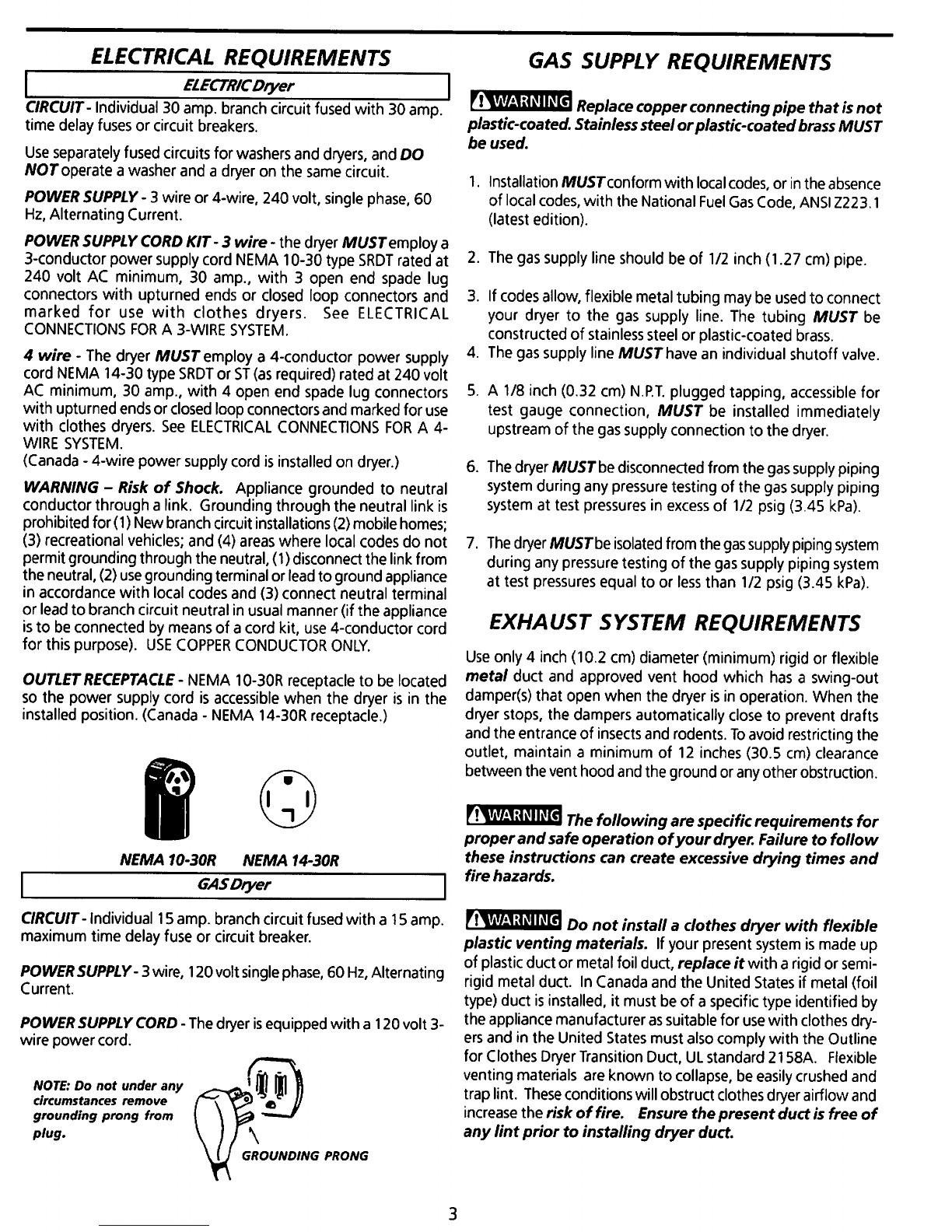
NEMA
10-30R
NEMA
14-30R
GAS
Dryer
CIRCUIT-
Individual
15
amp.
branch
circuit
fused
with a
15
amp.
maximum
time
delay
fuse or
circuit
breaker.
POWER
SUPPLY-
3
wire,
120
volt
single
phase,
60
Hz,
Alternating
Current.
POWER
SUPPLY
CORD
-
The
dryer
is
equipped
with
a
120
volt
3-
wire
power
cord.
NOTE:
Do
not
under
any
circumstances
remove
grounding
prong
from
plug.
A
WARNING
I
Replace
copper
connecting
pipe
that
is
not
plastic-coated.
Stainless
steel
or
plastic-coated
brass
MUST
be
used.
1.
Installation
Ml/STconform
with
local
codes,
or
in
the
absence
of
local
codes,
with
the
National
Fuel
Gas
Code,
ANSI
Z223.1
(latest
edition).
2.
The
gas
supply
line
should
be
of
1/2
inch
(1.27
cm)
pipe.
3.
If
codes
allow,
flexible
metal
tubing
may
be
used
to
connect
your
dryer
to
the
gas
supply
line.
The
tubing
MUST
be
constructed
of
stainless
steel
or
plastic-coated
brass.
4.
The
gas
supply
line
MUST
have
an
individual
shutoff
valve.
5.
A
1/8
inch
(0.32
cm)
N.P.T.
plugged
tapping,
accessible
for
test
gauge
connection,
MUST
be
installed
immediately
upstream
of
the
gas
supply
connection
to
the
dryer.
6.
The
dryer
MUST
be
disconnected
from
the
gas
supply
piping
system
during
any
pressure
testing
of
the
gas
supply
piping
system
at
test
pressures
in
excess
of
1/2
psig
(3.45
kPa).
7.
The
dryer
MUSTbe
isolated
from
the
gas
supply
piping
system
during
any
pressure
testing
of
the
gas
supply
piping
system
at
test
pressures
equal
to or
less
than
1/2
psig
(3.45
kPa).
EXHAUST
SYSTEM
REQUIREMENTS
Use
only
4
inch
(10.2
cm)
diameter
(minimum)
rigid
or
flexible
metal
duct
and
approved
vent
hood
which
has
a
swing-out
damper(s)
that
open
when
the
dryer
is
in
operation.
When
the
dryer
stops,
the
dampers
automatically
close
to
prevent
drafts
and
the
entrance
of
insects
and
rodents.
To
avoid
restricting
the
outlet,
maintain
a
minimum
of
12
inches (30.5
cm)
clearance
between
the
vent
hood
and
the
ground
or
any
other
obstruction.
A
WARNING
I
The
following
are
specific
requirements
for
proper
and
safe
operation
of
your
dryer.
Failure
to
follow
these
instructions
can
create
excessive
drying
times
and
fire
hazards.
Do
not
install
a
clothes
dryer
with
flexible
plastic
venting
materials.
If
your
present
system
is
made
up
of
plastic
duct
or
metal
foil
duct,
replace
/f
with
a
rigid
or
semi
rigid
metal
duct.
In
Canada
and
the
United
States
if
metal
(foil
type)
duct
is
installed,
it
must
be
of
a
specific
type
identified
by
the
appliance
manufacturer
as
suitable
for
use with
clothes
dry
ers
and
in
the
United
States
must
also
comply
with
the
Outline
for
Clothes
Dryer
Transition
Duct,
UL
standard
2158A.
Flexible
venting
materials
are
known
to
collapse,
be
easily
crushed
and
trap
lint.
These
conditions
will
obstruct
clothes
dryer
airflow
and
increase
the
risk
of
fire.
Ensure
the
present
duct
is
free
of
any
lint
prior
to
installing
dryer
duct.
GROUNDING
PRONG
ACAUTION
-
Risk
of
Fire
-
A
clothes
dryer
must
be
ex
hausted
outdoors.
Do
not
exhaust
drver
into
a
chimney,
a
wall,
a
ceiling,
an
attic,
a
crawl
space
or
any
concealed
space
of
a
building.
A
clothes
dryer
produces
combustible
lint.
If
the
dryer
is
not
exhausted
outdoors,
some
fine
lint
will
be
expelled
into
the
laundry
area.
An
accumulation
of
lint
in
any
area of
the
home
can
create
a
health
and
fire
hazard.
The
dryer
must
be
connected
to
an
exhaust
outdoors.
Regularly
inspect
the
outdoor
exhaust
opening
and
remove
any
accumulation
of
lint
around
the
outdoor
exhaust
opening
and
in
the
surrounding
area.
A
WARNING
I
Do
not
allow
combustible
materials
(for
ex
ample:
clothing,
draperies/curtains,
paper)
to
come
in
con
tact
with
exhaust
system.
The
dryer
MUSTNOTbe
exhausted
into
a
chimney,
a
wall,
a
ceiling,
or
any
concealed
space
of
a
building
which
can
accumulate
lint,
resulting
in
a
fire
hazard.
A
WARNING
Exceeding
the
length
of
duct pipe or
num
ber
of
elbows
allowed
in
the
"MAXIMUM
LENGTH"
charts
can
cause
an
accumulation
of
lint
in
the
exhaust
system.
Plug
ging
the
system
could
create
a
fire
hazard,
as
well
as increase
drying
times.
A
WARNING
I
Do
not
screen
the
exhaust
ends
of
the
vent
system,
nor
use
any
screws,
rivets
or other
fastening
means
that
extend
into
the
duct
and
catch
lint
to
assemble
the
exhaust
system.
Lint
can
become
caught
in
the
screen,
on
the
screws
or
rivets,
clogging
the
duct
work
and
creating
a
fire
haz
ard
as
well
as increasing
drying
times.
Use
an
approved
vent
hood
to
terminate
the
duct
outdoors,
and
seal
all
joints
with
duct
tape.
All
male
duct
pipe
fittings
MUSTbe
installed
downstream
with
the
flow
of
air.
A
WARNING
,.
—........
J
Explosion
hazard.
Do
not
install
the
dryer
where
gasoline
or
other
flammables
are
kept
or
stored.
If
the
dryer
is
installed
in
a
garage,
it
must
be
a
minimum
of
18
inches
(45.7
cm)
above
the
floor.
Failure
to
do
so
can
result
in
death,
explosion,
fire
or
burns.
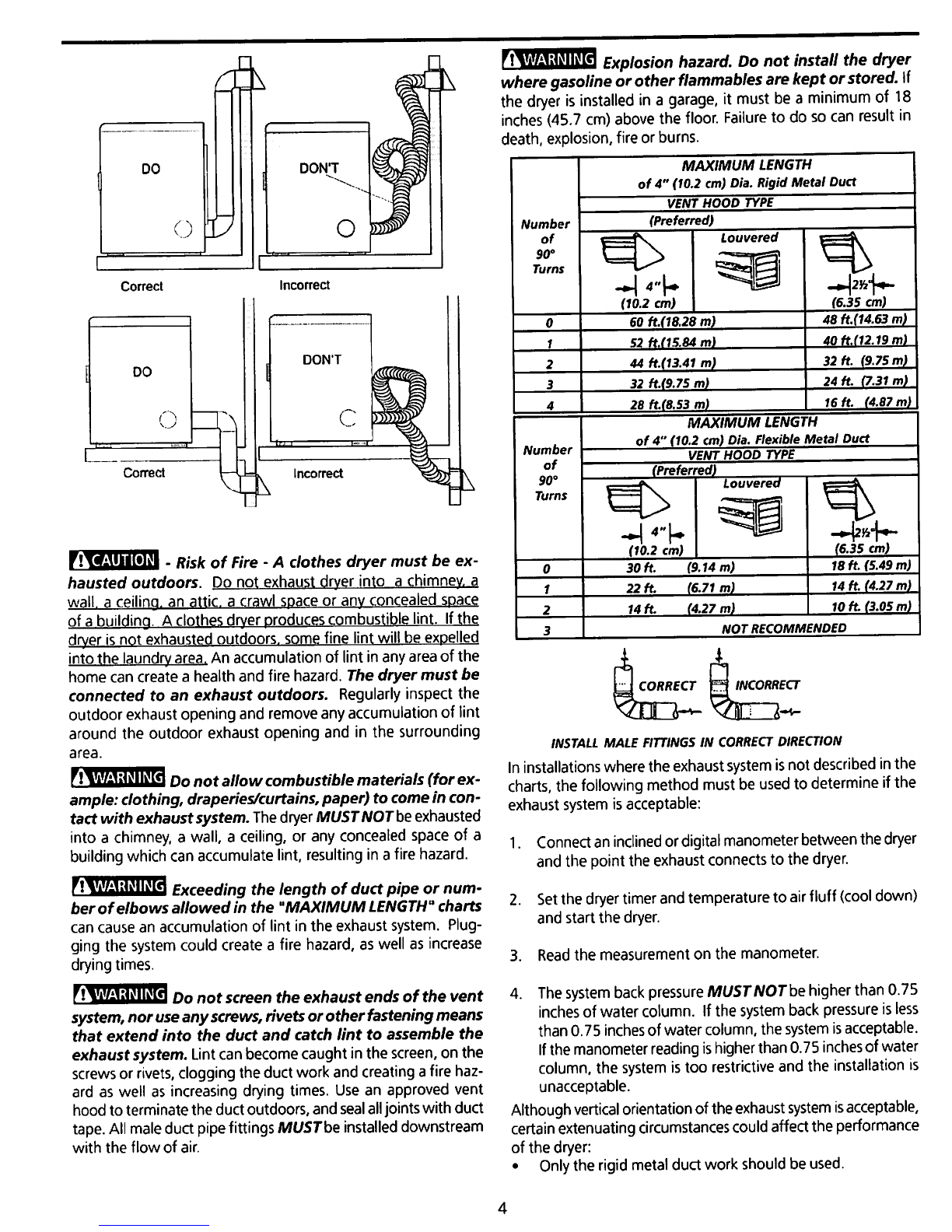
Number
of
90"
Turns
Number
of
90°
Turns
MAXIMUM
LENGTH
of
4"
(10.2
cm)
Dia.
Rigid
Metal
Duct
VENT
HOOD
TYPE
(Preferred)
| 1
(10.2
cm)
Louvered
60
ft.(18.28
m)
52
ft.(1S.84
m)
44
tt.(13.41
m)
32
HA9.7S
m)
28
ft.(8.53
m)
4H
(6.3S
cm)
48
ft.(14.63
m)
40ft.(12.19m)
32
ft.
(9.75
m)
24
ft.
(7.31m)
16
ft.
(4.87
m)
MAXIMUM
LENGTH
of
4"
(10.2
cm)
Dia.
Flexible
Metal Duct
VENT
HOOD
TYPE
(Preferred)
(10.2
cm)
Louvered
30
ft.
(9.14
m)
22
ft.
(6.71
m)
14
ft.
(4.27
m)
H
(6.35
cm)
18
ft.
(5.49
m)
14
ft.
(4.27
m)
10
ft
(3.05
m)
NOT
RECOMMENDED
CORRECT
W
INCORRECT
INSTALL
MALE
FITTINGS IN
CORRECT
DIRECTION
In
installations
where
the
exhaust
system
is
not
described
in
the
charts,
the
following
method
must
be
used
to
determine
if
the
exhaust
system
is
acceptable:
1.
Connect
an
inclined
or
digital
manometer
between
the
dryer
and
the
point
the
exhaust
connects
to
the
dryer.
2.
Set
the
dryer
timer
and
temperature
to
air
fluff
(cool
down)
and
start
the
dryer.
3.
Read
the
measurement
on
the
manometer.
4.
The
system
back
pressure
MUSTNOTbe
higher
than 0.75
inches
of
water
column.
If
the
system
back
pressure
is
less
than 0.75
inches
of
water
column,
the
system
is
acceptable.
If
the
manometer
reading
is
higher
than
0.75
inches
of
water
column,
the
system
is
too
restrictive
and
the
installation
is
unacceptable.
Although
vertical
orientation
of
the
exhaust
system
is
acceptable,
certain
extenuating
circumstances
could
affect
the
performance
of
the
dryer:
•
Only
the
rigid
metal
duct
work
should
be
used.
•
Venting
vertical
through
a
roof
may
expose
the
exhaust
system
to
down
drafts
causing
an
increase
in
vent
restriction.
•
Running
the
exhaust
system
through
an
uninsulated area
may
cause
condensation
and
faster
accumulation
of
lint.
•
Compression
or
crimping
of
the
exhaust
system
will
cause
an
increase
in
vent
restriction.
The
exhaust
system
should
be
inspected
and
cleaned
a
minimum
of
every
18
months
with
normal
usage.
The
more
the
dryer
is
used,
the
more
often
you
should
check
the
exhaust
system
and
vent
hood
for
proper
operation.
EXHAUST
DIRECTION
All
dryers
shipped
from
the
factory
are
set
up
for
rear
exhausting.
However,
on
electric
dryers,
exhausting
can
be
to
the
right
or
left
side
of
the
cabinet
or
the
bottom
of
the
dryer.
On
gas
dryers,
exhausting
can
be
to
the
right
side
of
the
cabinet
or
the
bottom
of
the
dryer.
Directional
exhausting
can
be
accomplished
by
install
ing
Exhaust
Kit,
P/N
131456800,
available
through
your
parts
dis
tributor.
Follow
the
instructions
supplied
with
the
kit.
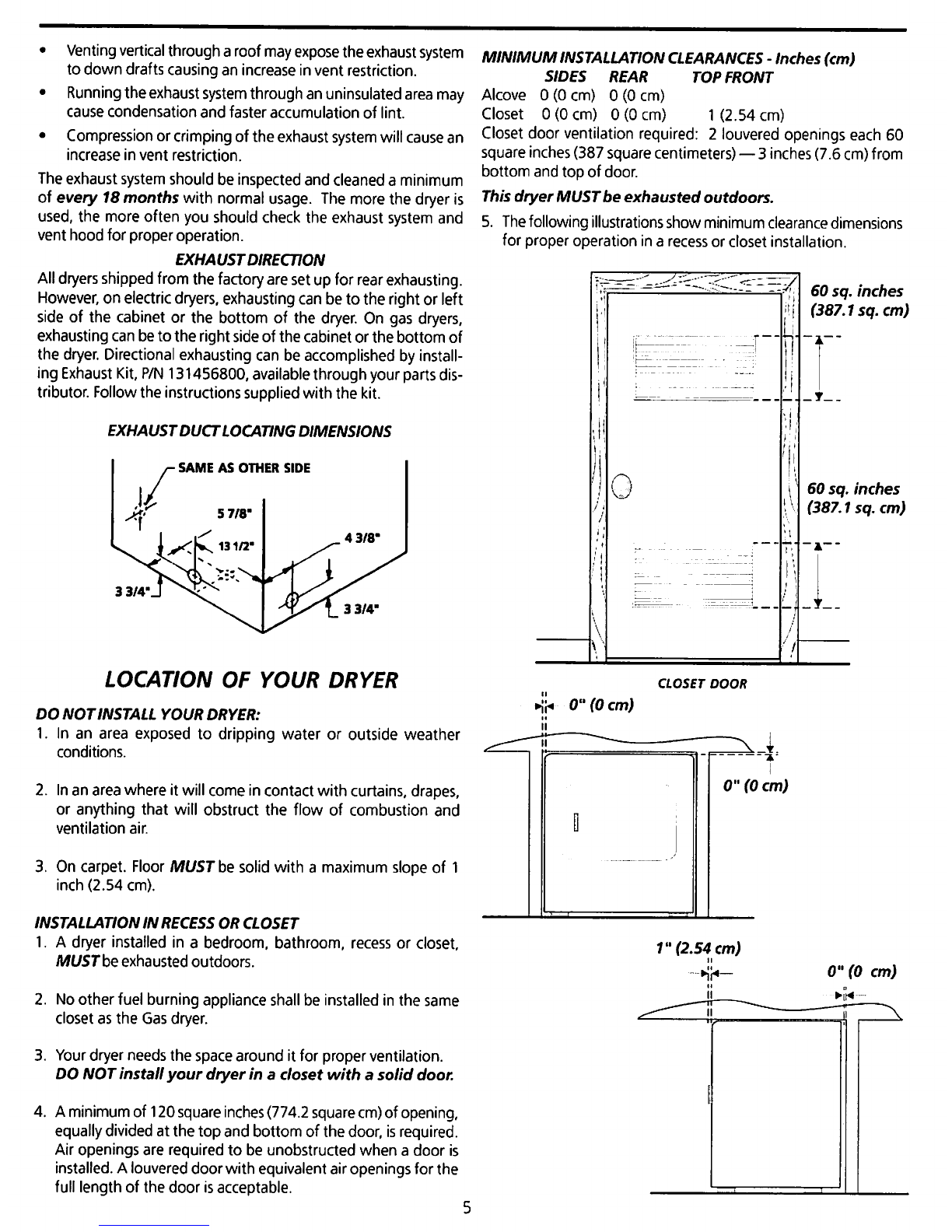
EXHAUST
DUCT
LOCATING
DIMENSIONS
3
3/4'
3
3/4"
LOCATION
OF
YOUR
DRYER
DO
NOT
INSTALL
YOUR
DRYER:
1.
In
an
area
exposed
to
dripping
water
or
outside
weather
conditions.
2.
In
an
area
where
it
will
come
in
contact
with
curtains,
drapes,
or
anything
that
will
obstruct
the
flow
of
combustion
and
ventilation
air.
3.
On
carpet.
Floor
MUST
be
solid
with
a
maximum
slope
of
1
inch
(2.54
cm).
INSTALLATION
IN
RECESS
OR
CLOSET
1.
A
dryer
installed
in
a
bedroom,
bathroom,
recess
or
closet,
MUST
be
exhausted
outdoors.
2.
No
other
fuel
burning
appliance
shall
be
installed
in
the
same
closet
as
the
Gas
dryer.
3.
Your
dryer
needs
the
space
around
it
for
proper
ventilation.
DO
NOT
install
your
dryer
in
a
closet
with
a
solid door.
4.
A
minimum
of
120
square
inches
(774.2
square
cm)
of
opening,
equally
divided
at
the
top
and
bottom
of
the
door,
is
required.
Air
openings
are
required
to
be
unobstructed
when
a
door
is
installed.
A
louvered
door
with
equivalent
air
openings
for
the
full
length
of
the
door
is
acceptable.
MINIMUM
INSTALLATION
CLEARANCES
-
Inches
(cm)
SIDES
REAR
TOP
FRONT
Alcove
0
(0
cm) 0
(0
cm)
Closet
0(0
cm) 0
(0
cm)
1
(2.54
cm)
Closet
door
ventilation
required:
2
louvered
openings
each
60
square
inches
(387
square
centimeters)
—
3
inches
(7.6
cm)
from
bottom
and
top
of
door.
This
dryer
MUST
be
exhausted
outdoors.
5.
The
following
illustrations
show
minimum
clearance
dimensions
for
proper
operation
in
a
recess
or
closet
installation.
i
\
\
,1
i ;
!
0
i
!
f
\
r
■
:
--
\
-
"-I
—-—i
i
/ 6
I
(387.1
sq.
cm)
i
t
60
sq.
inches
\
(387.1
sq.
cm)
T
—J
/
CLOSET
DOOR
0"
(0
cm)
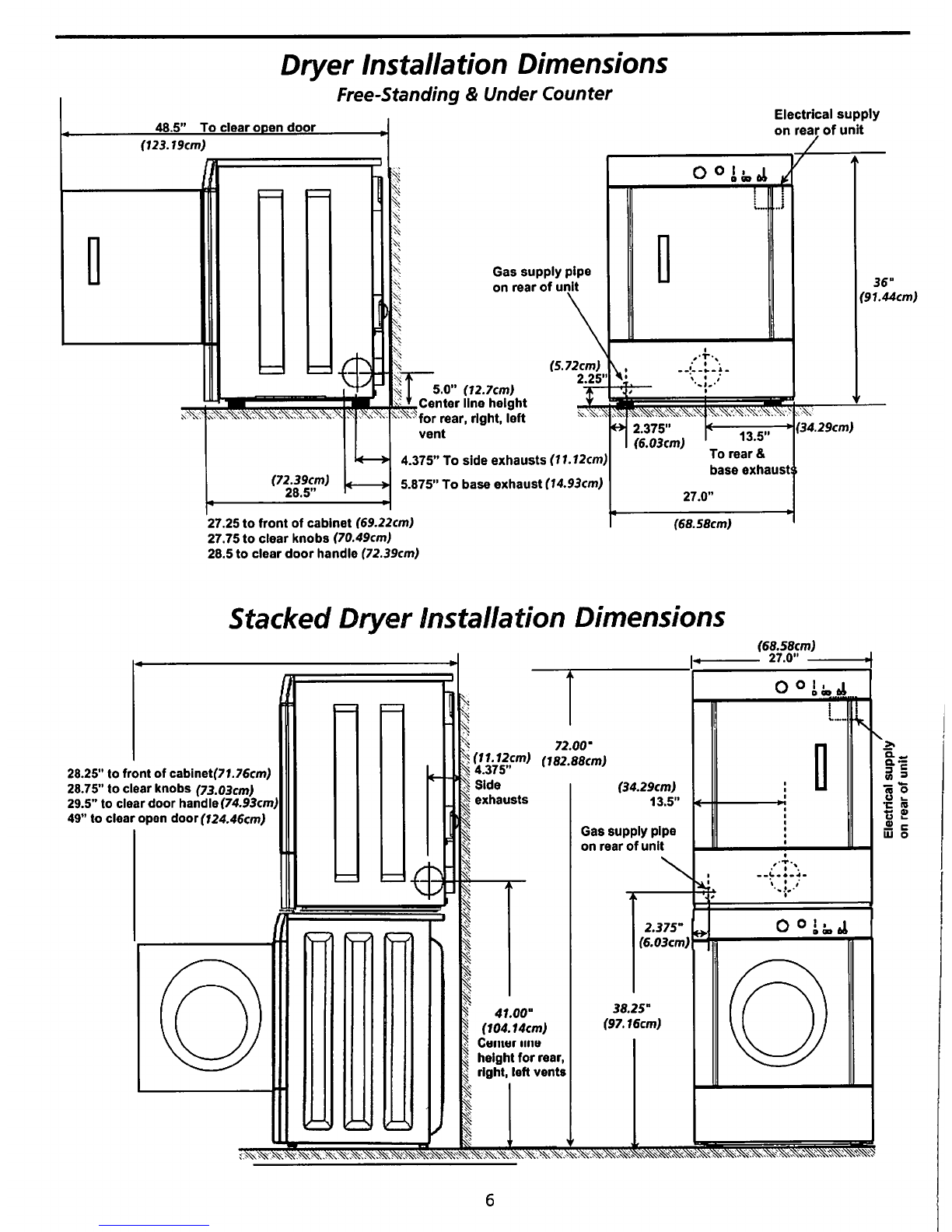
Dryer
Installation
Dimensions
Free-Standing
&
Under
Counter
Gas
supply
pipe
on
rear
of
unit
J
ff
5.0"
si
»
Heritor
(12.7cm)
Center
line
height
for
rear,
right,
left
vent
(5.72cm)
2.25"
4.375"
To
side
exhausts
(11.12cm)
5.875"
To
base
exhaust
(14.93cm)
27.25
to
front
of
cabinet
(69.22cm)
27.75
to
clear
knobs
(70.49cm)
28.5
to
clear
door
handle
(72.39cm)
2.375"
(6.03cm;
Electrical
supply
on
rear
of
unit
13.5"
To
rear
&
base
exhaust
27.0"
(68.58cm)
36"
(91.44cm)
(34.29cm)
Stacked
Dryer
Installation
Dimensions
(68.58cm)
27.0"
28.25"
to front
of
cabinet(7J.76cm;
28.75"
to
clear
knobs
(73.03cm)
29.5"
to
clear
door
handle
(74.93cm)
49"
to
clear
open
door
(124.46cm)
Gas
supply
pipe
on
rear
of
unit
height
for
rear,
right,
left
vents
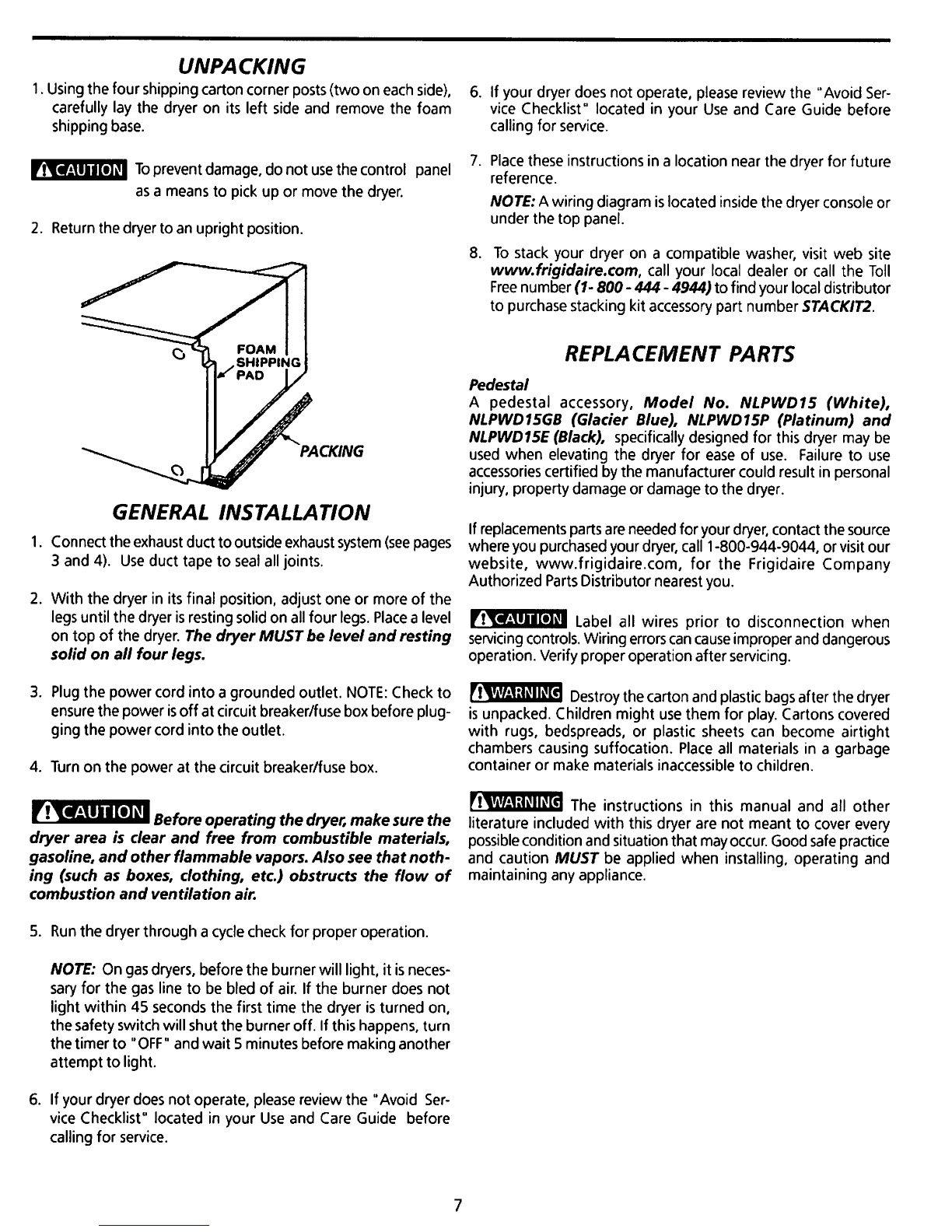
UNPACKING
1.
Using the
four
shipping
carton
corner
posts
(two
on
each
side),
carefully
lay
the
dryer
on
its
left
side
and
remove
the
foam
shipping
base.
A
CAUTION
To
prevent
damage,
do
not use
the
control
panel
as
a
means
to
pick
up
or
move
the
dryer.
2.
Return
the
dryer
to
an
upright
position.
PACKING
GENERAL
INSTALLATION
1.
Connect
the
exhaust
duct
to
outside
exhaust
system
(see
pages
3
and
4).
Use
duct
tape
to
seal
all
joints.
2.
With
the
dryer
in
its
final
position,
adjust
one
or
more
of
the
legs
until
the
dryer
is
resting
solid
on
all
four
legs.
Place
a
level
on
top
of
the
dryer.
The
dryer
MUST
be
level
and
resting
solid
on
all
four
legs.
3.
Plug
the
power
cord
into
a
grounded
outlet.
NOTE:
Check
to
ensure
the
power
is
off
at
circuit
breaker/fuse
box
before
plug
ging
the
power
cord
into
the
outlet.
4.
Turn
on
the
power
at
the
circuit
breaker/fuse
box.
f-VfiVimm
Before
operating the
dryer,
make
sure
the
dryer
area
is
clear
and
free
from
combustible
materials,
gasoline,
and
other
flammable
vapors.
Also
see
that
noth
ing
(such
as
boxes,
clothing,
etc.)
obstructs
the
flow
of
combustion
and
ventilation
air.
5.
Run
the
dryer
through
a cycle
check
for
proper
operation.
/VO7JF:
On
gas
dryers,
before
the
burner
will
light,
it
is
neces
sary
for
the
gas
line
to
be
bled
of
air.
If
the
burner
does
not
light
within
45
seconds
the
first
time
the
dryer
is
turned
on,
the
safety
switch
will
shut
the
burner
off.
If
this
happens,
turn
the
timer
to
"OFF"
and
wait
5
minutes
before
making
another
attempt
to
light.
6.
If
your
dryer
does
not
operate,
please
review
the
"Avoid
Ser
vice
Checklist"
located
in
your
Use
and
Care
Guide
before
calling
for
service.
6.
If
your
dryer
does
not
operate, please
review
the
"Avoid
Ser
vice
Checklist"
located
in
your
Use
and
Care
Guide
before
calling
for
service.
7.
Place
these
instructions
in
a
location
near
the
dryer
for
future
reference.
NOTE:
A
wiring
diagram
is
located
inside
the
dryer
console
or
under
the
top
panel.
8.
To
stack
your
dryer
on
a
compatible
washer,
visit
web
site
www.frigidaire.com,
call
your
local
dealer
or
call
the
Toll
Free
number
(1-
800
-
444
-
4944)
to
find
your
local
distributor
to
purchase
stacking
kit
accessory
part
number
STACKIT2.
REPLACEMENT
PARTS
Pedestal
A
pedestal
accessory.
Model
No.
NLPWD1S
(White),
NLPWD15GB
(Glacier
Blue),
NLPWD15P
(Platinum)
and
NLPWD15E
(Black),
specifically
designed
for
this
dryer
may
be
used
when
elevating
the
dryer
for
ease
of
use.
Failure
to
use
accessories
certified
by
the
manufacturer
could
result
in
personal
injury,
property
damage
or
damage
to
the
dryer.
If
replacements
parts
are
needed
for
your
dryer,
contact
the
source
where
you
purchased
your
dryer,
call
1
-800-944-9044,
or
visit
our
website,
www.frigidaire.com,
for
the
Frigidaire
Company
Authorized
Parts
Distributor
nearest
you.
ACAUTION
Label
all
wires
prior
to
disconnection
when
servicing
controls.
Wiring
errors
can
cause
improper
and
dangerous
operation.
Verify
proper
operation
after
servicing.
A
WARNING
Destroy
the carton
and
plastic
bags
after
the
dryer
is
unpacked.
Children
might
use
them
for
play.
Cartons
covered
with
rugs,
bedspreads,
or
plastic
sheets
can
become
airtight
chambers
causing
suffocation.
Place
all
materials
in
a
garbage
container
or
make
materials
inaccessible to
children.
A
WARNING
The
instructions
in
this
manual and
all
other
literature
included
with
this
dryer
are
not
meant
to
cover
every
possible
condition
and
situation
that
may
occur.
Good
safe
practice
and
caution
MUST
be
applied
when
installing,
operating
and
maintaining
any
appliance.
MOBILE
HOME
INSTALLATION
1.
Dryer
MUST
be
exhausted
outside
(outdoors,
not
beneath
the
mobile
home)
using
metal
ducting
that
will
not
support
combustion.
Metal
ducting
must
be
4
inches
(10.16
cm)
in
diameter
with
no
obstructions.
Rigid
metal
duct
is
preferred.
2.
If
dryer
is
exhausted
through
the
floor
and
area
beneath
the
mobile
home
is
enclosed,
the
exhaust
system
MUST
terminate
outside
the
enclosure
with
the
termination
securely
fastened
to
the
mobile
home
structure.
3.
When
installing
a
gas
dryer
into
a
mobile
home,
a
provision
must
be
made
for
outside
make
up
air.
This
provision
is
to
be
not
less
than
twice
the
area
of
the
dryer
exhaust
outlet.
4.
This
dryer
MUST
be
fastened
to
the
floor.
Mobile
Home
Installation
Kit
No.
346764
is
available
from
your
dealer.
5.
Refer
to
pages
2
and
3
for
other
important
venting
requirements.
6.
Installation
MUST
conform
to
current
Manufactured
Home
Construction
&
Safety
Standard
(which
is
a
Federal
Regulation
Title
24
CFR-Part
32-80)
or
when
such
standard
is
not
applicable,
with
American
National
Standard
for
Mobile
Homes.
A
WARNING
I
The
dryer
is
designed
under
ANSI
Z
21.5.1
or
ANSI/
UL2158
-
CAN/CSA
C22.2
(latest
editions)
for
HOME
USE
only.
Correct
Incorrect
REVERSING
DOOR
SWING
Solid
Door
Reversing
Instructions:
1.
Open
door
and
remove
four
(4)
plugs
in
the
door
opening
opposite
the
hinges.
Retain
all
parts
for
uses
later,
un
less
otherwise
noted.
Note:
Use
care
in
removing
plugs
in
not
scratching
paint
on
the
front
panel.
REMOVE
4
SCREWS
(ONE
FROM
EACH
HINGE
FIRST)
2.
Begin
removing
the
four
(4)
screws
that
attach
the
hinge
to
the
front
panel.
For
best
results,
start
by
only
removing
one
screw
per
hinge.
Then
only
loosen the
two
remaining
screws
while
firmly
holding
door
to
prevent
damage
to
hinge,
front
panel
or
door.
After
the
remaining
screws
are
loosened,
continue
to
remove
all.
3.
Place
door
handle
side
down
on
a
towel
or
pad
to
prevent
any
possible
scratches
to
door.
Remove
all
remaining
four
(4)
screws
between
hinge
and
door.
4.
Remove
four
(4)
screws
on
opposite
side
of
door.
5.
Separate
inner
door
from
outer
door
by
placing
a
flat
screw
driver
or
putty
knife.
Rotate
the
inner
door
180
degree
and
reassemble
the
two
door
halves.
6.
Install
four
(4)
screws
securing
door
halves
where
hinge
was
previously
attached.
7.
Install
four
(4)
screws
securing
hinge
to
door
assembly.
8.
Remove
striker
and
discard.
9.
Remove
square
plug
and
reinstall
in
hole
striker
was
just
removed.
10.Install
striker
(included
in
literature
bag)
into
hole
square
plug
was
previously
installed.
11.
Grasping
firmly
the
top
of
the
door,
position
the
door
near
the
door
opening
and
align
the
top
hinge
hole
to
the
top
hole
in
the
front
panel
door
opening.
Once
the
first
screw
is
started,
attach
the
second
screw
to
the
lower
hinge.
Once
both
screws
are
tightened,
install
the
remaining
two
screws.
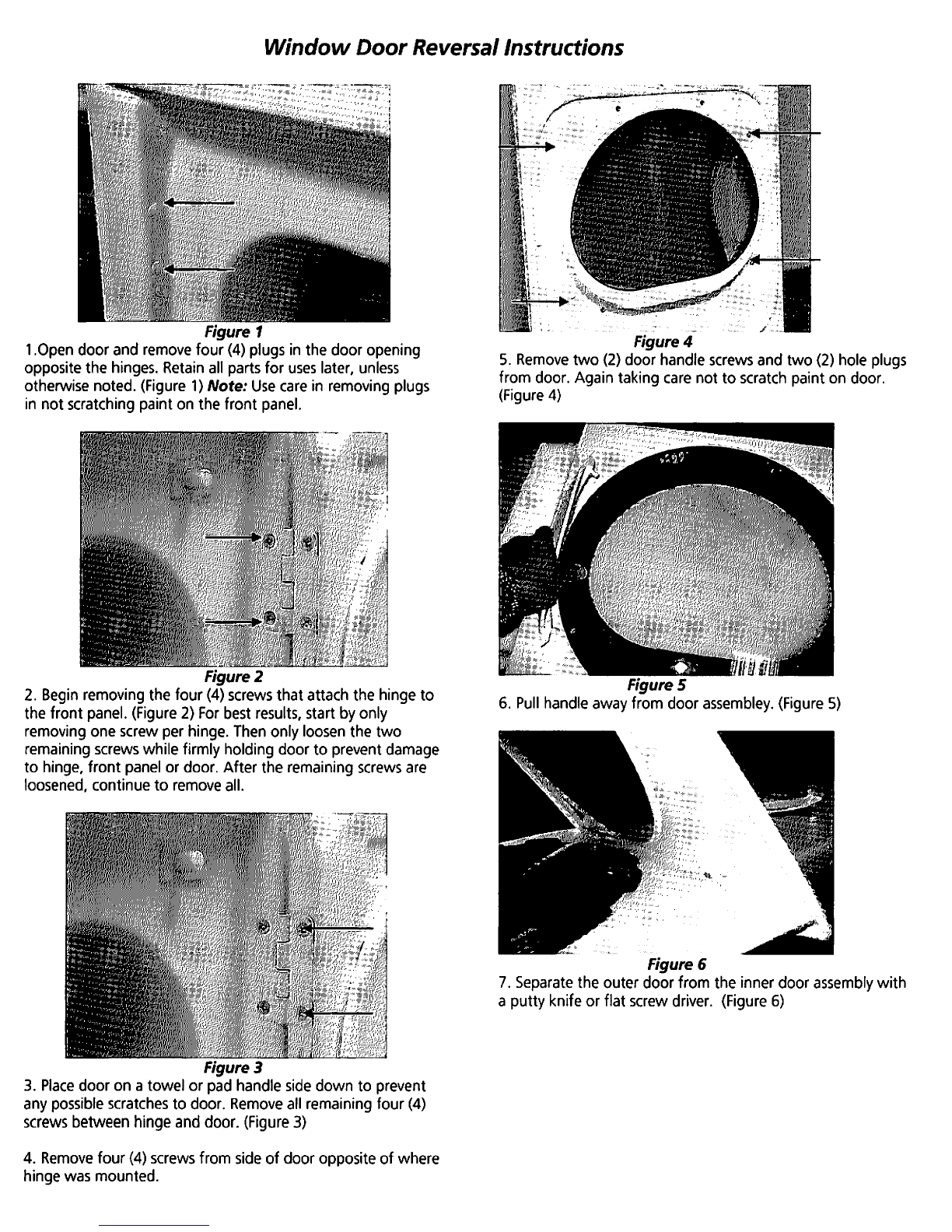
8
Window
Door
Reversal
Instructions
Figure
1
1
.Open
door
and
remove
four
(4)
plugs
in
the
door
opening
opposite
the
hinges.
Retain
all
parts
for
uses
later,
unless
otherwise
noted.
(Figure
1)
Note: Use
care
in
removing
plugs
in
not
scratching
paint
on
the
front
panel.
\>
.1
•
''ill.
r.'v:^'■''".
Figure
2
2.
Begin
removing
the
four
(4)
screws
that
attach
the
hinge
to
the
front
panel.
(Figure
2)
For
best
results,
start
by
only
removing
one
screw
per
hinge.
Then
only loosen
the
two
remaining
screws
while
firmly
holding
door
to
prevent
damage
to
hinge,
front
panel
or
door.
After
the
remaining screws
are
loosened,
continue
to
remove
all.
Figure
3
3.
Place
door
on
a
towel
or
pad
handle
side
down
to
prevent
any
possible
scratches
to
door.
Remove
all
remaining
four
(4)
screws
between
hinge
and
door.
(Figure
3)
Figure
4
5.
Remove
two
(2)
door
handle
screws
and
two
(2)
hole
plugs
from
door.
Again
taking care
not
to
scratch
paint
on
door.
(Figure
4)
Figure
5
6.
Pull
handle
away
from
door
assembley.
(Figure
5)
Figure
6
7.
Separate
the
outer
door
from
the
inner
door
assembly
with
a
putty
knife
or
flat
screw
driver.
(Figure
6)
4.
Remove
four
(4)
screws
from
side
of
door
opposite
of
where
hinge
was
mounted.
Figure
7
8.
Remove
lens
locating
screw.
(Figure
7)
Figure
8
9.
Disengaging
several
of
the
retention
tabs
and
pull
lens
away
from
the
transition
ring.
(Figure
8)
Figure
9
Figure
10
10.
Remove
two
(2)
transition
ring
plugs
and
reinstall
on
previous
handle
side.
(Figures
9
and
10)
11.
Reassemble
lens
to
transition
ring
with
holes
to
install
handle
on
right-hand
side
of
door
assembly.
For
proper
fit
insure
the
retention
tabs
on
transition
ring
are
on
top
of
lens
Figure
11
12.
Reassembly
outer
door
to
inner
door
assembly.
(Figure
11)
13.
Install
four
(4)
screws
securing
hinge
to
door
assembly
in
the
new
location,
take
note
to
place
hinge
in
correct
orientation.
14.
Install
four
(4)
screws
into
holes
that
had
secured
the
hinge.
15.
Remove
striker
and
discard.
16.
Remove
square
plug
and
reinstall
in
hole
striker
was
just
removed.
17.
Install
striker
(included
in
literature
bag)
into
hole
square
plug
was
previously
installed.
Figure
12
18.
Reinstall
door
handle
by
placing
the
handle
mounting
bosses
through
holes
in
lens
and
transition
ring
and
installing
screws
through
inner
door
and
tighten
into
handle
bosses.
(Figure
12).
19.
Grasping
firmly
the
top
of
the
door,
position
the
door
near
the
door
opening
and
align
the
top
hinge
hole
to
the
top
hole
in
the
front
panel
door
opening.
Once
the
first
screw
is
started,
attach
the
second
screw
to
the
lower
hinge.
Once
both
screws
are
tightened,
install
the
remaining
two
screws.
20.
Install
four
(4)
plugs
into
the
front
panel
door
opening
where
hinges
were
originally
installed.