www.fullwat.com
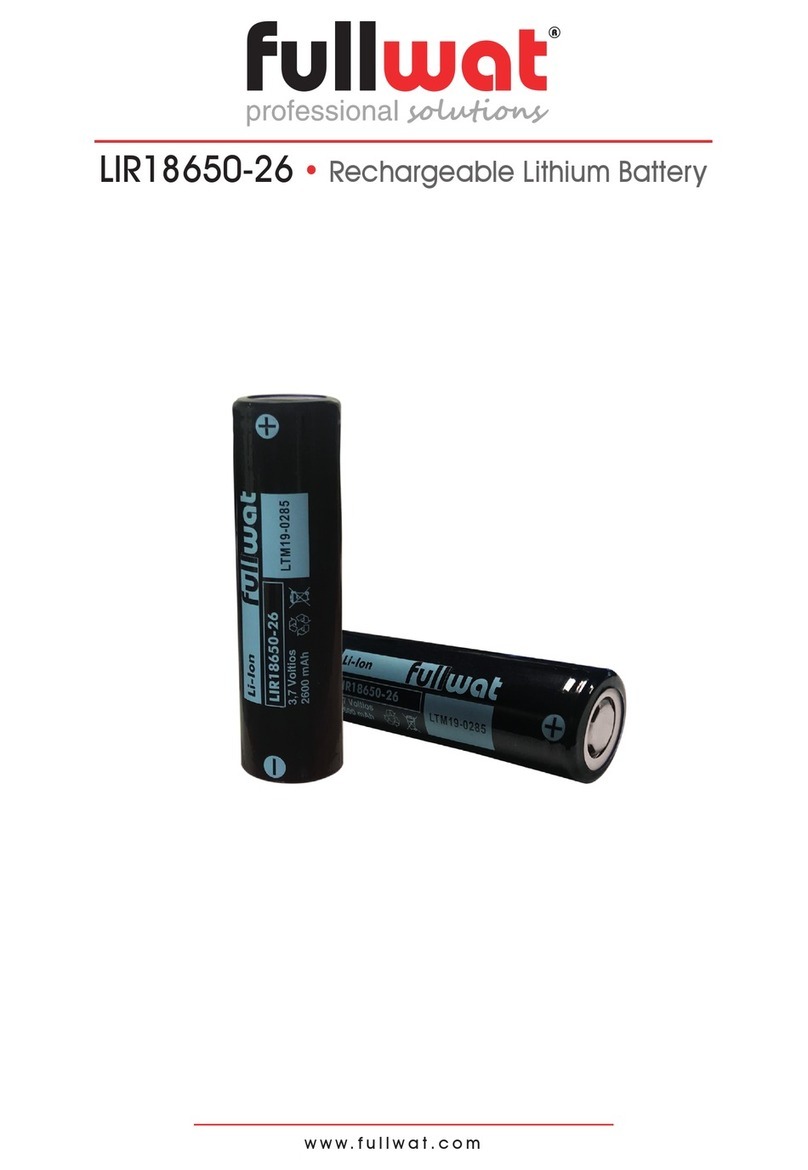
LIR17500-12 •Li-ion cylindrical rechargeable battery
4. General performance
NO. Item Test Methods and Condition Criteria
4.1 0.2C Capacity After standard charging, rest battery for 10min, then
discharging at 0.2C to voltage 3.0V, recording the
discharging time.
≥300min
4.2 Cycle Life Constant current 0.5C charge to 4.2V, then constant
voltage charge to current declines to 0.01C, rest 10min,
constant current 0.5C discharge to 3.0V, rest 10min.
Repeat above steps till continuously discharging capacity
higher than 80% of the initial capacities of the cells.
≥300 times
4.3 Capability
of keeping
electricity
20±5ºC, After standard charging, rest the battery 28days,
discharging at 0.2C to voltage 3.0V, recording the
discharging time.
≥240min
5. Environment performance
NO. Item Test Methods and Condition Criteria
5.1 Discharge at high
temperature
After standard charging, rest the cells 4h at 60±2ºC,
then discharging at 1C to voltage 3.0V, recording the
discharging time.
≥54min
5.2 Discharge at low
temperature
After standard charging, rest the cells for 16h at -20±2ºC,
then discharging at 0.2C to voltage 3.0V, recording the
discharging time.
≥210min
5.3 Thermal shock Put the cells in the oven. The temperature of the oven
is to be raised at 5±2ºC per minute to a temperature of
130±2ºC and remains 30 minutes.
No re
or explosion
6. Safe characteristic
NO. Item Test Methods and Condition Criteria
6.1 Over charge
testing
At 20±5ºC, charging cells with constant current 2C to
voltage 5.0V, Stop test till cells temperature 10ºC lower
than max temperature.
No re
or explosion
6.2 Over discharge
testing
At 20±5ºC, According to the requirements of standard
charge, the cells will be discharge to cut-off voltage,
then The discharged cell is then subjected to a forced
discharge at constant current 1C to -4.2V. The total
duration for the forced discharge testing is 90 min.
No re
or explosion
6.3 Short-circuit
testing
At 55±5ºC, After standard charging, connect cells
anode and cathode by wire which impedance less than
80±20mΩ, The cell remains on test for 24 h or until the
surface temperature declines by 20% of the maximum
temperature rise, whichever is the sooner.
No re
or explosion
Note: Above testing of safe characteristic must be with protective equipment.