4 13
OPERATION OF DEVICE
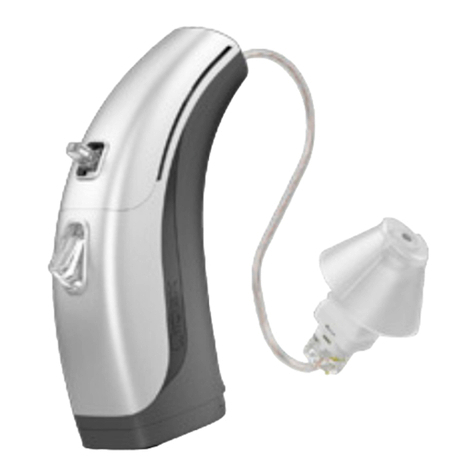
To turn your device on:
Insert battery into battery door and close the door. Insert into
your ear, then rotate the volume control slowly to the right.
To turn your device off:
Rotate volume control to the left. You should feel a slight
click when full “off” position is achieved. Do not force the
volume control, damage may occur. Or, open battery door
fully so that the battery is no longer making contact with
the device. This will allow you to leave the volume control
at your favorite listening level without
any readjustment.
Note: If you detect a high pitched
whistling sound coming from the device,
turn down the volume slightly, check the
positioning of the sound tube in your ear,
then slowly increase the volume to a desired level.
IMPORTANT NOTICE TO PROSPECTIVE HEARING AID USERS (continued)
If you have reservations about your ability to adapt to amplification, you
should inquire about the availability of a trial-rental or purchase option
program. Many hearing aid dispensers now offer programs that permit
you to wear a hearing aid for a period of time for a nominal fee after
which you may decide if you want to purchase the hearing aid.
Federal law restricts the sale of hearing aids to those individuals who have
obtained a medical evaluation from a licensed physician. Federal law per-
mits a fully informed adult to sign a waiver statement declining the medical
evaluation for religious or personal beliefs that preclude consultation with a
physician. The exercise of such a waiver is not in your best health interest
and its use is strongly discouraged.
Children with a hearing loss. In addition to seeing a physician for a
medical evaluation, a child with a hearing loss should be directed to an
audiologist for evaluation and rehabilitation since hearing loss may cause
problems in language development and the educational and social growth
of a child. An audiologist is qualified by training and experience to assist
in the evaluation and rehabilitation of a child with a hearing loss.