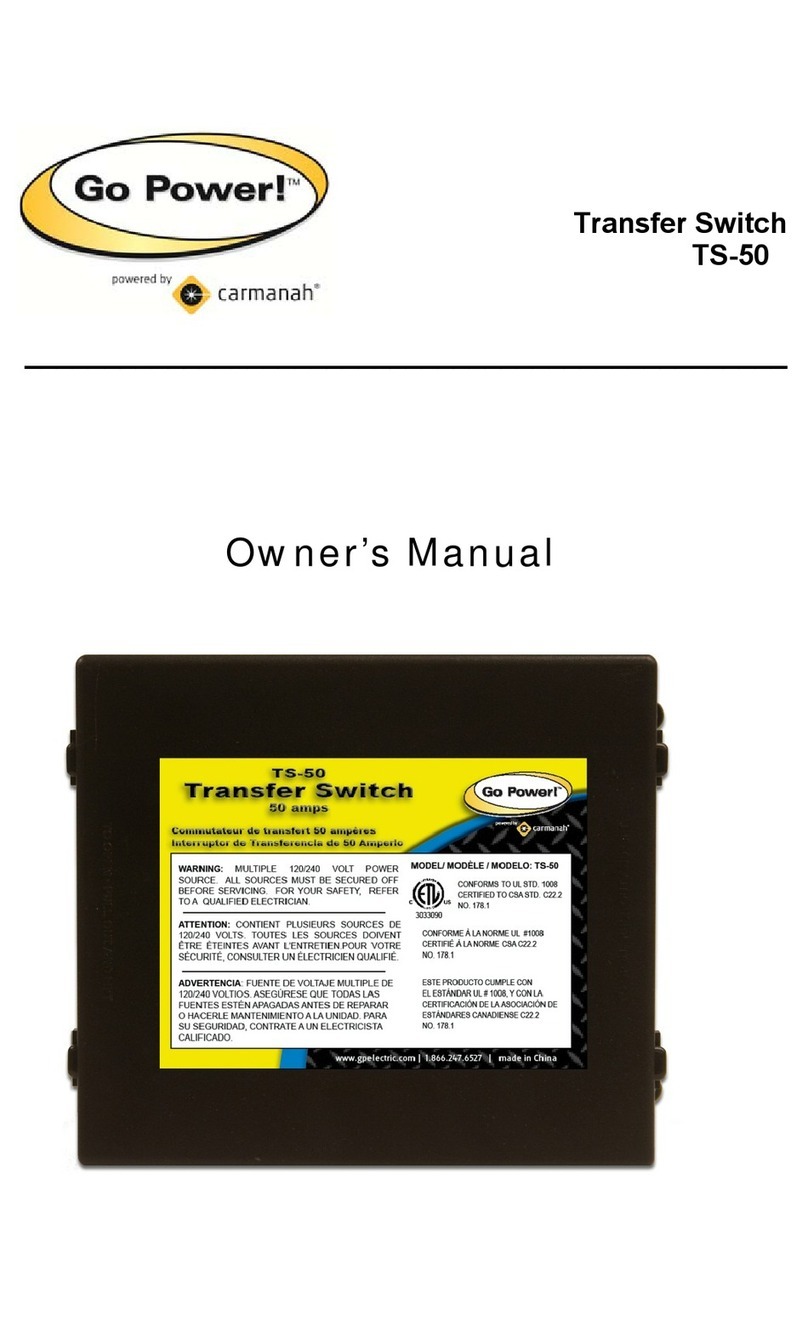
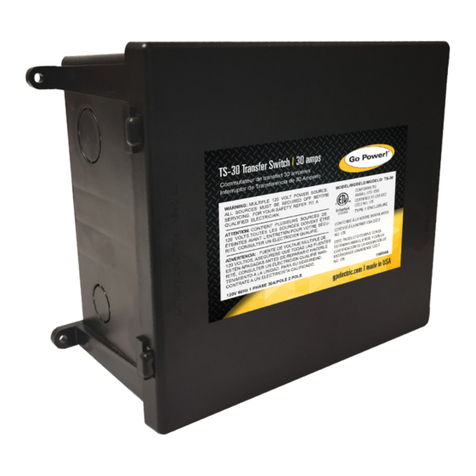
Go Power! TS-50
Owner’s Manual
8
start-up. Contactor-based transfer switches are affected by this. The compressor
will try to start, the voltage will drop, which will cause the contactor to drop out, at
which point the voltage will rise to the pre-in rush level. The contacts will chatter
when the A/C compressor kicks in, however the voltage may read normal.
Most meters are not fast enough to record this voltage drop. You can test for low
voltage readings during this inrush cycle by reading voltage at the contactor
terminals while manually holding the contactor plunger down in its closed position.
This will override the chattering condition and the meter will have time to register the
reduced voltage. If this condition exists, identify and correct the low voltage situation
before proceeding further.
4.4 PHYSICAL INTERFERENCE
Some transfer switch models have wiring connections made by wire nuts on 63
leads. Occasionally on these models, the wiring connections will get folded into the
cbox in such a manner that the wiring will interfere with the physical operation of the
relay. Visually inspect for free operation of the relay(s).
4.5 TIME DELAY BYPASS SWITCH
The time delay function in the control module on some models may be bypassed.
Relay-based transfer switches have incorporated into the control module board a
small switch that allows the technician to activate or bypass the time delay. The time
delay is necessary during generator start-up so that the generator does not have to
start under load; the delay is not necessary for powercords or inverters. Therefore in
transfer switch operation where the module is controlling a supply other than a
generator, the delay switch should be set to the bypass (ON) position. This will allow
instantaneous switching. Another time for bypassing the delay is during diagnostic
and troubleshooting efforts; if bypassing the delay causes the switch to work when it
otherwise won’t, then the time delay has malfunctioned and the board should be
replaced. To bypass the time delay, locate the switch on the end of the circuit board
and select the position on the switch marked ON. Time delay bypass is now
activated, and transfer will be instantaneous.
4.6 FAILED TIME DELAY CONTROL MODULE
It is possible for a voltage spike, etc. to cause the time delay module to fail: if this
happens the switch will no longer transfer. Transfer Switch models have a
diagnostic LED mounted on the control module circuit board. If the module is
receiving 120 VAC input and is operating properly, the LED will be lit. This means
the control module has timed for the 20-30 second delay and is now providing
power to the coil on the relay. If the module input is energized and the LED does not
light after 30 seconds, the time delay function in the module has failed, and the
module should be replaced. To verify this, try setting the time delay switch on the
board to the delay bypass position; the switch should transfer with no delay.
Note that this position will allow emergency operation until the module can be
replaced; however there will not be a 20-30 second delay for generator start-up. All
repairs should begin by unplugging and replacing the control module first. However,
if the LED is on and the switch is not working, then the control module is functioning
properly and the switch has other problems, such as a failed relay or contactor, and
the entire switch should be returned for replacement.