inoperative,
while
transmitting
or
for
any
other
purpose,
although
the
tube
heaters
remain
hot
and
read~
for
instant
use.
(4)
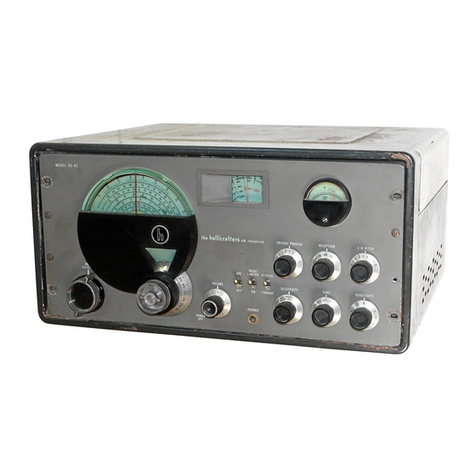
CRYStAL
PBA8IKG
Contro~..
This
control
permits
the
discrimination
of
code
signals
whose
frequencies
are
very
nearly
the
same.
The
SELECTIVITY
control
must be
set
at
one
of
its
two
crystal
selectivity
positions
When
using
the
phas
ing
control.
It
is
extremely
simple
to
attain
single
signal
c-w
reception
with
the
SX-43.
First,
set
the
RECEPTION
switch
at
CW
and
the
SELECTIVITY
control
at
CRYSTAL
SHARP.
Pick
a good
solid
c-w
signal,
preferably
a com-
mercial
station
because
a
commercial
is
likely
to
stay
on
long-enough
for
you
to
complete
the
phasing
adjustment
for
single
signal
reception.
You
will
find
on
tuning
across
this
signal
that
it
has
two
amplitudes.
Tune
first
to
the
'Weaker
of
these
two
amplitudes.
How,
turn
the
CRYSTAL
PHASING
control
until
the
'Weaker
of
tl;Le
two
amplitudes
is
reduced
to
a minimum.
Then,
tune
to
the
stronger
of
the
two
amplitudes
and
adjust
the
PITCH
control
to
a
tone
most
pleasing
to
you.
This
adjustment
for
single
signal
selecti~
itywill
hold
with
no
further
adjustment
unless
you change
the
phasing
control.
(See
Fig.
11
for
an
illustration
of
single
sig-
nal
operation.)
Ad
Jus,
phaaioB control
cucn.lIy
....Iil
Irw
..
cakcr ampli.udc
is
roiuccd
to
a minimum.
Figure
11.
Itroo.r
amplit:udc
and
then
odius, pitCh control un.il
you
jICf
Il0l.
moo.
pI
...
iDB
co
copy.
Illustration
showing
Single
Signal
Operation
-6-
8.
(5) SELECtIYlfY
Control..
This
control
de-
termines
the
sharpness
of
the
response.
Four
degrees
of
selectivity
are
provided,
raDging from
CRYSTAL
SHARP
for
c-w
code
re-
ception
under
difficult
receiving
condi-
tions
to
NORMAL
BROAD
response
for
Be
re-
ception.
..
NORMAL
BROAD
(for
high
fidelity
reception)
•
2.
NORMAL
SHARP
(for
reduced
adjacent
channel
interferences).
3.
CRYSTAL
BROAD
(similar
to
sharp
i-f
response
but
with
sharper
cutting
on
sidebands).
4.-
CRYsTAL
SHARP
(position
of
extreme
selectivity
-
practically
no
side-
band.
content).
(6)
tOlE
Control.
This
control
selects
the
tone
qualities
desired
by
the
operator.
The
types
of
response
available
are
LOW,
and
HIGH.
(a)
LOV.
The
high
audio
frequencies
are
attenuated
to
provide
a
minimum
re-
sponse
for
voice
reception
when
the
background
noise
level
is
objectionably
high.
(b)
HIGH. The
bass
and
high
frequen-
cies
;;;-
passed
at
the
same
level
there-
by
providing
as
near
a
true
reproduc-
tion
of
the
original
transmitted
signal
as
possible.
The
response
is
essen-
tially
flat
between 70 and
8,000
cycles
per
second
for
good
fidelity
reception.
(7)
CW
PlfCH
Control.
This
control
varies
the
frequency
of
the
beat
frequency
oscilla-
tor
thus
varying
the
pitch
of
the
c-w
code
signal
as
desired.
(8)
S8KSlfIYIfY
Control.
This
control
ad-
justs
the
sensitivity
by
varying
the
re-
sistance
in
the
cathodes
of
the
r-f
and
i-f
amplifiers.
Turning
the
control
to
the
right
increases
the
sensitivity.
This
cen-
trol
must
be
set
at
maximum
sensitivity
when
using
the
carrier
level
met~r.
At
any
other
setting
of
this
control,
r~adings
of
the
carrier
meter
are
meaningless.
·S"
METER
ADJUSTMENT
Adjustment
of
the
"S"
meter
control
is
per-
formed
by
varying
the
knurled
knob
located
on
the
rear
apron
of
the
receiver
chassis.
This
control
enables
yoU
to
properly
set
the
"S"