Installation
Notice: If you are installing the entire Z-Wave™ system for the first time, please refer to
the installation guide of Z-Wave™ Interface Controller before installing
HSC-ZD2102US-5.
1. Unscrew the screw fastening the rear cover and slide the rear cover down.
2. Using the screws or adhesive tape to affix the rear cover on the frame along the
opening edge of door / window.
3. Insert a CR123A battery into the battery compartment, LED will start to flash slowly
and HSC-ZD2102US-5 will go to sleep if user didn’t press the tamper switch within 10
seconds or HSC-ZD2102US-5 will send the NIF.
LED Status for Z-Wave Network:
* After power on, the red LED will flash if the HSC-ZD2102US-5 has not been included
yet.
* After power on, the red LED will go on if the HSC-ZD2102US-5 has been included.
(The LED will turn on lasting 10 seconds then go off and go to sleep mode.)
4. For “Inclusion”in (adding to) a network: Put the Z-Wave™Interface Controller into
“inclusion”mode, and following its instruction to add the HSC-ZD2102US-5 to your
controller. To get in the “inclusion”mode. Quick press the program switch of
HSC-ZD2102US-5 for sending the NIF. After sending NIF, Z-Wave will send the auto
inclusion; otherwise, HSC-ZD2102US-5 will go to sleep after 15 seconds.
For “Exclusion” from (removing from) a network: Put the Z-Wave™ Interface
Controller into “exclusion” mode, and following its instruction to delete the
HSC-ZD2102US-5 from your controller. Quick press the program switch of
HSC-ZD2102US-5 to be excluded.
Note: All user and network settings will be cleared and the device reset to factory
defaults when the device is excluded.
6. Slide back the rear cover and screw fastening with the front cover, the LED should go
off.
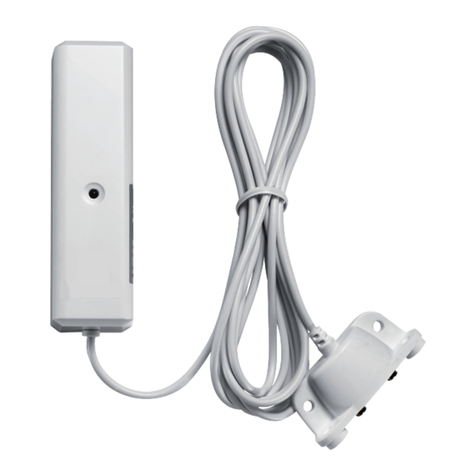
7. Fix the Magnet by using the adhesive tape or fixing screws, locate the Magnet close to
the HSC-ZD2102US-5 sensor the distance between these two devices should be in
1.9cm.
8. External Switch: If your window needs two sensors for fully monitoring. You could use
an external switch to connect with the HSC-ZD2102US-5 for extending detection. The
HSC-ZD2102US-5 has 2 normally closed contact terminals. These can be used for
additional external switch wired contacts.
(Remark: Either reed switch or external switch has been opened means “open”, but,
both of them should be closed at the same time means “close”.)
9. Awake Mode:
It will be triggering after opening the rear cover, also the red LED will keep on lasting
10 seconds and HSC-ZD2102US-5 will send “Wake Up Notification”after 10 seconds.
If HSC-ZD2102US-5 received “Wake Up No More Information”command then the red
LED will go off or it will wait 10 seconds then go off. It will proceed all the commands
after sending the “Wake Up Notification”
10. Auto Wake Up:
Use “Wake Up” command to set up the awaking time and send the wake up
notification to controller. User can use command to change the auto wake up from
10 minutes to 1 week, Interval increment is 3 minutes.
11.Battery Capacity Detection:
* Use “Battery Get” command to have the battery capacity back in %
* It will detect the battery capacity automatically
* Low Battery Auto Report (low battery is set as 2.6+/-0.1 Voltage, detects every 2
hours)
12.Association:
* Support one group with 5 nodes
* Support grouping identifier: 1
* All triggering reports & low voltage report will be sent to the associated nodes
13.Power Level Control:
* Use “Power Level Set”to set up the RF strength
* Use “Power Level Test Node Set”to test specific node’s RF sensitivity
14.Support Explorer Frame Function
15.Support OTA Firmware update from controller. Please refer to your controller manual.
Once OTA function success, please make sure to exclude the device & include
again before use the device.
16. All the rest commands depend on Z-Wave standard
17. Factory Default Reset: Trigger the rear cover switch to send the Alarm Report and
trigger the reed switch (close & open) 5 times in 10 seconds, ZD2102 will send the
“Device Reset Locally Notification”command and reset to the factory default.
(Remark: This is to be used only in the case of primary controller being inoperable or
otherwise unavailable.)