For advice on the safety and suitability of this
equipment contact your local HSS Hire Shop.
There is a serious risk of personal injury if you do
not follow all instructions laid down in this guide.
The hirer has a responsibility to ensure that all
necessary risk assessments have been completed
prior to the use of this equipment.
This equipment should only be used by an
operator who has been deemed competent to do
so by his/her employer.
This equipment should be used by an able bodied,
competent adult who has read and understood these
instructions. Anyone with either a temporary or
permanent disability, should seek expert advice before
using it.
Keep children, animals and bystanders away from
the work area. Cordon off a NO GO area using either
cones, barriers or tape, available for hire from your local
HSS Hire Shop.
Never use this equipment if you are ill,
feeling tired, or under the influence of
alcohol or drugs.
This equipment generates potentially harmful
noise levels. To comply with health and safety at
work regulations, ear defenders must be worn by
everyone in the vicinity.
Wear practical, protective clothing, gloves and
footwear. Avoid loose garments and jewellery that
could catch in moving parts, tie back long hair.
This equipment is heavy (382kg), never attempt
to lift it, always use suitable lifting equipment. This
unit can be craned by its lifting eye or moved by a
suitable forklift truck.
Ensure the work area is well lit and ventilated, if in
doubt, ask about lighting and ventilation equipment at
your local HSS Hire Shop.
Do not work near flammable gases or liquids, petrol
or paint thinner fumes for example. Keep combustible
materials at a safe distance - at least 5m.
Make sure you know how to switch this machine
OFF before you switch it ON in case you get into
difficulty.
Always switch the engine off and wait for moving
parts to come to rest before making adjustments to
it.
Engines, especially the exhausts, get very hot so switch
OFF and allow to cool before touching them.
Make sure everyone is warned of what you are
doing.
Check the condition of the equipment before use. If
it shows signs of damage or excessive wear, return it to
your local HSS Hire Shop.
COSHH information sheets are available from your local
HSS Hire Shop.
Keep the generator and other electrical equipment
dry at all times, providing it with adequate shelter from
the weather. Operating in wet or very damp conditions can
be dangerous.
If powering equipment that requires an earth, have a
qualified electrician connect the generator’s earth
terminal to an earthing point.
Always turn OFF all electrical switches before making
or breaking connections or servicing equipment
powered by the generator.
And always turn OFF the generator’s engine when
not in use and before servicing the engine itself.
Never use a generator to power computers, and
similar electronic equipment, unless you power them
via a suitable surge protection device, available for hire from
your local HSS Hire Shop.
It is essential to familiarise yourself with all the
controls before starting.
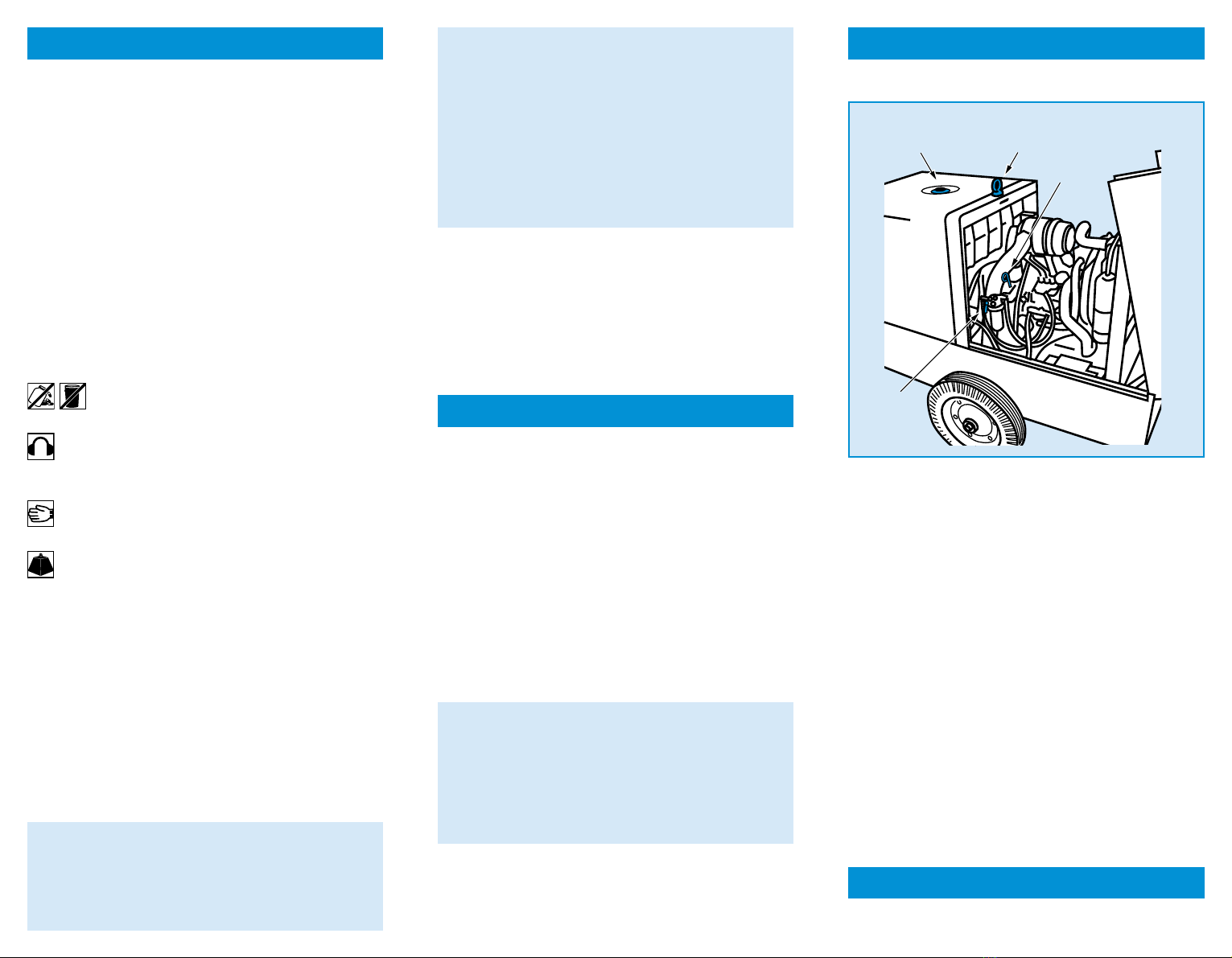
With the machine on firm level ground, open the
engine compartment cover and check fuel and oil
levels (see EQUIPMENT CARE).
If appropriate, have a qualified electrician connect the
generator’s earth terminal (labelled with a sticker marked
‘PE’) to a suitable earthing point using suitable cable.
Disconnect any cables to the generator and set the
generators voltage selector switch to the central
(OFF) position.
To start the generator, open the fuel tap, turn the
ignition key clockwise to the ‘ON’ position then depress
the preheat button for 10 to 15 seconds. Next turn the key
to ‘START’ until the engine starts, then return the key to
the ‘ON’ position.
To stop the generator, turn the key to the ‘OFF’
position.
The engine is fitted with a cut out system, which will
stop the engine if the engine overheats or the oil
pressure is too low. If the oil warning lamp illuminates
and the engine stops, allow the unit to cool down before
checking both coolant levels and oil level.
There is also a low fuel indicator lamp and if this lamp
illuminates during use, stop and refuel as described in
‘EQUIPMENT CARE’.
The generator can supply either 115V or 230V, it is
unable to supply both at the same time.
GENERAL SAFETY
Exhaust Danger
NEVER operate diesel engines indoors or in a
confined space.
The exhaust contains gases that can kill.
Safety Cut-Outs
All HSS generators have circuit breakers that cut
OFF the power if the electrics become overloaded
(due to a fault in the generator or the equipment
being powered by it). If a circuit breaker trips,
unplug everything, then reset the switch to
restore the power.
Fuel Safety
NEVER refuel while the engine is hot or running.
Never smoke or allow naked lights into the area
while refuelling.
Never inhale fuel vapour.
ALWAYS mop up any spillage as quickly as
possible, and change your clothes if you get fuel
on yourself.
ALWAYS store fuel in a purpose-made sealed
container, in a cool, safe place well away from the
work area.
GETTING STARTED
ELECTRICAL SAFETY
Engine Compartment
BASIC TECHNIQUES
Never start or stop the generator ‘on load’. Always
switch OFF and unplug all equipment powered by it.
Keep power supply cables and leads out of harm’s
way. Never trail them through water, over sharp edges or
where they could trip someone.
Fuel Tap
Fuel Tank Lifting Eye
Dipstick