manuals.online logo
Brands
  1. Home
  2. •
  3. Brands
  4. •
  5. HyperLink Technologies
  6. •
  7. Antenna
  8. •
  9. HyperLink Technologies HG2415Y User manual

HyperLink Technologies HG2415Y User manual

Other HyperLink Technologies Antenna manuals

HyperLink Technologies HG2415G User manual

HyperLink Technologies

HyperLink Technologies HG2415G User manual

HyperLink Technologies HG2408P User manual

HyperLink Technologies

HyperLink Technologies HG2408P User manual

HyperLink Technologies HG2430G User manual

HyperLink Technologies

HyperLink Technologies HG2430G User manual

HyperLink Technologies HyperGain HG2424G User manual

HyperLink Technologies

HyperLink Technologies HyperGain HG2424G User manual

Popular Antenna manuals by other brands

DAVIS Windex AV 3160 installation instructions

DAVIS

DAVIS Windex AV 3160 installation instructions

Belden Hirschmann BAT-ANT-N-14G-IP23 Mounting instruction

Belden

Belden Hirschmann BAT-ANT-N-14G-IP23 Mounting instruction

Vtronix YHK Fitting instructions

Vtronix

Vtronix YHK Fitting instructions

KVH Industries TracVision 6 Technical manual

KVH Industries

KVH Industries TracVision 6 Technical manual

Leica Geosystems GS10 user manual

Leica Geosystems

Leica Geosystems GS10 user manual

Sirio Antenne Gain-Master manual

Sirio Antenne

Sirio Antenne Gain-Master manual

Sony VCA-41 Installation/connections

Sony

Sony VCA-41 Installation/connections

ZCG Y100 Series installation guide

ZCG

ZCG Y100 Series installation guide

Advantech Wireless INTREPID120 Assembly instructions

Advantech Wireless

Advantech Wireless INTREPID120 Assembly instructions

Cerio ANT-10AO installation guide

Cerio

Cerio ANT-10AO installation guide

Alfa Network APA-L01 Specifications

Alfa Network

Alfa Network APA-L01 Specifications

Naval PR-422CA Operation manual

Naval

Naval PR-422CA Operation manual

Feig Electronic ID ISC.ANTH200/200 Series manual

Feig Electronic

Feig Electronic ID ISC.ANTH200/200 Series manual

TERK Technologies TV44 owner's manual

TERK Technologies

TERK Technologies TV44 owner's manual

TERK Technologies SIR3 owner's manual

TERK Technologies

TERK Technologies SIR3 owner's manual

Directive Systems & Engineering DSE2324LYRMK quick start guide

Directive Systems & Engineering

Directive Systems & Engineering DSE2324LYRMK quick start guide

HP J8999A instructions

HP

HP J8999A instructions

MobilSat MSP-S Mounting instructions

MobilSat

MobilSat MSP-S Mounting instructions

manuals.online logo
manuals.online logoBrands
  • About & Mission
  • Contact us
  • Privacy Policy
  • Terms and Conditions

Copyright 2025 Manuals.Online. All Rights Reserved.

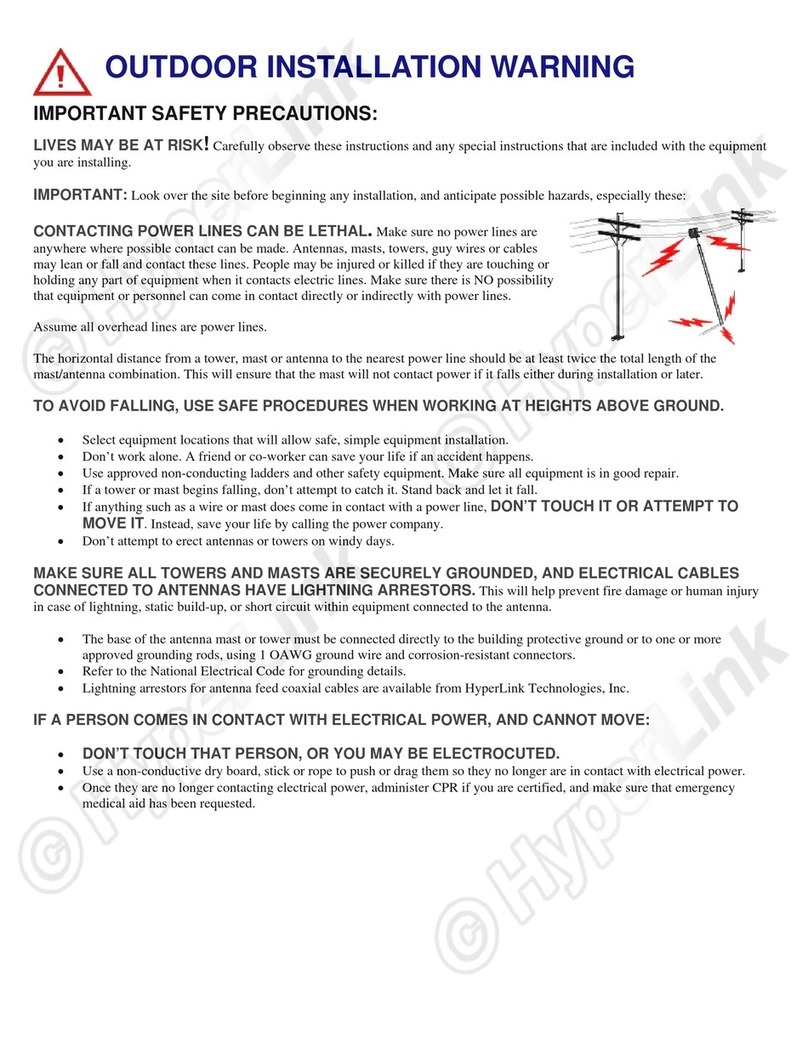
LIVES MAY BE AT RISK!Carefully observe these instructions and any special instructions that are included with the equipment you are installing.
IMPORTANT: Look over the site before beginning any installation, and anticipate possible hazards, especially these:
CONTACTING POWER LINES CAN BE LETHAL.Make sure no power lines are anywhere where possible
contact can be made. Antennas, masts, towers, guy wires or cables may lean or fall and contact these lines.
People may be injured or killed if they are touching or holding any part of equipment when it contacts electric lines.
Make sure there is NO possibility that equipment or personnel can come in contact directly or indirectly with power lines.
Assume all overhead lines are power lines.
The horizontal distance from a tower, mast or antenna to the nearest power line should be at least twice the total length of the mast/antenna combination.
This will ensure that the mast will not contact power if it falls either during installation or later.
TO AVOID FALLING, USE SAFE PROCEDURES WHEN WORKING AT HEIGHTS ABOVE GROUND.
• Select equipment locations that will allow safe, simple equipment installation.
• Don’t work alone. A friend or co-worker can save your life if an accident happens.
• Use approved non-conducting ladders and other safety equipment. Make sure all equipment is in good repair.
• If a tower or mast begins falling, don’t attempt to catch it. Stand back and let it fall.
• If anything such as a wire or mast does come in contact with a power line, DON’T TOUCH IT OR ATTEMPT TO MOVE IT. Instead, save your life
by calling the power company.
• Don’t attempt to erect antennas or towers on windy days.
MAKE SURE ALL TOWERS AND MASTS ARE SECURELY GROUNDED, AND ELECTRICAL CABLES CONNECTED TO ANTENNAS
HAVE LIGHTNING ARRESTORS. This will help prevent fire damage or human injury in case of lightning, static build-up, or short circuit within
equipment connected to the antenna.
• The base of the antenna mast or tower must be connected directly to the building protective ground or to one or more approved grounding rods, using 1
OAWG ground wire and corrosion-resistant connectors.
• Refer to the National Electrical Code for grounding details.
• Lightning arrestors for antenna feed coaxial cables are available from HyperLink Technologies, Inc.
IF A PERSON COMES IN CONTACT WITH ELECTRICAL POWER, AND CANNOT MOVE:
•DON’T TOUCH THAT PERSON, OR YOU MAY BE ELECTROCUTED.
• Use a non-conductive dry board, stick or rope to push or drag them so they no longer are in contact with electrical power.
• Once they are no longer contacting electrical power, administer CPR if you are certified, and make sure that emergency medical aid has been requested.
IP-00009 Rev. A – 10/07 Page 2/2 Copyright © This drawing is property of HyperLink Technologies, Inc. All rights reserved.
IMPORTANT SAFETY PRECAUTIONS:
HyperLink Technologies, Inc. – 1201 Clint Moore Rd. – Boca Raton, Florida 33487 USA
561-995-2256 • www.hyperlinktech.com • Sales@hyperlinktech.com

HyperLink Technologies, Inc. – 1201 Clint Moore Rd. – Boca Raton, Florida 33487 USA
561-995-2256 • www.hyperlinktech.com • Sales@hyperlinktech.com
IP-00009 Rev. A – 10/07 Page 1/2
HyperLink
Technologies,INC.
Copyright © This drawing is property of HyperLink Technologies, Inc. All rights reserved.
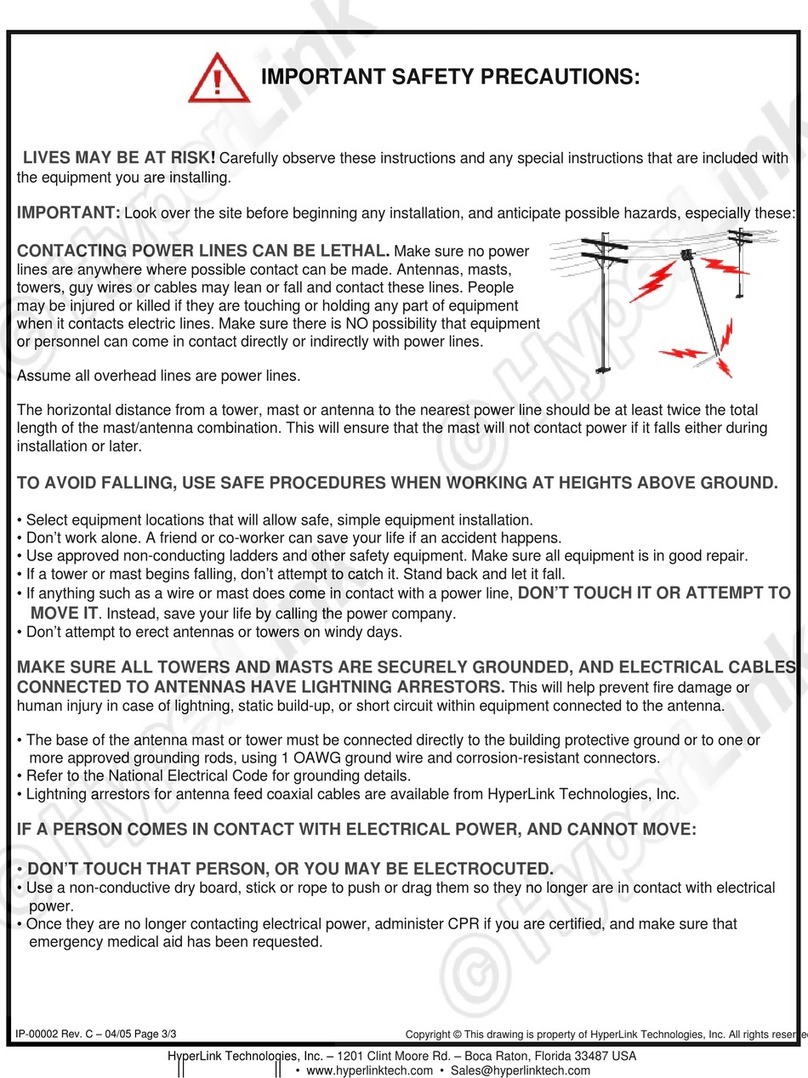
INSTALLATION INSTRUCTIONS: HG2415Y
Location
1. The antenna receives and transmits within a horizontal angle of 30°.
Locate the antenna so linked equipment will be in this beam. The
center of the antenna beam is the long axis of the antenna, with the
beam pointing away from the mast.
2. Surrounding objects such as metal structures, trees, power lines,
other antennas, etc. will reduce antenna efficiency and may block
signals. Choose a location that is high and clear of obstruction.
3. Make absolutely sure that the location is safe, especially from
possible contact with power lines. See warning on back.
Mounting
1. The antenna can be vertical polarized mounted (Figure A) or
horizontal polarized mounted (Figure B). It is shipped from the
factory in the vertical polarized position.
2. Mount the antenna as shown, ensuring U-Bolt nuts are securely
tightened to prevent antenna shift in high wind.
3. The antenna can be mounted in a up or down tilt position from 0-60°.
See below for mounting options.
0°
10°
40°
50°
60°
Variable
Mounting
0°-60°
Fixed 0° Mounting
Figure A
Vertical Polarized Position
(As shipped from factory)
(2) Drain Hole Plugs
(2) Open Drain Holes
on bottom
Side exiting cable
(2) Drain Hole Plugs
(2) Open Drain Holes
on bottom
Beam Direction
30° Bottom exiting cable
(4) Pan Head Screws
Horizontal Polarized Mounting
1. To mount the antenna in the horizontal
polarized position, rotate antenna into
the position shown in Figure B. The
cable should be exiting from the side of
the antenna and the plugged drain
holes facing down.
2. Remove (2) drain hole plugs from
bottom and insert into side holes.
3. Attach antenna to L-Bracket using the
(4) pan head screws.
L-Bracket Mounting Options
Fixed
Mounting 20°
30°
L-Bracket
L-Bracket shown for down-tilt mounting. For up-tilt,
rotate bracket 180 degrees when attaching to antenna.
Figure B
Horizontal Polarized Position