8
Step 2: Set-up sensor functionality
Detection Mode
The Detection Mode for both output Channels 1 and 2 can
be set to behave in Presence or Absence mode:
Presence mode allows a channel to turn on when
movement is detected. Once turned on, if no movement
is detected the Time Adjustment (10 minutes by
default) the channel will turn off.
Absence mode requires the channel to be turned on by
some other means (e.g. by issuing a Scene Select
message via an Input Unit or IR Handset). Once turned
on, if no movement is detected for period of time (the
Time Adjustment) the channel will turn off.
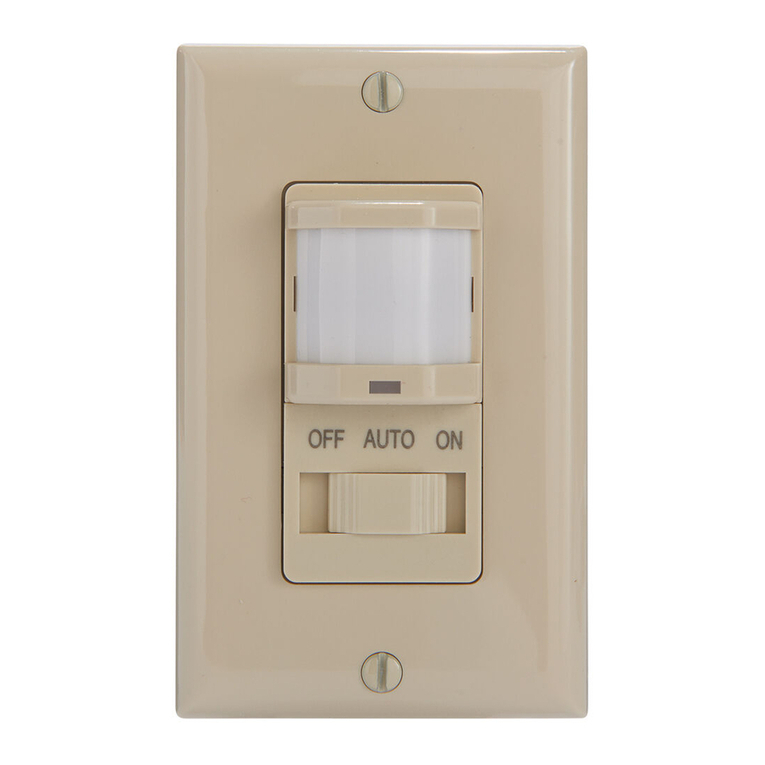
In either case, sensitivity to movement of the PIR sensor
(Channel 3) can be adjusted using the Sensitivity
parameter (set to 5 by default).
HINT: To assist in setting the Sensitivity, turn on the Walk
Test LED which will flash red when movement is detected.
By default when the detector turns on Local Scene 1 is
selected. When the detector turns off Local Scene 20 is
selected. See ‘Scenes Used for Occupancy Detection’ in
Step 3 for further details.
Switch Level On/Off
Occupancy detection can be made dependant on the
ambient light level using the Lux On Level and Lux Off
Level parameters.
Maintained Illuminance
The detector measures the overall light level in the
detection area and calculates the correct output for the
luminaires, to achieve a preset lux level (maintained
illuminance or daylight harvesting).
By specifying a Maintained Illuminance Light Level the unit
adjusts the output Channel levels to maintain a near
constant light level.
Programming Maintained Illuminance Light Level
Presence detection Sensing mode (below)
Absence detection Scene mode (opposite)
Basic programming
Note: for applications where there is only one channel of lighting
being controlled in a room there is no need to select the channel
number.