Intermec DCS 300 Product manual
DCS 300
P/N 067717-001
Technical Reference Manual

DCS 300 User’s Manual
Intermec Technologies Corporation
6001 36th Avenue West
P.O. Box 4280
Everett, WA 98203-9280
U.S. service and technical support: 1.800.755.5505
U.S. media supplies ordering information: 1.800.227.9947
Canadian service and technical support: 1.800.688.7043
Canadian media supplies ordering information: 1.800.268.6936
Outside U.S. and Canada: Contact your local Intermec service supplier.
The information contained herein is proprietary and is provided solely for the purpose of allowing customers to
operate and/or service Intermec manufactured equipment and is not to be released, reproduced, or used for any
other purpose without written permission of Intermec.
Information and specifications in this manual are subject to change without notice.
1998 by Intermec Technologies Corporation
All Rights Reserved
The word Intermec, the Intermec logo, JANUS, IRL, TRAKKER, Antares, Adara, Duratherm, EZBuilder,
Precision Print, PrintSet, Virtual Wedge, and CrossBar are either trademarks or registered trademarks of
Intermec Corporation.
Throughout this manual, trademarked names may be used. Rather than put a trademark (or ) symbol in
every occurrence of a trademarked name, we state that we are using the names only in an editorial fashion, and to
the benefit of the trademark owner, with no intention of infringement.

Contents
iii
Contents
Before You Begin xi
Warranty Information xi
Safety Summary xi
Warnings, Cautions, and Notes xii
About This Manual xii
How the DCS 300 Works
DCS 300 Architecture 1-3
How an Application Is Identified as a Destination 1-5
How the Message Handler Routes Transactions 1-5
How the DCS 300 Ensures Data Integrity 1-10
Interactivity With Devices 1-10
Fully Interactive System 1-10
Partially Interactive System 1-11
Noninteractive System 1-11
Data Integrity Modes 1-11
Faster Mode 1-12
Safer Mode 1-13
Retaining Transactions in Memory 1-14
How the DCS 300 Sets Application Status 1-15
Active Applications 1-15
Nonactive Applications 1-16
Sending Hot Standby Messages 1-16
Changing from a Nonactive State to an Active State 1-17
Active Recovery Mode 1-17
About DevComms 1-18
External Intermec Controllers 1-19
Interpreting ASCII Characters 1-19
Inserting and Deleting DLEs 1-20
Sending Transactions to a Device 1-20
Receiving Transactions From a Device 1-21
Inserting a Transaction ID 1-21
Configuring and Sending Delivery Responses 1-22
About NetComms 1-23
TCP/IP NetComms 1-23
1

DCS 300 Technical Reference Manual
iv
APPC NetComms 1-23
Shutting Down a Send NetComm 1-24
Transferring Batch Files 1-25
Learning About Transactions
Understanding Transaction Structures 2-3
About the Transaction Header 2-3
Transaction Data 2-7
How Transactions Are Routed 2-7
Routing Transactions From Applications 2-8
Routing Transactions From Devices 2-10
How the DCS 300 Acknowledges Transactions 2-14
How Applications Acknowledge Transactions 2-14
How Applications Receive Transactions 2-15
How Applications Send Transactions 2-16
Solicited Transactions 2-16
Unsolicited Transactions 2-17
Fields in Transactions 2-17
Using the Transaction ID to Send Transactions 2-18
About System Transactions 2-18
DcmFilResp 2-21
FileXfer 2-22
Specifying a Value for “device” 2-23
Specifying a Value for “parameter” 2-23
Omitting “parameter” and “eof
|
targetfile
|
targetdrive” 2-24
Using BFT Command Files With a JANUS Device 2-24
Command File Examples 2-24
DcmHltTran 2-25
Inter 2-26
Master 2-26
DcmMstResp 2-27
NoInter 2-27
DcmRsmTran 2-28
DcmSysHalt 2-28
2

Contents
v
Communicating With TCP/IP Applications
Overview 3-3
Opening Connections 3-4
Opening a Requester Connection 3-4
Send Connection From DCS 300 to Application 3-5
Receive Connection From Application to DCS 300 3-5
Using TCP/IP Sockets 3-7
Establishing a Requester Connection 3-7
About Message Boundaries 3-8
Sending Data 3-9
Receiving Data 3-9
Understanding NetAck and NetError 3-11
How the DCS 300 Communicates With Applications 3-12
About Transaction Routing in a TCP/IP Network 3-14
Communicating Using the Direct TCP/IP Socket Interface 3-17
Using the Direct TCP/IP Socket Interface 3-19
About the $IPT Transaction ID 3-20
Using the $IPT Transaction ID 3-21
Format of OPEN Packet Sent From a Terminal to the DCS 300 3-21
Format of OPEN_ACK Packet Sent From the DCS 300 to a Terminal 3-21
Format of OPEN_NAK Packet Sent From the DCS 300 to a Terminal 3-21
Format of DATA Packet Sent From a Terminal 3-22
Format of DATA Packet Sent From the DCS 300 3-22
Format of CLOSE Packet Sent From a Terminal 3-22
Format of CLOSE Packet Sent From the DCS 300 3-23
Understanding Error Codes 3-23
Sample Program for JANUS 900 MHz RF Devices 3-25
Setting Up the Sample Program 3-25
Running the Sample Program 3-26
Sample Program for TRAKKER Antares UDP Plus Terminals 3-26
Setting Up the Sample Program 3-26
Running the Sample Program 3-27
Sample Program Examples 3-27
Using the Terminal Emulation Auto-Login Feature 3-29
Developing Auto-Login Scripts 3-29
Control Characters for Auto-Login Scripts 3-30
Sample Auto-Login Scripts 3-31
3

DCS 300 Technical Reference Manual
vi
Communicating With APPC Applications
Learning About APPC Applications 4-3
Allocating APPC Conversations 4-4
Receive Applications 4-4
Send Applications 4-5
Interactive Applications 4-5
Batch Applications 4-5
Learning About APPC Verbs 4-7
IMS Applications 4-8
NetComm Pairs 4-8
Verb Flow Diagrams 4-8
Host Receive Requester With a DCS 300 Send Server 4-9
Host Send Requester With a DCS 300 Receive Server 4-12
Host Batch File Transfer Application With a DCS 300 Batch File Transfer
NetComm 4-15
Host IMS Receive Requester With a DCS 300/IMS Send Server 4-18
Host IMS Send Requester With a DCS 300/IMS Receive Server 4-21
Host IMS Batch File Transfer Application With a DCS 300/IMS Batch File
Transfer NetComm 4-23
Creating Script Files for Screen Mapping
About Script Files 5-3
Using a Manual or Automatic Process 5-3
Validating Data 5-3
Synchronous vs. Asynchronous Communications 5-3
Using the DCS 300 to Manually Create Script Files 5-4
Creating a Screen Mapping Session 5-5
Creating a Standard Script File 5-6
Sample Screen and Script File 5-8
Editing Script Files 5-10
Design Considerations 5-11
Practical Advice for Editing Script Files 5-12
Skeleton Script 5-14
Sample Script 1 5-15
Sample Script 2 5-18
Checking a Script File 5-21
Using Script Variables 5-21
About String Variables 5-22
4
5

Contents
vii
About Integer Variables 5-22
Hard-Coding Integer Variables 5-23
Performing Integer Math 5-23
Using Variables to Get String Length (StrLength) 5-24
Using Variables to Concatenate Strings 5-25
Converting Variables from String to Integer (StrToInt) 5-25
Converting Variables from Integer to String (IntToStr) 5-26
Using Variables to Do a String Search (StrSearch) 5-26
Copying a String or Integer Variable 5-27
Copying the Middle Part of a String (StrCopyMid) 5-27
Copying the Left Part of a String (StrCopyLeft) 5-28
Copying the Right Part of a String (StrCopyRight) 5-28
Trimming the Left Part of a String (StrLTrim) 5-29
Trimming the Right Part of a String (StrRTrim) 5-29
Comparing Two Strings, Case-Sensitive (StrComp) 5-30
Comparing Two Strings, Case-Insensitive (StrCompI) 5-30
Converting a String to Uppercase (StrUpper) 5-31
Converting a String to Lowercase (StrLower) 5-31
Other Script Variables 5-32
Using Keystrokes 5-33
Using Audit Files 5-34
Script Calls 5-35
ACK_MESSAGE 5-35
BREAK 5-36
CALL 5-36
CAPTURE_POS 5-37
CURRENT_SCREEN 5-37
EXIT 5-38
FILL_FIELD 5-38
GET_DCM_TRANS 5-39
IF_BATCH 5-39
IF_EXIT 5-40
IF_
integercomparison
5-41
IF_
string | integer
5-42
IF_REGION 5-44
IF_SCREEN 5-45
IF_SEARCH 5-46
IF_TRANS 5-47
IF_WAIT 5-47
LOG_ERROR 5-48
LOOP 5-48
PAUSE 5-49

DCS 300 Technical Reference Manual
viii
PUT_MAPPED_TRANS 5-49
PUT_TRANS_FIELD 5-50
SEARCH_SCREEN 5-51
SEND_MESSAGE 5-52
USER_INPUT 5-53
WAIT_FOR 5-54
WAIT_FOR_LABEL_POS 5-55
WAIT_FOR_POS 5-56
Reserved Words 5-57
Working With Host Systems
Overview 6-3
Connecting to a Mainframe for 3270 TE 6-3
Connecting to an AS/400 for 5250 TE 6-4
Setting Up an SDLC Connection 6-5
Setting Up a Twinaxial Connection (6140, 5394, 5494) 6-9
Setting Up a Twinaxial Connection (6050, 266C) 6-14
Setting Up an Ethernet Connection 6-20
Setting Up a Token Ring Connection 6-25
Understanding LAN Adapter Address Formats 6-30
Setting the Local Adapter Address on the AS/400 6-30
Setting the LAN Remote Adapter Address on the AS/400 6-31
Setting the Address Parameter on the DCS 300 6-31
Byte-Flipping an Address 6-31
Testing the AS/400 Connection 6-33
Configuring the Virtual Devices for 5250 TE 6-34
Remotely Connecting the DCS 300 to an AS/400 6-35
Using a 5394 Controller 6-35
Using a 5494 Controller 6-36
Receiving a CPF4128 Error 6-37
Creating the #ACCNET Mode on an AS/400 6-38
Using Remote APPC Applications Instead of 5250 TE 6-38
Configuring the Terminal Over the Network 6-41
Configuring the Terminal From the DCS 300 6-41
Configuring the Terminal From the Host Computer 6-42
6

Contents
ix
Sample Programs
About the Sample Programs 7-3
About the VT100 Screen Mapping Demonstration 7-4
Setting Up the Sample Host Application 7-4
Downloading the Template to the TRAKKER Antares Terminal 7-6
Running the VT100 Screen Mapping Demonstration 7-6
LOOPTCP Program 7-8
TCPAPP and PICKTCP Programs 7-9
WRITETCP Program 7-9
Utility Functions for TCP/IP Communication 7-10
O200ECHO Program 7-10
WAIT_FOR Commands Screen Mapping Demonstration 7-12
Index
7
I

DCS 300 Technical Reference Manual
x
Other manuals for DCS 300
3
Table of contents
Other Intermec Server manuals
Intermec
Intermec 6950 User manual
Intermec
Intermec DCS 301 User manual
Intermec
Intermec G4000 User manual
Intermec
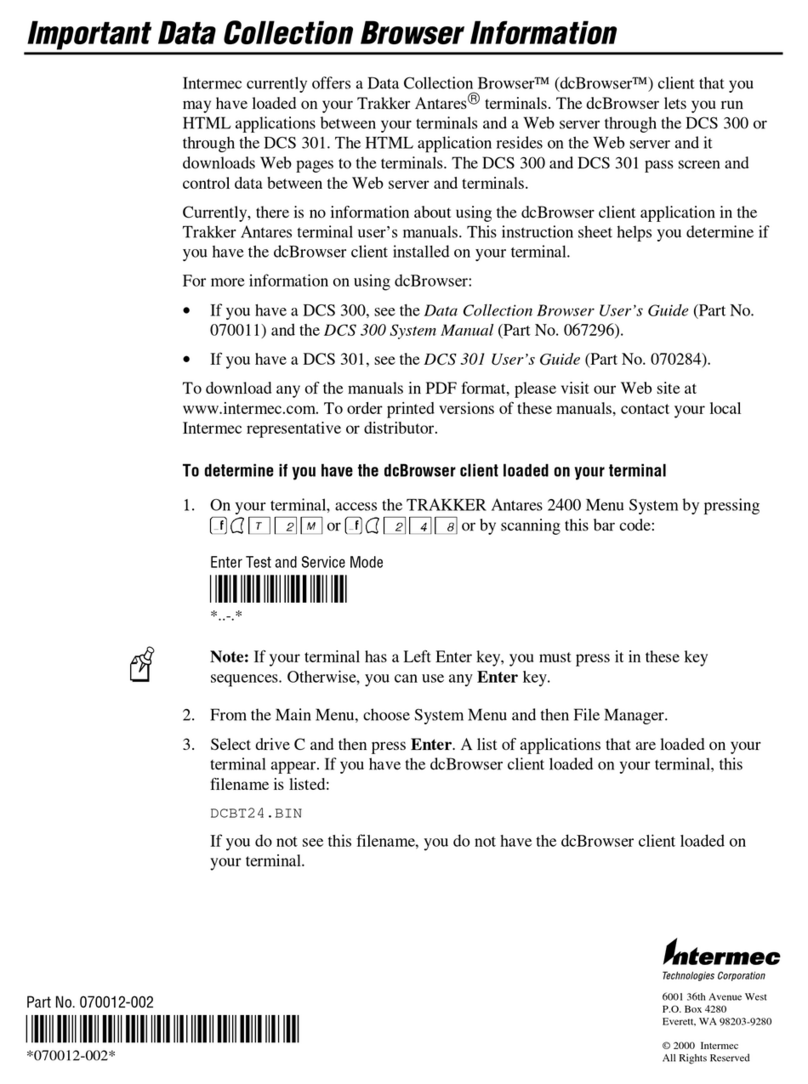
Intermec DCS 300 Quick start guide
Intermec
Intermec DCS 300 User manual

Intermec
Intermec DCS 300 User manual
Intermec
Intermec G4000 Manual
Intermec
Intermec 6950 EGS User manual
Intermec
Intermec DCS 302 User manual
Intermec
Intermec G4100 User manual