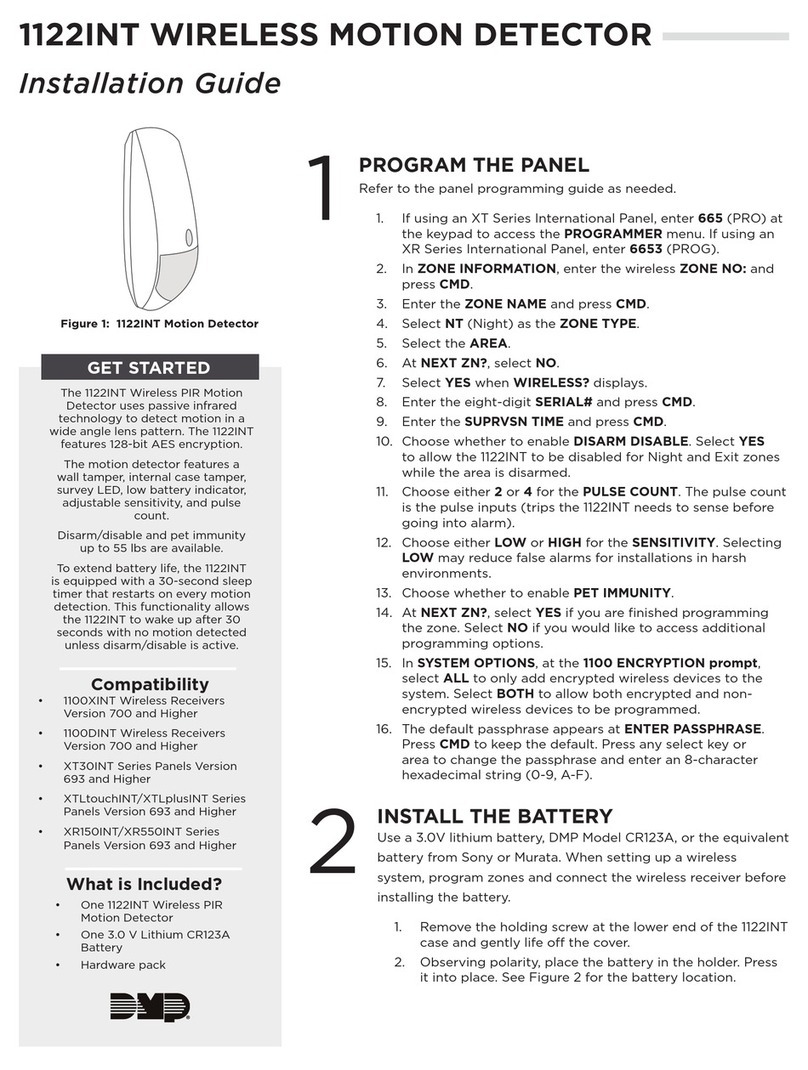
iPROTECT 1217 User manual

iPR TECTO
THE ANTI-TRACKING
MOBILE SYSTEM
DETECTOR OF MOBILE AND WIRELESS SIGNALS
1217

ABOUT THE DEVICE
Unfortunately, wide range RF detectors or near-field receivers have a low sensitivity and
are not very suitable for the detection of mobile devices. This is caused by the ability of the RF
detectors to receive all signals simultaneously and display them cumulatively on a bargraph,
and as a result, stronger signals prevent the detection of weaker ones.
Selective detectors have a much greater distance of detecting mobile signals because
they only accept them, and ignore other frequencies. Unfortunately, during the development of
a selective detector, one nuance appears. It is very difficult to create a detector able to receive
all mobile bands at the same time. As is well known, more and more mobile bands are being
used worldwide. The GSM standard works on two bands. Then 3G appeared, occupying one
more band. The introduction of the 4G/LTE standard required a wider frequency spectrum for
functioning; therefore 3-7 frequency bands were allocated for it in each country. Later still 5G
appeared, which requires an even wider spectrum so more wide bands have been allocated for
its functioning. Thus, currently, in most countries, there are up to 10-15 different frequency
It is very difficult to create a selective detector which is able to detect signals from all
mobile bands which will work in all countries. Thankfully, the designers of the iProtect 1217
have achieved this. The iProtect 1217 is the only detector in the world which is able to detect
all the existing mobile standards on all continents. Its table includes at least 26 bands, which
can be selected automatically or manually.
In addition to mobile communication, the 1217 detects signals of Wi-Fi, Bluetooth, DECT,
ISM 434 MHz, ISM 868 MHz and ISM 915 MHz. It is well known that these standards can be
used by hidden surveillance devices for audio and video signal transmission, and therefore such
transmitters must be found and identified.
Searching for the illegal use of mobile signals is becoming an increasingly important task
during counter surveillance sweeping. It is connected with the numerous means of eaves-
dropping that transmit information via mobile networks. The mass production of components
for developers, such as GSM, 3G, 4G/LTE and 5G modules, enables them to develop cheap and
quick surveillance methods which have ultra-high quality of sound, video or location trans-
mission. Hidden cameras camouflaged as household appliances, toys or interior objects, will
most likely transmit data via mobile networks or Wi-Fi. Spy listening devices quite often have a
slot for SIM-cards for functioning on a cellular network. A GPS tracker is a device that is
installed in a vehicle and informs about its location, these also send coordinates via mobile
communication.
bands of mobile communication according to the national frequency allocation.
2

Apart from a high sensitivity, selective detectors have one more significant advantage
compared to wide-band detectors. This is, the user is able to see exactly which signal has been
detected. This greatly improves the ability to distinguish suspicious signals from external inter-
ferences and enables the user to perform a physical search for a certain transmitter. Such an
ability is not available for wide-band detectors which mix up all the signals. The iProtect 1217,
as a selective detector, can inspect one separate band, which is why it is irreplaceable during
professional searches.
One more important advantage of the iP rotect 1217 is the TRACKER mode (searching for
GPS trackers). In this mode, the device is adjusted for detecting only mobile signals and
accumulates a histor y for finding the periodic sending of data with coordinates.
3

MAIN FEATURES
Able to detect mobile and wireless signals at a much greater distance compared to conven-
tional RF detectors (at least,10 times more)
Selective: interference resistant and with a high sensitivity
Has worldwide coverage of mobile standards – can detect all existing bands of GSM, CDMA,
3G, 4G/LTE and 5G in the range up to 6 GHz
Able to detect all types of wireless signals,including Wi-Fi 2.4 GHz, Bluetooth, Wi-Fi 5 GHz,
DECT, ISM 434MHz, ISM 968 MHz and ISM 915 MHz
Detection of at least 26 mobile and wireless bands
Can be adjusted to the frequency allocation of the country of use
A selective multi-band principle of work informs the user of exactly which signals were found
The mode of analysis of a certain band facilitates the physical search of a transmitter
A separate mode for the detection of GPS trackers with history accumulation (TRACKER)
ALARM function warns the operator about exceeding the threshold, both with sound and
visually
43 threshold levels for setting optimal sensitivity
Can be set up for specific tasks, for example, for the detection of Wi-Fi only, etc.
Operation modes:
ALL BANDS (detection on all bands)
GROUP (detection on the selected group of bands)
BAND (analysis of a separate band)
TRACKER (detection of GPS trackers)
Two antenna inputs and two antennas in the set for ensuring maximum sensitivity
The high-band directional antenna facilitates locating of transmitters above 2400 MHz
The built-in rechargeable battery provides an operational time of up to 5 hours
USB recharging
4

SPECIFICATION
Number of bands
Antenna inputs
Average sensitivity
Operation modes
Alarm function
Number of alarm threshold levels
Sound signals
Regions
Operating and control elements
Power supply source
Power
Battery operational resource
Mass
Dimensions
Operating temperature range
26
Input 1: SMA, 2400 – 6000 MHz
Input 2: SMA, 600 - 2400 MHz
-60 dBm
ALL BANDS (detection on all bands)
GROUP (detection on the selected group of bands)
BAND (analysis of a separate band)
TRACKER (detection of GPS trackers)
Visual or audio
43
Alarm, depression of buttons
US (bands of the USA)
EU (European bands)
TOTAL (all bands)
Joystick: move left-right, up-down, threshold
adjustment, mode selection
Button POWER OFF: switch off
Button POWER ON: switch on
Button ALARM: alarm
Button AUDIO: sound
Button BANDS: band set up
Button BACK: exit to the previous mode
Button SAVE (storing the current state)
USB 5V
Built-in rechargeable battery 6800 mA*h 3.7 V
Up to 5 hours
The device without antenna: 750 g
Packed: 1500 g
The device without antenna: 208 x 86 x 41mm
Packed: 27 x 22 x 10 cm
-5…50 °C
Supplied set
Device 1
High-band antenna Micro-Pointer LPDA-12 1
Low-band rod antenna 1
Charging cable USB Type C 1
Angle adapter SMA 2
A case for transportation 1
5

BA ND S
Mobile communication (MBL1, MBL2, MBL3 and MBL4 groups)
The use of mobile communication has a number of advantages for covert surveillance:
1 Broadband channels enable transmission of high quality audio or video
2 There is no need to organize a control post near the surveillance object. The data
transmission is performed via the Internet. Recording into a cloud service is possible.
3 Remote control of the device is possible.
4 A convenient channel for transmitting the position of a vehicle (GPS trackers).
5 The possibility of information accumulation and a quick transmission according to a
schedule, or upon request.
6 The typical nature of the signal is a contributing factor for masking any surveillance.
Thanks to a wide coverage, unlimited distance and high quality of information transmission,
secret surveillance devices are using mobile communications increasingly frequently; while
the mass production of components for developers, such as GSM, 3G, 4G/LTE and 5G modules,
enable the development of cheap and quickly hidden bugging devices with high quality
The main types of the covert surveillance devices that use mobile communication:
A hidden wireless microphone
A hidden spy camera (possibly with a microphone)
An “infected” mobile telephone that transmits video and/or acoustics around itself
without its owner's knowledge
The deliberate use of a telephone for audio or video transmission
GPS trackers (beacons), which enable tracking of a car's coordinates
The iProtect 1217 can detect all types of secret surveillance devices which use mobile
communication and transmit a radio signal during a search.
Signals of DECT cordless phones (DECT group)
This standard was developed for cordless home phones. Most countries have an allocation for
its frequency band. The DECT standard has a high quality of sound transmission and an element
base available for the creation of a hidden spy device. It is possible to modify a household
appliance, for example, a baby monitor, for the purposes of covert surveillance.
The iProtect 1217 detects DECT signals which are active during a search.
ISM signals (ISM group)
ISM bands (Industrial, Science, Medicine) do not require licensing and are used by a number of
household and industrial appliances. The ISM group has the following bands:
433.05-434.79 MHz (Europe)
863-870 MHz (Europe)
902-928 MHz (the USA)
6
transmission of sound, video or location coordinates.
Remote controls, alarm sensors, Smart Home systems, various sensors, etc., function at these
frequencies. LoRa, DASH7, IEE 802.11ah, CC430, NB-IoT protocols and others are used.

7
FREQUENCY BANDS
MBT-WIFI
BAND
B8
B20
B20
B12/17
B13
B71
B1/65
B3
B14
B5/26
B4/66
B2/25
B30/40
B7/41
DECT-EU
DECT-US
ISM433
ISM868
ISM915
WIFI2.4
WIFI5.8
B42
B43
B7
B34
B38
Frequency,
MHz
880 – 915
832 – 862
703 – 748
699 – 716
777 – 787
788 – 798
814 – 849
2500 – 2570
2570 – 2620
1710 – 1780
1850 – 1915
3400 – 3600
3600 – 3800
2300 – 2400
2496 – 2690
1880 – 1900
1920 – 1930
433 – 435
863 – 870
902 – 928
2400 – 2484
5150 – 5875
2010 – 2025
663 – 698
1920 – 2010
1710 – 1785
GROUP
MBL1
MBL2
MBL3
MBL4
DECT
ISM
Besides their intended purposes, these bands can
be used for transmitting information from
secret surveillance devices, or for their control.
The iProtect 1217 can detect all these signals.
Bluetooth, Wi-Fi and other
signals in the bands of 2.4 GHz
and 5 GHz (BT-WIFI group)
This is the group of bands that do not require
licensing and are used by a number of wireless
devices, first of all, by Wi-Fi and Bluetooth.
The wireless standards can be used for the trans-
mission of audio or video information. Their
advantages are:
1 Easy development and creation of secret
surveillance devices – the necessary
components are readily available.
2 The bandwidth is sufficient for high-quality
audio or video transmission.
3 Remote control is possible.
4 The possibility of information accumulation
and its quick transmission, according to a
schedule, or upon request.
5 A 'typical' signal, which can easily be
mistaken for the operation of a usual router
or any other household wireless appliance.
The 2.4 GHz band is more saturated and is used
by different devices simultaneously. They are
Bluetooth, Bluetooth LE, Wi-Fi, ZigBee and others.
The 5 GHz band is less loaded and is usually used
only for Wi-Fi.
The iProtect 1217 can successfully detect radio
frequency devices that work in the bands of
2.4 GHz and 5 GHz, including those used for
covert surveillance – wireless hidden video
cameras, microphones, remote control devices,
etc.

8
OPE RAT ING C ONT ROLS
Microwave
antenna
Power
Alarm
function
Sound
indication
Recording of
the current mode
and condition
Groups or bands Level indicator Alarm threshold Joystick
BACK
Band
adjustment
Rod antenna
Battery status
Current modeAlarm
Alarm (red)
External power (green)
“Measuring is in progress” (orange)

Start working with the iProtect 1217 by adjusting the device to the frequency allocation in the
country of use. As mentioned above, every country has its own frequency allocation for bands
of mobile communication and wireless devices. Frequencies such as 4G/LTE, 5G and other
bands can differ significantly in different parts of the world. The iProtect 1217 can detect signals
in almost all bands, however, in order to ensure the maximum probability and speed of detec-
tion, as well as to avoid false responses, the device should be adjusted purely to the bands
which are used in the country.
Press the BANDS button in order to enter the adjustment mode.
9
BAND ADJUSTMENT
A group
An active band Selected region Non-active band
Move the joystick in order to go left, right, up, down or press it in order to activate or
deactivate certain items. To exit, press the BACK button.
Start by choosing the region, and then go down to select, or unselect, groups or certain
bands. Select US if the country of use is the USA, Caribbean or Latin American countries. Select
EU if the device is in a European country, or any other country that a similar frequency distribu-
tion is used. Select TOTAL in order to open the full list of bands and to select them manually.
Follow the "Table of Bands" attached to these instructions in order to edit the list of bands in
the device. Always try to set all the bands which are allocated in the country of use, and to de
activate those bands which are not used. If necessary, when a specific task arises, it is possible
to switch off certain bands or groups temporarily. For instance, if you want to detect only Wi-Fi,
Bluetooth and LoRa signals, or mobile communication only. Deactivation of other band groups
will cause an increase in the probability of detecting active bands and will speed up the search.

When the bands have been adjusted, you can proceed with working. The iProtect 1217 detector
has several searching modes.
OPERATION MODES
ALL BANDS
This is the main searching mode that enables the detection of all mobile and wireless
signals. Use this mode as the main one for all search tasks.
The selected group Bands of the selected group
The level
bargraph
The group
The alarm
threshold Al.
The groups will be displayed at the bottom of the screen. The signal levels by groups are dis-
played on the bargraphs. By pressing the joystick to the left and right, the user can choose
a group and see which bands belong to it.
It is possible to set the alarm threshold Al by pressing the joystick up and down. In case of
a signal exceeding the threshold, an alarm indication and alarm sound can be displayed
(ALARM and AUDIO functions).
A subsequent pressing of the joystick button selects the GROUP mode, in which the operator
can inspect the bands belonging to the group.
10
Press SAVE in order to save the results of the adjustment. If the changes are not saved, the
device will work with the new settings until the power is shut down, then any previous settings
will be chosen when next used.
You can switch on, or off, all of the group altogether by pressing the joystick when you are
hovering over it (MBL1, MBL2, MBL3, MBL4, DECT, ISM, BT-WIFI). If you want to switch on, or
switch off a certain band, simply go to it with the help of the joystick and then press it.
Table of contents
Other iPROTECT Security Sensor manuals