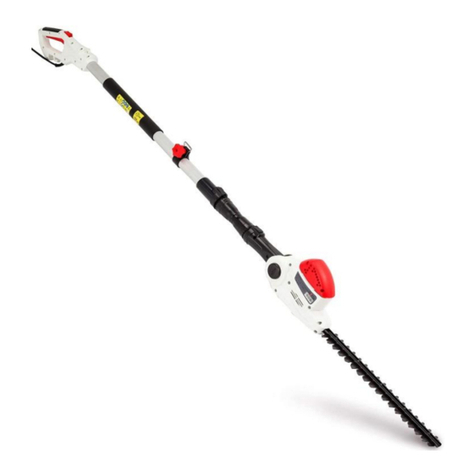
- Do not use a ladder to reach the higher parts; use
appropriate hedge trimmers equipped with extension
cables.
USE
Prepare the machine and all the items will you need for your work
(not included): an extension cable, personal protective equipment
and tools such as a branch-cutting trimmer, a rake and a cord.
Wear the personal protective equipment listed in the ‘Warnings’
section.
The hedge must be cut first on the sides then on the upper part.
When cutting, start vertically from the bottom, then move to the top,
keeping the blade inclined by about 15° (Fig. F).
In order to obtain a uniform profile on the top of the hedge, it is
advisable to use a thin cord, which will act as a reference point
when cutting.
The branch-cutting trimmer may be useful for trimming large
branches exposed when trimming the hedge.
1. Always hold the appliance with both hands. The power cable
must be kept far from the moving parts and from your body. The
normal position for the user is with arms slightly stretched
forward. Keep your legs slightly apart and maintain a stable
position that allows you to keep your balance. Avoid putting your
face too close to the work area, and maintain a safe distance at
all times.
2. Switch on the appliance and wait for it to reach full speed, then
slowly insert it in the foliage of the hedge. It is very important
that the appliance is already on when the sharp teeth of the
blade touch the hedge; otherwise, you may feel a kickback due
to the blade getting stuck in the branches.
3. When the machine is switched on, handle it with caution, as any
carelessness may cause serious injury. Therefore, keep
unauthorised persons, children and pets away from the work
area.
Do not put your hands in the cutting area for any
reason.
4. The moment the blade begins cutting, the machine will start
vibrating. It is necessary to hold the machine firmly and
counteract this force. Cut the hedge carefully and proceed
gradually without forcing the machine too much. Excessive