5
• Due to their nature and finish, woven and knitted fabrics are particularly susceptible
to the formation of ring marks. Before treating such materials it is recommended to
apply a thin layer of cleaning fluid using the fine mist setting. Working quickly
reduces the risk of ring marks becoming fixed in the material. The formation of ring
marks can be further minimised by, as soon as the stain has been removed,
spraying a wide mist pattern in a circular and uniform way from the damp to the dry
part of the fabric. The treated area should then look uniformly damp and without
patches.
• If the stain removal is being carried out on an ironing board or extraction table
using a damp fabric underlay, this material should be moved after treatment to
avoid the risk of dissolved stain residues being transferred back into the next
treated material.
• With stains such as molybdenum sulphide based oils, tallow, wax, ballpoint pen
ink, make-up, stamp pad ink and fruit juices, it may be necessary to apply a few
drops of an specialised solvent (K1-K4- see spotting chart) before the normal
aforementioned cleaning process. For the rinsing process, the fine mist spray
should be brought as close to the fabric as possible without causing any damage
(thread displacement), followed immediately by making circular movements at a
greater distance from the fabric from the wet to dry area. Repeat this process
once or twice. Never allow too much fluid to penetrate the fabric and always work
very quickly. Dry and if necessary, repeat the process.
• Stains caused by oil or grease, or those which have worked into the fabric over a
lengthy period should be pre-spotted by first applying a very thin layer of fluid using
the fine mist spray setting.
• Sedimentary spots, which have formed a crust on one side of the fabric, should be
cleaned from the reverse side. Where possible, the crust should first of all be
scraped off with the dull edge of a knife blade. The spray jet should be kept at a
right-angle to the material, in order to reduce danger of thread displacement.
• Spraying of dense fabrics, treated with moisture-repellant, should be carried out
when they are lying flat, and stretched out where possible. Treating when
suspended vertically risks fluid running downwards and away from the stained
area.
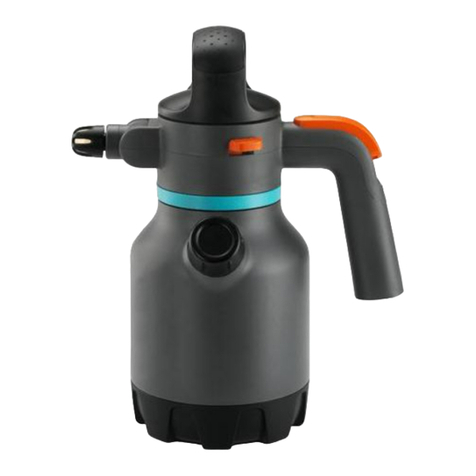
• Textile related fluids of a similar viscosity such as moth repellant and impregnating
agent can also be sprayed. However, such fluids are often corrosive, and for this
reason the TEX25 should be thoroughly cleaned immediately after use. It is
recommended to use a separate container for different types of fluid.
• The TEX25 can also be used to clean production machines such as screen
printing sieves, ring travellers, shuttle-boxes, loom reeds, needle beds, sewing
machines as well as general degreasing of and machines and motors.