10
GENERAL NOTES
“ZGS” pumps are designed and built for the transfer of liquid chemical products having a specific weight, viscosity, tem-
perature and stability of state appropriate for use with centrifugal pumps in a fixed installation, from a tank at a lower
level to a tank or a pipe to a higher level. The characteristics of the liquid (pressure, temperature, chemical reactivity,
specific weight, viscosity, vapour tension) and the enviromental conditions must be compatible with the characteristics
of the pump and are defined upon ordering. Impeller and static casings, in contact with the liquid, are constructed from
thermosetting resins; other parts in high chemical-resistant materials.
The pump’s performance (capacity, head, rpm) is defined upon ordering and specified on the identification plate.
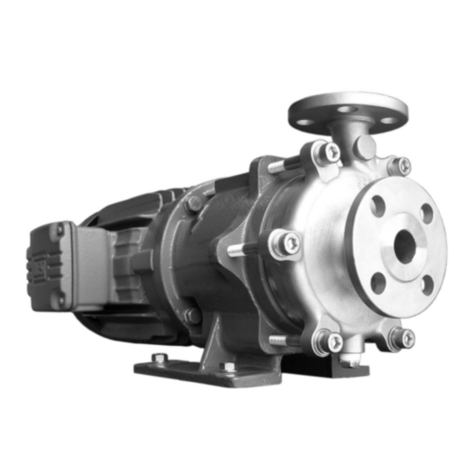
“ZGS” series pumps are manufactured in compliance with ANSI/ASME B73.1 standards. They are of the centrifugal,
horizontal, single-stage type, with self-supporting shaft. ZGS pumps are coupled to a non-synchronous electric motor
by means of flexible coupling and spacer; with axial inlet and radial outlet for connection to the hydraulic system. These
pumps are of the foot-mounted type for fixing onto base-plate in compliance with ASME B73.1.
“ZGS” pumps are not self priming.
“ZGS” pumps cannot run dry.
The liquid being pumped may contain a maximum 5% of solid non-abrasive particles not greater than 0,1 mm in size.
The presence of fibrous, adhesive or abrasive bodies is not allowed. The maximum allowed size for bodies occasionally
present is 0,5 mm.
Clockwise rotation seen from the motor side.
Make sure that the chemical and physical characteristics of the liquid have been carefully evaluated for pump suitability.
The specific weight which can be pumped at a temperature of 25°C (both of the liquid and the ambient) depends upon the
diameter of the impeller (shown on the identification plate) and the installed motor power (shown on the motor identifica-
tion plate) ans has to be defined upon ordering.
The level of kinematic viscosity must not exceed 40 cSt so as not to significantly modify the pump’s performance. Higher
values up to a maximum of 120 cSt are possible provided that the pump is equipped with suitable impeller and motor to
be defined upon ordering.
The maximum continuous working temperature referred to water depends on the choice of materials (specified on the
identification plate):
80 °C execution V1G
80 °C execution V1A
80 °C execution V1C
80 °C execution V1F
110°C execution E1S
modifications may occour depending upon the operating pressure value.
The ambient temperature interval is related to the choice of materials (specified on the identification plate):
The maximum pressure the pump may be subjected to is 1.5 times the head value developed with the outlet closed.
The vapour pressure value of the liquid to be pumped must exceed (by at least 1m w.c) to the difference between the
absolute total head (suction side pressure added to the positive suction head, or subtracted by the suction lift) and the
pressure drops in the suction side piping (including the inlet NPSHr drops shown on the specific tables).
In case of double mechanical seal, the value of the pressure in the seal chamber must be equal to half value of the ope-
rating pressure of the pump.
In case of double mechanical seal, the flushing liquid must be clean and must not lead to violent chemical reactions on
contact with the liquid being pumped.
The pump shaft is supported by rolling bearings packed with grease (to be periodically recharged).
The pump does not include any non return valve nor any liquid flow control or motor stop device.
The coupling guard must be fitted before starting up the pump.