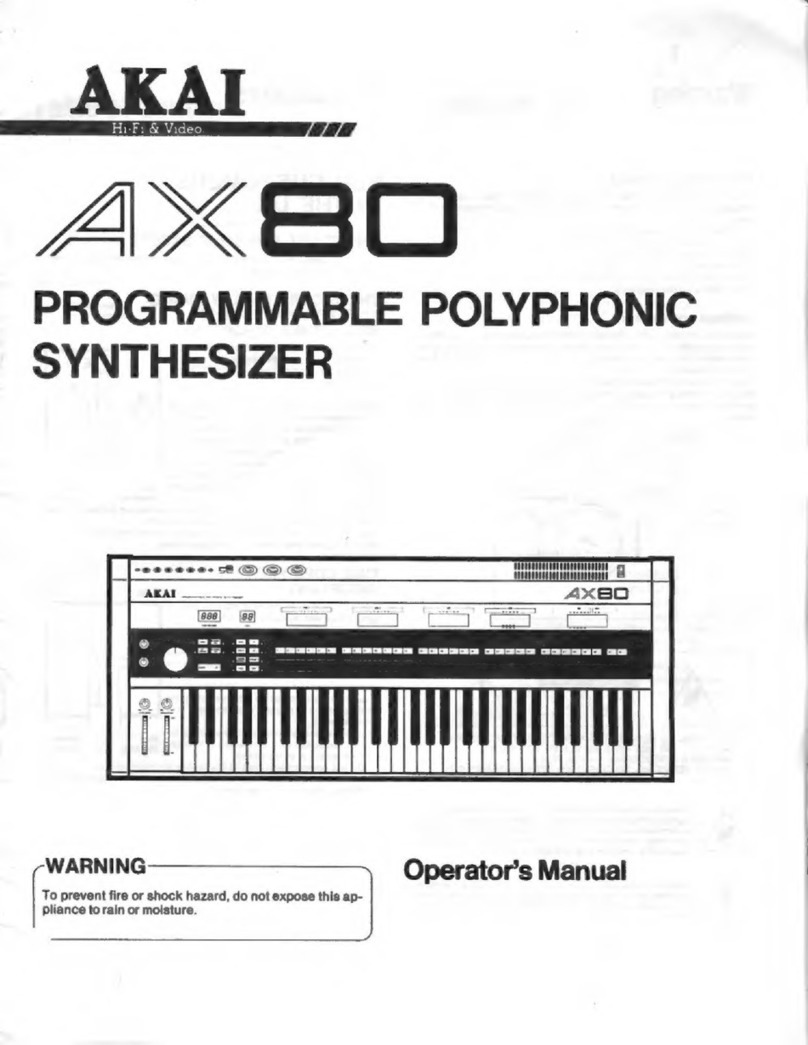
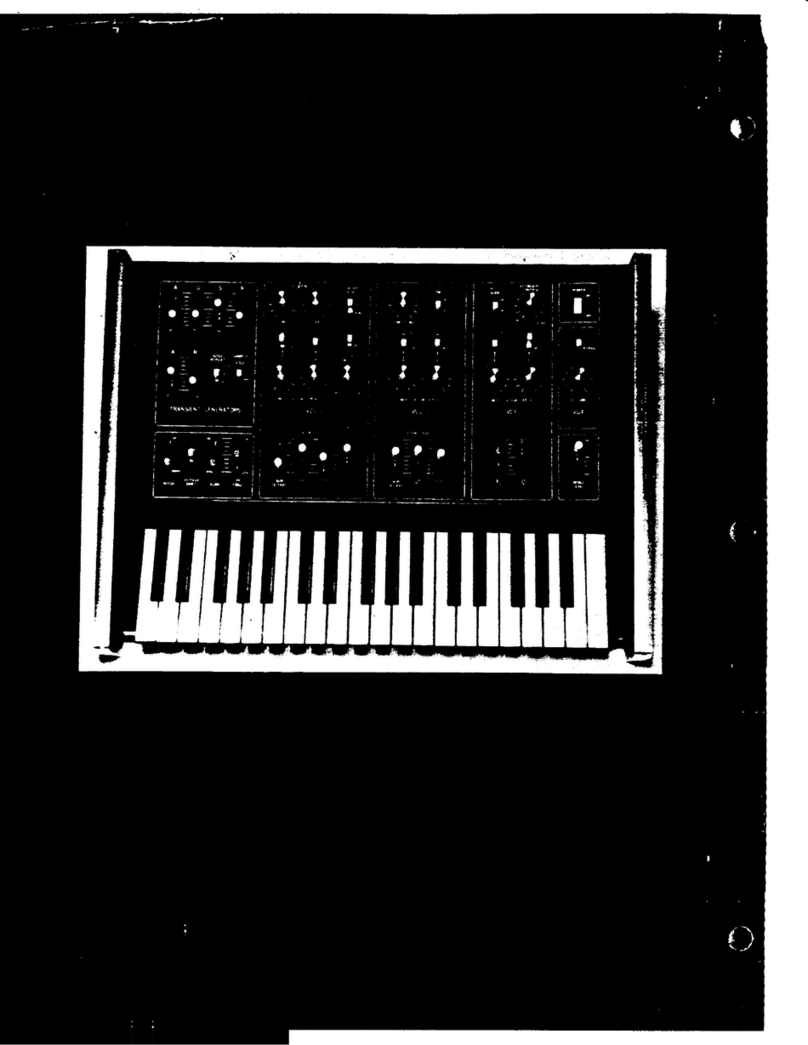
Manx Destubt V2 User manual


Contents
Getting Started
Introduction.................................................................
3
Installation................
...................................................4
Adjusting Parameters...................................................4
P
rogramming the Destiny v2
Oscillators...
..................................................................6
PWM
.............................
.......................
........................
.8
Filter...............................................................
..............
9
Envelopes
......
..............................................................10
LFO / Sample & Hold................
..............................
......14
Mixer...........................................................................15
Destiny v2 Controls
Keyboard modes, portamento, bend range
.........
.......
..17
LFO 2,.......................................................
...........
.........
17
Program saving and loading...........
......................
.........
18
Continuous Control & Midi Learn
..............................
....19
Zoom out....................................
..............................
....19
A
ppendices
Appendix One: Audio Filters.........................
.................21
Appendix Two: Troubleshooting.
...................................24
Appendix Three: Info for users
.......................................25
1 ContentsUser Guide last updated: 01-03-2015


2
Introduction
Congratulations on acquiring the Manx Destiny v2 synthesizer. The Destiny is inspired by a real vintage analog synth,a splendid instrument originally produced some 40 years ago, whose classic sound can be heard on countless popular recordings. It is still used today, by those fortunate enough to own one despite their rarity. The layout of the controls can seem a little confusing at first glance, but once you spend a bit of time with the Destiny, you will see that it’s fairly consistent with the standard 2 VCO subtractive synthesizer configuration, but with extensive modulation capabilities. This means that it is fairly quick and intuitive to work with, whilst allowing for a good range of sounds.
Manx Synthesizers originally started out as a vehicle to test out novel oscillator designs, whilst looking into the possibility of providing digital oscillators with more ‘power.’ These designs share much ‘DNA’ with what lies under the hood of Manx instruments today. However, we subsequently shifted our attention onto the filter and envelope sections, which we felt, were still being somewhat ‘trashed’ by real analog gear. For patches which feature an open filter and bland EG settings, the Destiny v2 does sound similar to its predecessor, the Manx Destiny v1. However, patches with significant filtering and bold EG settings are probably the most commonlyused synth sounds out there; and these are a kind of sounds in which the Destiny v2 can now excel. General features Switchable between monophonic (1 voice) and duo-phonic (2 voices). Midi Learn for all parameters; Patch memory system with full library. Two LFOs, Sample & hold, Ring modulation, PWM, Sync, much more.........
General information
The Destiny v2
has no on
-
board effects - its output is mono. External effects must
be used if you need stereo image
ry, or layer 2 Destiny v2s together, then pan.
-
-
Please note that if you are new to synthesis, parts of this user guide may appear to be ‘a bit heavy’.Don’t worry, once you start turning knobs and flicking switches on the Destiny v2, it will all start to make sense.3 Getting Started

Installation
Please extract the contents of your downloaded
RAR
file to
your VST plugins folder.
If you are installing the demo version of the Destiny v2, please copy both the dll file and the folder intoyour VSTplugins folder: If this folder is absent when the Destiny v2 is launched, the instrument will attempt to create one automatically, but this may be undermined by Windows security systems.
If you have already
installed the demonstration version and are upgrading to the retail version
(
recommended
), the computer
will ask if you want to overwrite an existing file (since the demo and
retail versions have the same file name). Click Yes
.
When upgrading from the demo version
you don’t
need to copy the Destiny v2
folder since it contains the same stuff. (Note: if for some reason you can’t open the RAR file, please let us know and we can send the dll & folder
to you directly, via email.) Patch data saving Please note that when you save a patch into the Destiny v2’s internal patch memory system, all variables are saved, including the test tone setting and master tune controls.
Adjusting parameters
For continuous parameters, click and drag
the respective
knob
or slider
.
For switches
,
click
repeatedly
on
the switch area to flick through the available settings
.
IMPORTANT!
You can achieve very fine adjustments for the
knobs
by clicking on the knob and
dragging the cursor
away from the knob
horizontally
for a good distance before adjusting the knob by moving vertically.
This advice is only
pertinent
to the
Bend Range Control.
4 Getting Started


The Destiny v2’s oscillatorsThe Destiny v2 features two fully loaded oscillators; you can control the pitch of each, from the oscillator panel shown above.
Both oscillators have course and fine sliders for pitch control, under the heading ‘frequency’.
There is no master tune control on the Destiny v2, but its very quick to dial up desired pitch using the foursliders in the oscillator sections - the Destiny’s sliders have a long ‘travel’. OSCILLATOR SYNCHRONIZATION (2)TUNING - Oscillator frequency (1)111 Normally, the two oscillators are free running (simulated); they operate independently. This means that when you press a key multiple times, the resulting sound may not be exactly the same each time,because the oscillators will interact with each other differently each time. However, when Oscillator Sync is turned on, the 2nd oscillator will be forced to reset to the start of its wave-cycle, every time the 1st oscillator naturally works round to the start of its cycle. If your new to synthesis and this sounds complex - don’t worry. Simply try it out - you will recognise the kind of sounds sync’ing can produce since they appear everywhere inpopular recorded music. The important charactoristic of sync’ing is that changing the 2nd oscillators pitch will 6 Programming -OscillatorsWhen playing a guitar, the sound produced originates from the strings. In the case of a synthesizer, the basicsound comes from a section called the ’oscillator’. Just as a guitar can have twelve strings instead of six, so a synthesizer may feature two oscillators instead of one. This is the case with the Manx Destiny v2. Having two oscillators instead of one can give you a fatter sound, especially if the two oscillators are set two be slightly out of tune. 112

7 Programming -Oscillators3( OSC SYNC CONTINUED ) The important characteristic of oscillator synchronising is that changing oscillator 2’s pitch will change thetimbre of the oscillator section but the pitch of both oscillators will track the pitch setting for oscillator 1. By modulating the 2nd oscillator’s pitch using the Destiny v2’s envelopes or LFOs, sync’ing will provide another means to have your patch’s timbre evolve as a key continues to be held down (along side with filter modulation - described later in the user guide).OSCILLATOR ONE KEY-TRACK ON/OFF (3) There are several factors which determine the pitch of the Destiny v2’s oscillators, besides their specific tuningsettings; other factors include; master-octave control , pitch-bend midi data, modulation sources and of coursethe keyboard itself. Oscillator Two is ‘hard wired’ to the keyboard and tracks it witha standard piano scale. Oscillator One can have key-track turned on or off, using theswitch (3). When key-tracking is turned off, oscillator One’s pitch is controlled by the frequency sliders and pitch modulation sources. WAVEFORMSEach of the Destiny’s two oscillators can output 2 different wave forms - sawtooth & pulse. There are no switches to switch between the two waves; The oscillators output both simultaneously and they can subsequently be routed as to your requirements in other sections of the synth.OSCILLATOR MODULATIONTwo aspects of oscillator function can be modulated (constantly varied) from other parts of the instrument. They are 1) Pitch 2) Pulse width. The latter is discussed in the next section. Pitch modulation works as follows: 4Like the main oscillators, the Destiny’s LFO outputs two waves simulaniously. Use switch (4) to switch between them when applying LFO->pitch modulation to oscillator One. Set the amount using slider (5). The LFO is discussed in detail later on, so don’t worry if you’re not familiar with it right now.Sample & Hold (S/H) and Envelopes (ADSR) are also discussed later on. For now, suffice to say they can both be a modulation source; use switch (6) to select between them and adjust the amount using slider (7). Oscillator Two has similar controls, but please note that switch (8) can select between an LFO sine wave and input from the S/H MIXER. More on that later.5768FM stands for ‘Frequency Modulation’!

Pulse Width Modulation Both of the Destiny v2’s oscillators output pulse waves, which looks like this:
The pulse waves have a feature which the sawtooth waveforms don’t have; The peak to troughratio can be adjusted. We do this using a parameter known as ‘pulse width’.
Pulse WidthPulse Width increased
This is a superb feature for two reasons: Firstly, one wave shape - pulse - becomes an infinite number of wave shapes; all pulse waves with different pulse widths. The second reason is even more useful; Because pulse width is a continuous variable, we can modulate it (vary it) in real time, using either LFOs, envelopes (see later sections), or key tracking. 8 Programming -PWMThe controls labelled ‘WIDTH’ set the pulse width for each oscillator. (1) If the oscillator’s saw wave is patched in for audio output, thepulse wave can’t be heard and so the settings here will have no effect. The actual Pulse width can be made to fluctuate around the point set by the ‘WIDTH’ slider, by an amount set by the ‘MOD’ slider - this stands for ‘Modulation’.(2) The modulation source is selected using the switch below(3),either LFO Sine wave or Envelope two (envelopes are describedlater.) 14231

The Destiny v2’s Filter 87The controls labelled 5 - 9 control modulation of the filter cut-off: Switch (4) - Select between modulation sources; Sample and Hold, or keyboard tracking. Slider (5) - Attenuate source from (4). Switch (6) - Select between modulation sources; Sample and Hold, or LFO sine wave. Slider (7) - Attenuate source from (6). Switch (8) - Select between modulation sources; Envelope One or Envelope Two. Slider (9) - Attenuate source from (8). Envelopes are discussed in the next section, including a section on envelope filter clipping. 9 Programming -Filter123579468If your not already familiar with audio filters, please refer to our basic introduction in Appendix #1. The Destiny v2 has both a high-pass and a low-pass filter. The high-pass filter can not be modulated and only has one control; Frequency (3). VCF FREQ (1) is the main cut-off control for the low-pass filter, with associated resonance, (2).
CAUTION: Turning up the resonance can lead to a profound increase in sound volume, perhaps unexpectedly. Please consider both your speakersand your ears and use this feature cautiously.
FILTER MODULATION
Table of contents
Other Manx Synthesizer manuals