Introducon:
The Meade 0.68x focal reducer is designed for use with Me-
ade’s Advanced Coma-Free (ACF) telescopes, of any aperture,
using the 2”-24 (2” diameter, 24 threads per inch) rear cell
thread. This rear cell thread is standard on all Meade ACF tele-
scopes. The 0.68x focal reducer consists of 4 lenses in 2 groups
with all air-to-glass surfaces fully mul-coated with broadband
an-reecon (BBAR) coangs for maximum light transmis-
sion and image contrast. It provides good correcon across
a 28mm image circle making it ideal for APS-C sized sensors.
Meade’s ACF focal reducer reduces the eecve focal length
of the main telescopes opcal system by a factor of about
one third. When used with Meade’s f/10 ACF, the resulng
eecve f/rao becomes around f/6.8. When aached to
Meade’s f/8 ACF, the resulng eecve f/rao will be around
5.5, resulng in a substanally “faster” opcal system that
cuts exposure mes in half while increasing the eld of view.
The reducers opcal design provides full illuminaon of a 22mm
diagonal image sensor and nearly full illuminaon out to 28mm,
with just slight vigneng that is corrected with at eld calibra-
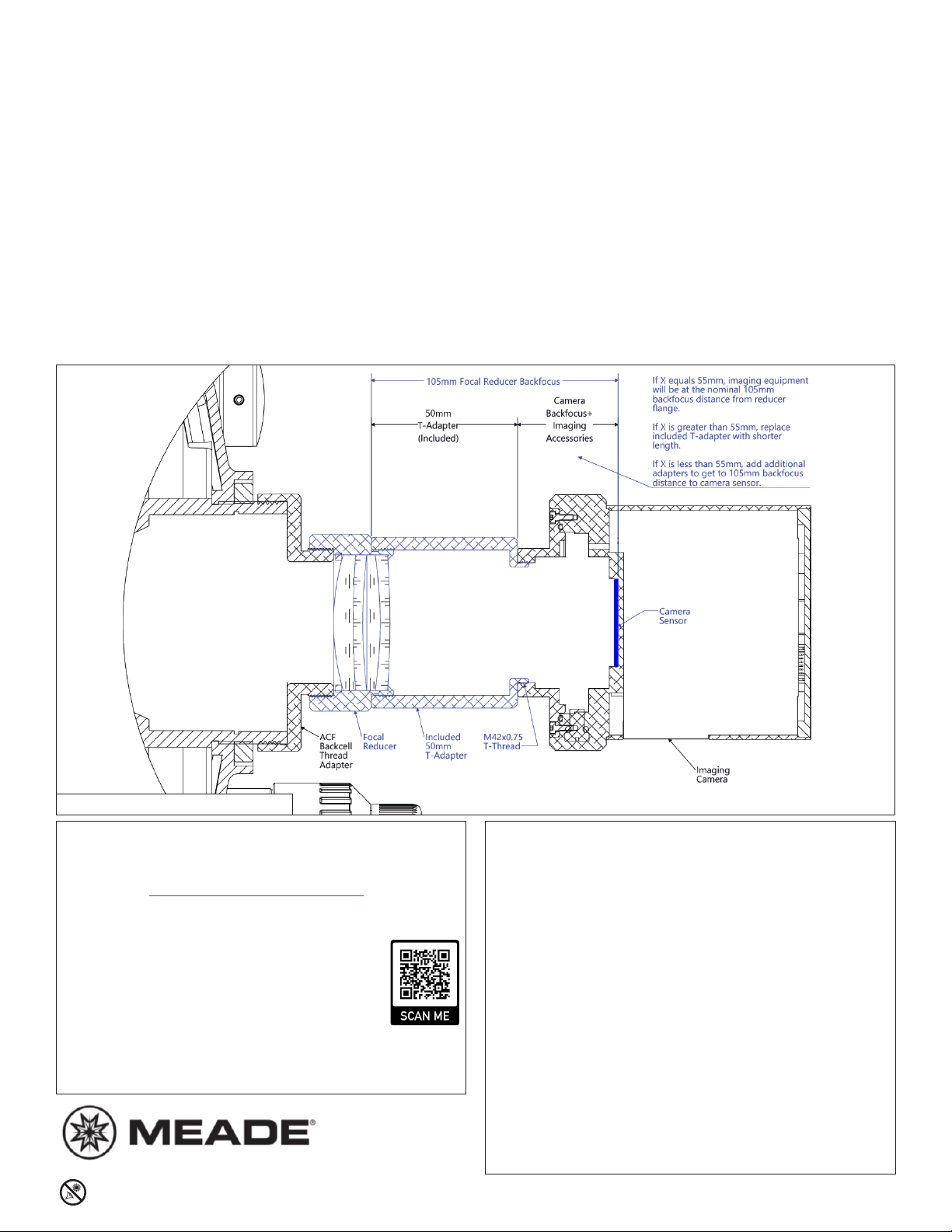
on. It boasts a generous 105mm of back-focus distance to the
image plane, measured from the reducer’s ange, or 100mm
on-axis from the last lens, allowing loads of space for imaging
train accessories such as a lter wheel and/or an o axis-guider.
Installaon:
To install the focal reducer onto your Meade ACF tele-
scope, rst remove the threaded protecve dust cap from
the reducer. Then thread the reducer directly onto the
back cell of the telescope using the 2”-24 TPI threads.
The included T-adapter, with a length of 50mm and an M42x0.75
thread, is well-suited for various applicaons to achieve the
nominal 105mm back focus required by the reducer. It’s suit-
able for use with DSLR cameras equipped with a t-ring, as
well as many cameras with a 55mm depth-to-sensor distance.
For dedicated astronomy cameras, addional adapters (us-
er-supplied) may be needed to reach the reducers nomi-
nal back focus distance. See Fig. 5. Various adapters of dif-
ferent length and aaching thread sizes are available from
third-party suppliers. These addional adapters typically con-
nect to the M42x0.75 t-thread connecon at the end of the
included T-adapter and then to your camera or lter wheel.
To determine the length of the addional adapter (if need-
ed), locate the depth-to-sensor distance for your camera.
This is oen called the camera backfocus. This is the dis-
tance from the cameras mounng point to the image sensor
and is usually found in the camera instrucons or webpage.
Next, measure the distance the other equipment in your
imaging train requires. This includes lter wheels, o-ax-
is guiders, electronic focusers, connecng adapters, and
anything else between the focal reducer and camera sen-
sor. Add up the camera’s backfocus distance and oth-
er image equipment distances. This is the total work-
ing distance (X) required by your imaging equipment.
Note: If using the Meade Zero-image Shi microfocuser, the
minimum needed backfocus for this device is 60mm with
the focuser draw tube fully retracted. When using this fo-
cuser, removal of the included 50mm T-adapter is necessary.
Since the focal reducers nominal back focus is 105mm when
measured from its mounng ange, subtract the distance in
mm your imaging equipment requires (X) from 105mm to
get the adapter length (Y) needed to reach nominal focus.
Meade ACF 0.68x Focal Reducer
with 50mm T-thread Adapter
Looking at or near the Sun will cause irreversible damage to your eye. Do not point this telescope at or near
the Sun without a proper solar filter attached.
Fig. 1: ACF 0.68x Focal Reducer Fig. 2: 50mm T-thread Adapter
Fig. 3: Focal Reducer Lens System
Fig. 4: Typical DSLR Conguration