the optical tube so it lines up with
your object.
Unlock the lock knobs: To move the
telescope, you will need to unlock the
horizontal (6) and vertical (5) lock knobs (just
rotate to unlock or lock; when locking, only
tighten to a “firm feel,” do not overtighten).
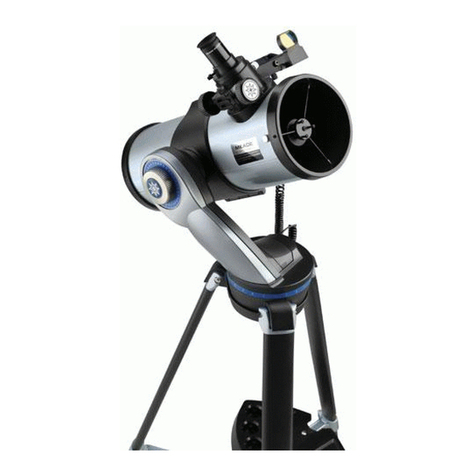
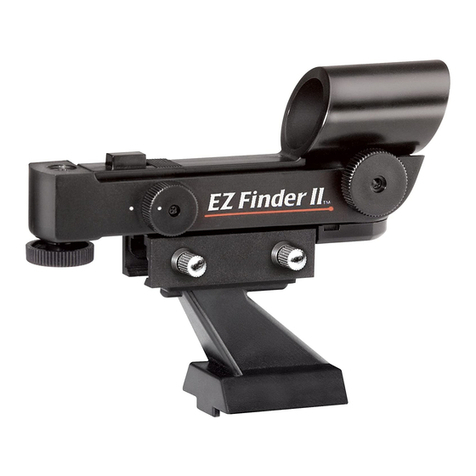
Use the red dot viewfinder: If you have not
done so, align the red dot viewfinder (2) with
the telescope’s eyepiece (1) as described
earlier. Look through the red dot viewfinder
until you can see the object. It will be easier
to locate an object using the red dot
viewfinder rather than locating with the
eyepiece. Line up the object using the
viewfinder's red dot.
Look through the eyepiece: Once you have
the object lined up in the viewfinder, look
through the optical tube’s eyepiece. If you
have aligned your viewfinder, you will you
see the object in your eyepiece.
Focus: Look through the eyepiece and
practice focusing on the object you have
chosen.
Try out the coarse and fine adjustment
controls: Practice using the fine
adjustment control (16) to move the
telescope. These can come in very handy,
especially when you wish to move the
telescope in very small (fine control) steps.
Observe the Moon: When you feel
comfortable with the viewfinder, the
eyepieces, the locks and the adjustment
controls, you will be ready to try out the
telescope at night. The Moon is the best
object to observe the first time you go out at
night. Pick a night when the Moon is a
6
TOO MUCH POWER?
Can you ever have too much power? If the type of
power you’re referring to is eyepiece magnification,
yes you can! The most common mistake of the
beginning observer is to “overpower” a telescope by
using high magnifications which the telescope’s
aperture and atmospheric conditions cannot
reasonably support. Keep in mind that a smaller,
but bright and well-resolved image is far superior
to one that is larger, but dim and poorly resolved.
Powers above 400x should be employed only under
the steadiest atmospheric conditions.
crescent. No shadows are seen during a full
Moon, making it appear flat and
uninteresting.
Look for different features on the Moon. The
most obvious features are craters. In fact
you can see craters within craters. Some
craters have bright lines about them. These
are called rays and are the result of material
thrown out of the crater when it was struck
by a colliding object. The dark areas on the
Moon are called maria and are composed of
lava from the period when the Moon still had
volcanic activity. You can also see mountain
ranges and fault lines on the Moon.
Use a neutral density filter (often called a
“moon filter”) when observing the Moon.
Neutral density filters are available from
Meade as an optional accessory and
enhance contrast to improve your
observation of lunar features. Spend several
nights observing the Moon. Some nights, the
Moon is so bright that it makes other objects
in the sky difficult to see. These are nights
that are excellent for lunar observation.