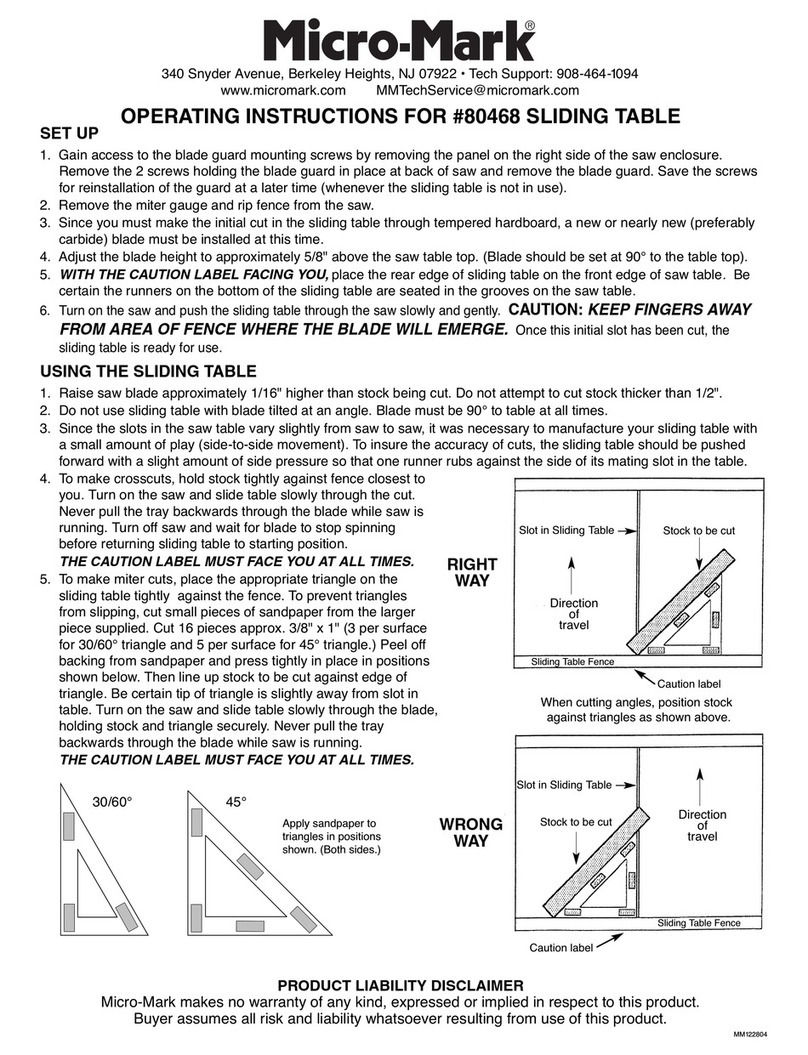
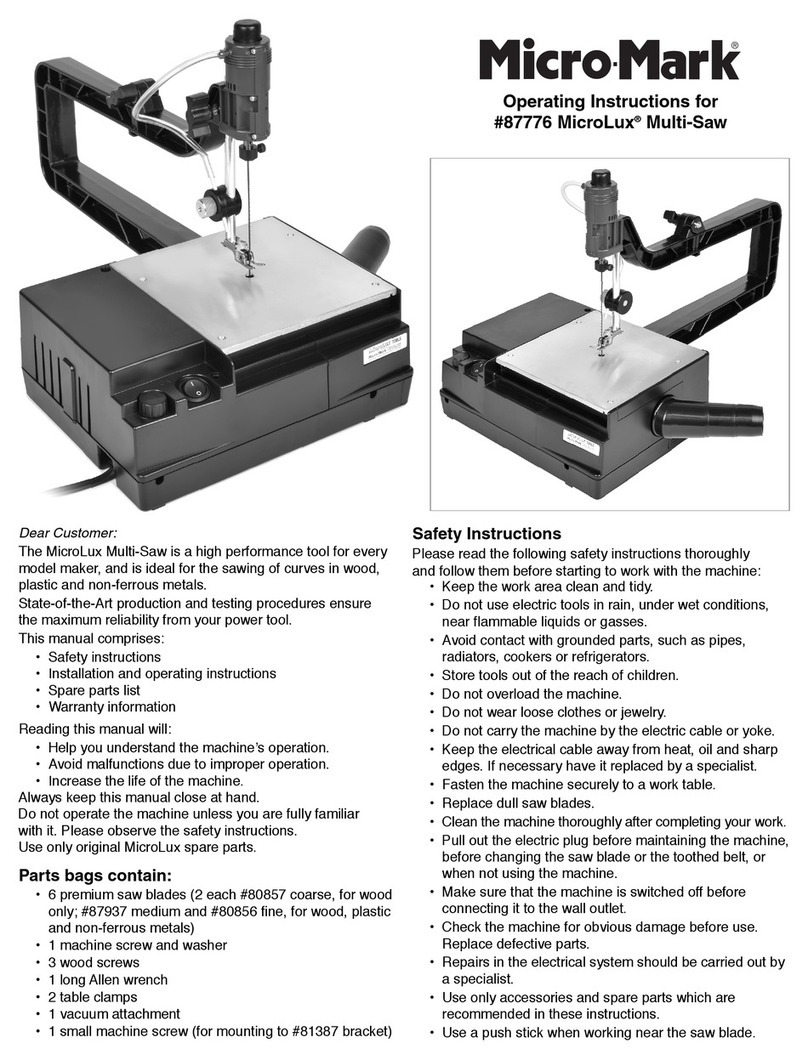
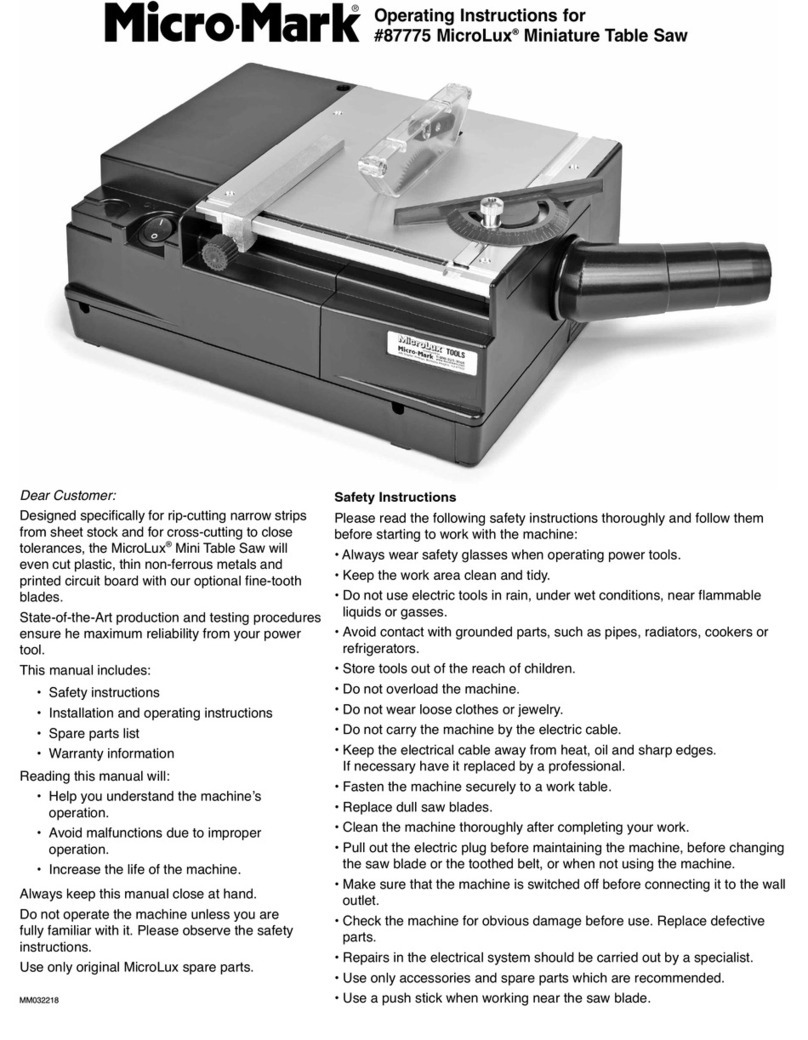
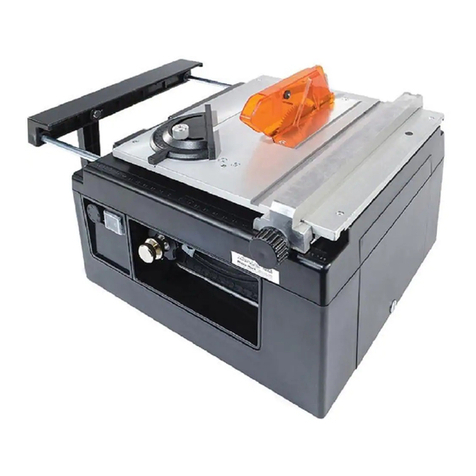
Open sliding door on right side of housing: To unlock door, turn
spring-loaded screw 1/4 turn or until it disengages. Slide door
forward to remove. Lower clamping ring “C” is visible inside
housing (Fig. 7). Plug in your scroll Saw. With speed control set
at slowest speed, cycle on/off switch quickly until the clamping
ring has reached the top of its stroke. Unplug unit.
Loosen set screw in the lower clamping ring with long Allen wrench
provided. Do not unscrew more than 2 turns or screw will fall out.
Insert saw blade between blade guide prongs (teeth downward,
facing forward) and into slot in lower assembly (Fig. 8). Adjust
WARNING!
To use the saw safely, accurately and to avoid vibration, it must
be secured to your table or workbench.
FASTE I G
THE MACHI E
Several options
are available. To
be portable, use
our saw mounting
plate (#81387), or
use the three
wood screws pro-
vided to mount the
saw to a piece of
3/4” pine or
plywood. Clamp
to the edge of
your bench with
C-clamps. These
methods do not
harm your table surface. If this is not a concern,
mount the saw directly to your bench with the three
wood screws. (Fig. 10).
Make a test cut. If saw will not cut, blade may not be inserted
deeply enough into lower blade chuck.
SPEED CO TROL
As a general rule, use slower speeds and finer blades (more
teeth) for thin materials and metal. Use faster speeds and coarser
blades (less teeth) for thick materials. Deciding on which blade to
use will come with experience and will vary depending on the
material being cut.
ADJUSTI G THE SAW BLADE GUIDE
Loosen the clamping screw 13 for the saw blade guide 1, set it as
low as possible, and tighten the clamping screw.
When sawing, always be sure to press material down against
table. Grip material firmly and feed slowly into the blade. If you
feed work too fast, blade may break or wander off the cutting line.
Keep blade guide tight against work whenever possible.
FREEHA D CUTTI G
Press the work piece firmly onto the working table and move it
slowly and with gentle forward force.
SAWI G WITH
RIP FE CE
Loosen the clamp-
ing screw for the rip
fence 8(Fig. 11)
and adjust it to the
desired width of the
workpiece.
ote: Maximum
width of workpiece
2-3/4"
SAWI G WITH
THE MITER GUIDE
Adjust the desired
angle on the miter
gauge. Hold the
workpiece tightly
against the miter
gauge and move it
together with the
miter gauge lightly
against the saw
blade (Fig. 12).
ote! Use only saw blades which are in good condition!
Replace blades when wear is apparent!
Always remove the plug from the wall outlet before
maintaining or cleaning the machine!
Do not leave the machine running while unattended!
2 3/4"
Fig. 7 Fig. 8 Fig. 9
A
B
C
A
B
C
A
B
C
Fig. 10
blade location so that at least 2 teeth are below table surface.
Orient blade vertically and tighten screw in “C”.
Depending on blade length, it may be necessary to “bow” the blade
slightly left or right in order to access the slot of upper locking ring
“B” (Fig. 9). Press downward on “A” to lower the clamping ring.
Hold in position with 1/8” to 1/4” of blade inserted into the slot of the
clamping ring. Tighten the set screw in “B.”
Blade should be perpendicular to table and should ride lightly in
blade guide roller. Adjust your blade and the roller in the guide as
necessary.
Plug in saw. Turn on and set at slowest speed. The spring under
knob “A” should NOT compress fully. If it does, loosen knob “A”
slightly. If spring still compresses fully, you may have not set the
blade into the lower clamping ring when it was at its highest point
of the stroke.
Reinstall blade into lower clamping ring per previous instructions.
Your unit should run smoothly throughout the speed range. If all
appears in good order, you can close and lock the sliding door.
Any standard jeweler’s blade can be used. If blade has cross
pins or is more than 5-1/2” long, it can be trimmed with wire
cutting pliers (Wear safety glasses).
BLADE I STALLATIO
WORKI G WITH THE SCROLL SAW
MAI TE A CE A D ADDITIO AL I FORMATIO
Frequently vacuum out the dust compartment.
Inspect blades periodically and replace as required.
Occasionally place a drop of oil on the upper and lower chuck
shafts. o other lubrication is required.
Should replacement parts become necessary, contact
Micro-Mark at 908-464-1094.
Fig. 11
Fig. 12