8
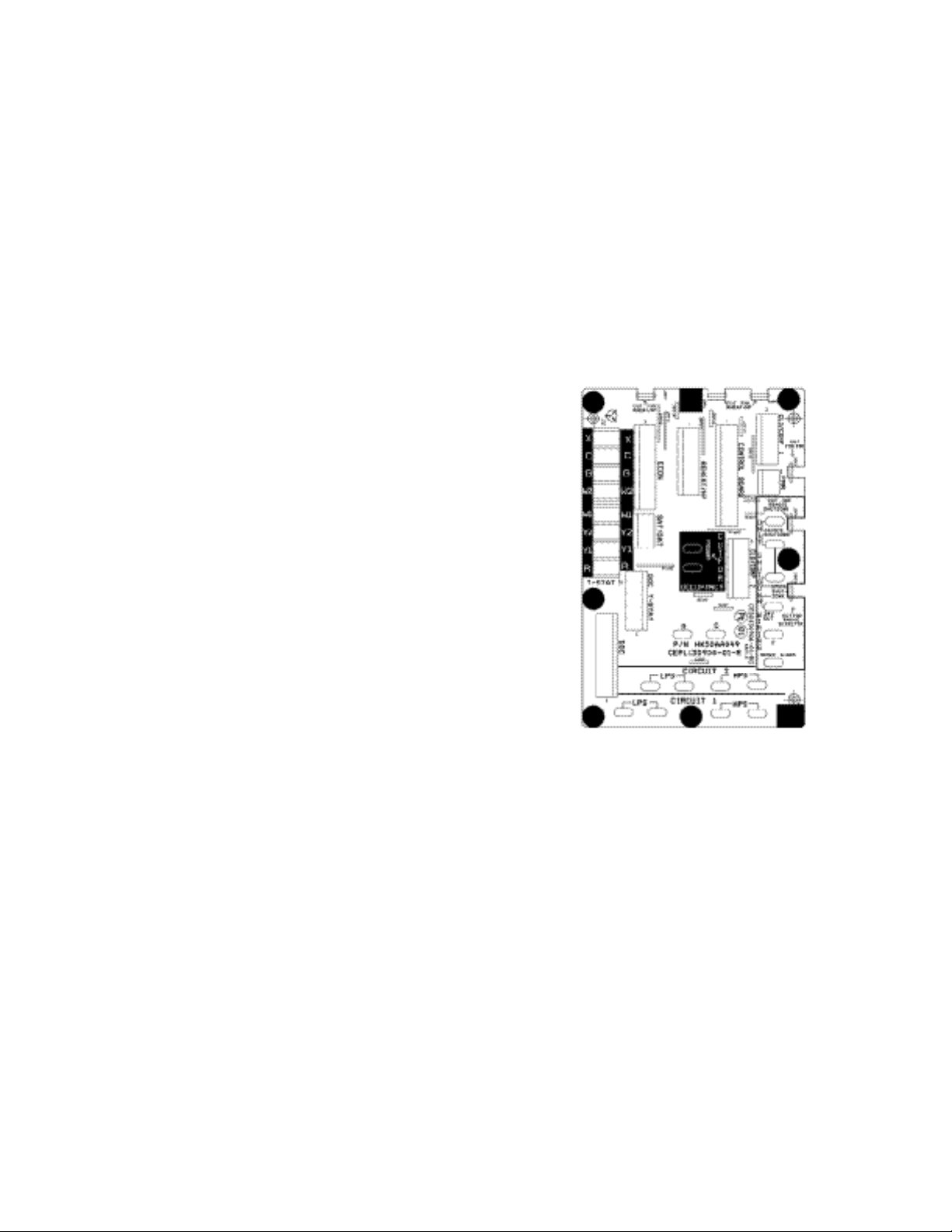
Fig. 17 - Central Terminal Board
MINIMUM DAMPER POSITION CONTROL —There is a minimum
damper position potentiometer on the W7212 controller. (See Fig. 11).
Adjust the Min Pos potentiometer to allow the minimum or base amount
of outdoor air, as required by local codes, to enter the building. Make
minimum position adjustments with at least 10°F temperature difference
between the outdoor and return-air temperatures. The minimum damper
position maintains the minimum airow for full occupancy into the
building during the occupied period when demand control ventilation is
not being used).
When the control is operating in Demand Control Ventilation (DCV)
mode (see separate section following), the minimum damper position sets
the minimum ventilation position for VOC (volatile organic compound)
contaminant removal during lightly occupied periods. In this mode the
DCV Max potentiometer is used for fully occupied ventilation.
NOTE: When DCV is not being used, set the DCV Max potentiometer
to completely closed (CCW) to insure that the Minimum Position
potentiometer functions correctly. If the DCV Max is set more open than
Min Pos and <1 Vdc is detected across the CO2 sensor terminals, then
DCV Max will override and become the actual lower limit on damper
position.
To determine the minimum position setting, perform the following
procedure:
1. Calculate the appropriate mixed air temperature using the following
formula:
(TO x OA/100) + (TR x RA/100) = TM
TO = Outdoor-Air Temperature
OA = Percent of Outdoor Air
TR = Return-Air Temperature
RA = Percent of Return Air
TM = Mixed-Air Temperature
As an example, if DCV is not being used and local codes require 10%
outdoor air during occupied conditions, outdoor-air temperature is 60°F,
and return-air temperature is 75°F.
(60 x 0.10) + (75 x 0.90) = 73.5°F
2. Disconnect the supply air sensor from terminals T and T1 (See
Fig. 14) and jumper them together. This fools the controller into
believing the mixed air temperature is 55 °F so it does not modulate
the damper.
3. Ensure that the factory-installed jumper is in place across terminals
P and P1 (for remote control of damper position see the paragraph
following.)
4. Connect 24 Vac across terminals TR and TR1(factory wiring should
ensure this if the 12-pin plug is connected. Carefully adjust the
Min Pos potentiometer until the measured mixed-air temperature
matches the calculated value. Measurement must be done with a
separate thermometer or sensor accurate to ± 0.5 °F because you
have fooled the unit controls in step 2 above.
5. If you are going to set the DCV maximum ventilation position
with the DCV Max potentiometer, do it now while you have 24Vac
across terminal TR & TR1. See the DEMAND CONTROLLED
VENTILATION section following.
6. Remove the jumper and reconnect the supply air sensor to terminals
T and T1.
REMOTE CONTROL OF DAMPER POSITION - Remote control
of the economizer damper is desirable when additional temporary
ventilation may be required. If a eld-supplied remote potentiometer
(such as Honeywell part number 9901-0101) is wired to the W7212
controller, the minimum position of the damper can be controlled from a
remote location. If remote damper positioning is being used, use the same
steps 1 & 2 above and then follow these additional steps to determine the
remote position setting for the desired percent airow.
3. Remove the factory installed black jumper connecting terminals P &
P1(See Fig. 7)
4. Turn the economizer Min Pos potentiometer fully clockwise.
5. Connect the remote minimum position potentiometer across
terminals P & P1.
6. Connect 24 Vac across terminals TR and TR1.
7. Carefully adjust the remote minimum position potentiometer until
the measured mixed-air temperature matches the calculated value.
8. Reconnect the supply air sensor to terminals T and T1.
DAMPER MOVEMENT — Damper movement from full open to full
close (or vice versa) takes 3 minutes.
DEMAND CONTROLLED VENTILATION (DCV)—Demand
controlled ventilation uses an optional accessory carbon dioxide (CO2)
sensor to measure the amount of CO2 in indoor air. The controller uses this
input to adjust outside air ventilation to maintain indoor air quality (IAQ)
based on a user congurable maximum CO2 level. This typically reduces
outside air intake requirements and therefore energy consumption.
When using the economizer for demand controlled ventilation, you will
need to adjust three controller potentiometers to set:
• the minimum damper position to ventilate the lightly occupied
building
• the triggering CO2 level to begin opening the damper
• the maximum damper position to provide fresh air to for a fully
occupied building.
The damper settings (in terms of % fresh air ow) and the CO2 level
in term of parts per million (ppm) should be provided to you by the
consulting engineer(s) on the job, calculated based on building codes
and/or ASHRAE Standard 62.1. Examples in this instruction use typical
numbers.