manuals.online logo
Brands
  1. Home
  2. •
  3. Brands
  4. •
  5. Milwaukee
  6. •
  7. Chainsaw
  8. •
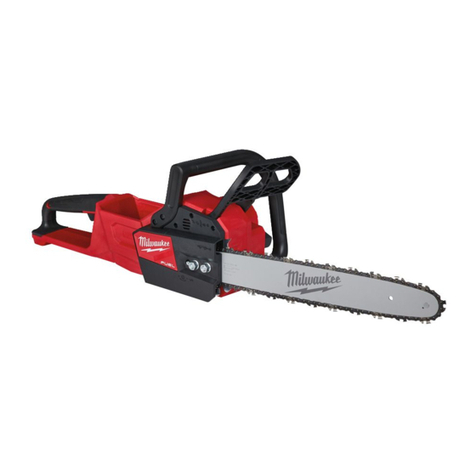
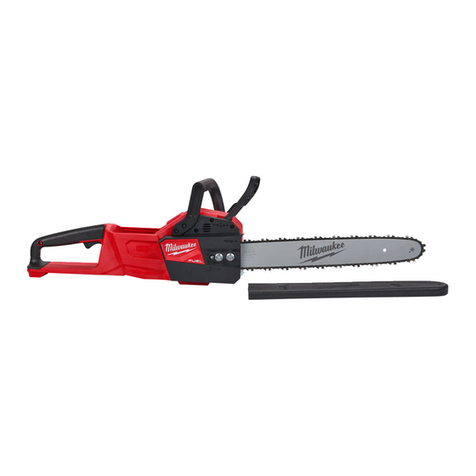
  9. Milwaukee M18 FUEL FTCHS12 User manual

Milwaukee M18 FUEL FTCHS12 User manual

This manual suits for next models

4

Other Milwaukee Chainsaw manuals

Milwaukee 6201 User manual

Milwaukee

Milwaukee 6201 User manual

Milwaukee 6210 User manual

Milwaukee

Milwaukee 6210 User manual

Milwaukee M18 FCHS User manual

Milwaukee

Milwaukee M18 FCHS User manual

Milwaukee M18 Fuel 2727-20 User manual

Milwaukee

Milwaukee M18 Fuel 2727-20 User manual

Milwaukee M18 FUEL 2727-20C User manual

Milwaukee

Milwaukee M18 FUEL 2727-20C User manual

Milwaukee 49-16-2732 User manual

Milwaukee

Milwaukee 49-16-2732 User manual

Milwaukee FM18 FCHS35 User manual

Milwaukee

Milwaukee FM18 FCHS35 User manual

Milwaukee M18 FCHS User manual

Milwaukee

Milwaukee M18 FCHS User manual

Milwaukee HATCHET M12 FHS User manual

Milwaukee

Milwaukee HATCHET M12 FHS User manual

Milwaukee M18 FCHS14 User manual

Milwaukee

Milwaukee M18 FCHS14 User manual

Milwaukee M18 FCHS-0 User manual

Milwaukee

Milwaukee M18 FCHS-0 User manual

Milwaukee 6215 User manual

Milwaukee

Milwaukee 6215 User manual

Milwaukee 49162715 Use and care manual

Milwaukee

Milwaukee 49162715 Use and care manual

Milwaukee M18 User manual

Milwaukee

Milwaukee M18 User manual

Milwaukee M18 FCHS User manual

Milwaukee

Milwaukee M18 FCHS User manual

Milwaukee 6215 User manual

Milwaukee

Milwaukee 6215 User manual

Milwaukee M18 FCHS User manual

Milwaukee

Milwaukee M18 FCHS User manual

Popular Chainsaw manuals by other brands

Husqvarna 435 Workshop manual

Husqvarna

Husqvarna 435 Workshop manual

Husqvarna 42, 242XP, 246 Operator's manual

Husqvarna

Husqvarna 42, 242XP, 246 Operator's manual

Makita EA3601FG instruction manual

Makita

Makita EA3601FG instruction manual

Premier MS-4815 instruction manual

Premier

Premier MS-4815 instruction manual

Echo CS-6703 parts catalog

Echo

Echo CS-6703 parts catalog

Husqvarna 1151338-95 Operator's manual

Husqvarna

Husqvarna 1151338-95 Operator's manual

Poulan Pro 380 Operator's manual

Poulan Pro

Poulan Pro 380 Operator's manual

Elem Garden Technic TRE2042SO-OR Original instructions

Elem Garden Technic

Elem Garden Technic TRE2042SO-OR Original instructions

Royal RPC 3835 Original operating instructions

Royal

Royal RPC 3835 Original operating instructions

Famastil F-Power instruction manual

Famastil

Famastil F-Power instruction manual

McCulloch M3816 instruction manual

McCulloch

McCulloch M3816 instruction manual

Echo CS-8000 TYPE1-E instruction manual

Echo

Echo CS-8000 TYPE1-E instruction manual

Echo CS-346 instruction manual

Echo

Echo CS-346 instruction manual

SNOWJOE sunjoe SWJ807E Operator's manual

SNOWJOE

SNOWJOE sunjoe SWJ807E Operator's manual

Husqvarna 555 Workshop manual

Husqvarna

Husqvarna 555 Workshop manual

Stiga A 305 Operator's manual

Stiga

Stiga A 305 Operator's manual

Bosch Ake 40 s Original instructions

Bosch

Bosch Ake 40 s Original instructions

Dolmar AS-3626 instruction manual

Dolmar

Dolmar AS-3626 instruction manual

manuals.online logo
manuals.online logoBrands
  • About & Mission
  • Contact us
  • Privacy Policy
  • Terms and Conditions

Copyright 2025 Manuals.Online. All Rights Reserved.

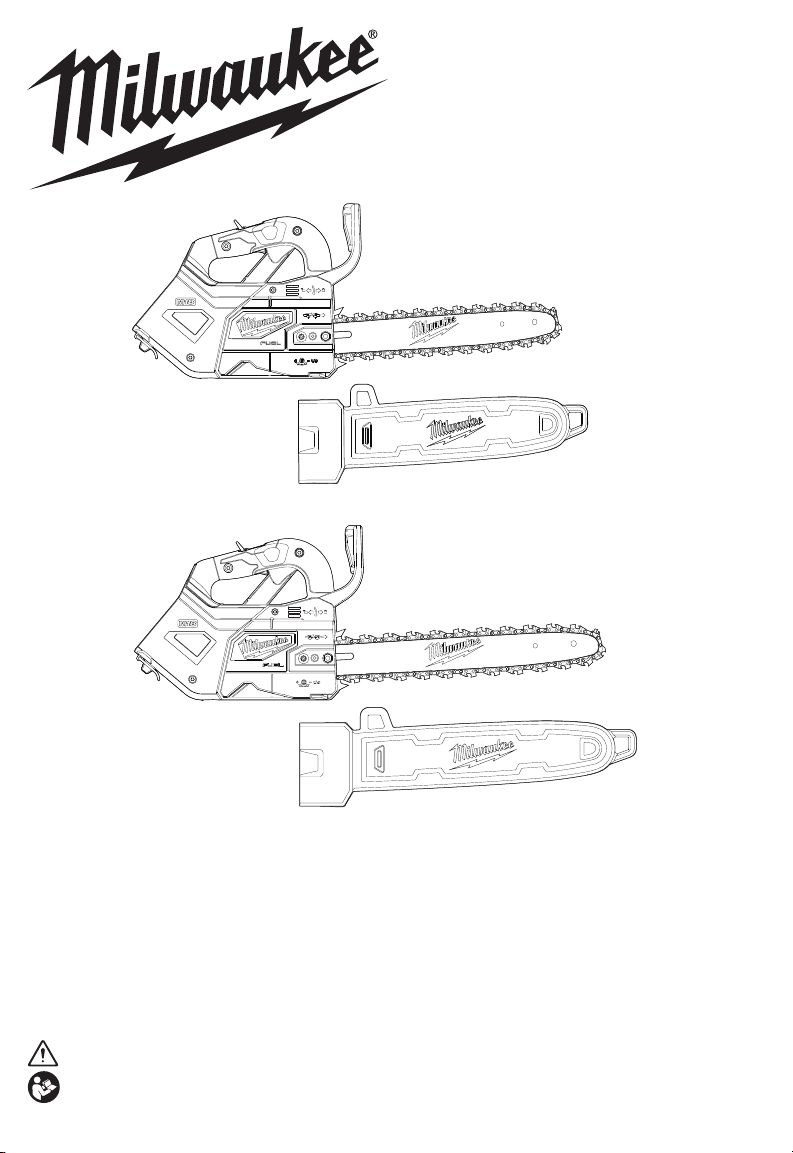
OPERATOR'S MANUAL
Cat. No.
M18 FTCHS12, M18 FTCHS14
WARNING
To reduce the risk of injury, user must read and understand operator's manual.
M18 FUEL™ 12" (305 MM) AND 14" (356 MM) TOP HANDLE
CHAINSAWS
2
GENERAL POWER TOOL
SAFETY WARNINGS
WARNING
Read all safety warnings, instruc-
-
•
WORK AREA SAFETY
•
ELECTRICAL SAFETY
Keep work area clean and well lit. Cluttered or
dark areas invite accidents.
Do not operate power tools in explosive atmo-
liquids, gases or dust. Power tools create sparks
which may ignite the dust or fumes.
tions provided with this power tool. Failure to follow
all instructions listed below may result in electric shock,
Save all warnings and in-
structions for future reference. The term "power tool"
in the warnings refers to your mains-operated (corded)
power tool or battery-operated (cordless) power tool.
•Keep children and bystanders away while operating
a power tool. Distractions can cause you to lose control.
PERSONAL SAFETY
as a dust mask, non-skid safety shoes, hard hat or
hearing protection used for appropriate conditions
will reduce personal injuries.
•Power tool plugs must match the outlet. Never
modify the plug in any way. Do not use any
adapter plugs with earthed (grounded) power
tools.
reduce risk of electric shock.
•Avoid body contact with earthed or grounded
surfaces, such as pipes, radiators, ranges and
refrigerators. There is an increased risk of electric
shock if your body is earthed or grounded.
•Do not expose power tools to rain or wet condi-
tions. Water entering a power tool will increase the
risk of electric shock.
•Do not abuse the cord. Never use the cord for
carrying, pulling or unplugging the power tool.
Keep cord away from heat, oil, sharp edges or
moving parts. Damaged or entangled cords increase
the risk of electric shock.
•When operating a power tool outdoors, use an
extension cord suitable for outdoor use. Use of
a cord suitable for outdoor use reduces the risk of
electric shock.
•Stay alert, watch what you are doing and use
common sense when operating a power tool. Do
not use a power tool while you are tired or under
A
moment of inattention while operating power tools
may result in serious personal injury.
•Use personal protective equipment. Always
wear eye protection. Protective equipment such
•Prevent unintentional starting. Ensure the switch
source and/or battery pack, picking up or carrying
the tool.
the switch or energising power tools that have the
switch on invites accidents.
•Remove any adjusting key or wrench before
turning the power tool on. A wrench or a key left
attached to a rotating part of the power tool may
result in personal injury.
POWER TOOL USE AND CARE
•Do not overreach. Keep proper footing and
balance at all times. This enables better control
of the power tool in unexpected situations.
•If devices are provided for the connection of
dust extraction and collection facilities, ensure
these are connected and properly used. Use of
dust collection can reduce dust-related hazards.
•Do not let familiarity gained from frequent use
of tools allow you to become complacent and
ignore tool safety principles. A careless action can
cause severe injury within a fraction of a second.
taking into account the working conditions and
the work to be performed. Use of the power tool
result in a hazardous situation.
BATTERY TOOL USE AND CARE
•Keep handles and grasping surfaces dry, clean
and free from oil and grease. Slippery handles and
grasping surfaces do not allow for safe handling and
control of the tool in unexpected situations.
•Do not force the power tool. Use the correct power
tool for your application. The correct power tool
will do the job better and safer at the rate for which
it was designed.
•Do not use the power tool if the switch does not
Any power tool that cannot be
controlled with the switch is dangerous and must be
repaired.
•Disconnect the plug from the power source and/
or remove the battery pack, if detachable, from
the power tool before making any adjustments,
changing accessories, or storing power tools.
Such preventive safety measures reduce the risk of
starting the power tool accidentally.
•Store idle power tools out of the reach of children
and do not allow persons unfamiliar with the
power tool or these instructions to operate the
power tool. Power tools are dangerous in the hands
of untrained users.
•Maintain power tools and accessories. Check
for misalignment or binding of moving parts,
breakage of parts and any other condition that
have the power tool repaired before use. Many ac-
cidents are caused by poorly maintained power tools.
•Keep cutting tools sharp and clean. Properly
maintained cutting tools with sharp cutting edges
are less likely to bind and are easier to control.
•Use the power tool, accessories and tool bits
etc. in accordance with these instructions,
manufacturer. A charger that is suitable for one type
with another battery pack.
battery packs. Use of any other battery packs may
•When battery pack is not in use, keep it away
from other metal objects, like paper clips, coins,
keys, nails, screws or other small metal objects,
that can make a connection from one terminal
to another. Shorting the battery terminals together
•
•
If operating a power tool in a damp location is
unavoidable, use a residual current device
(RCD) protected supply. Use of a RCD reduces
the risk of electric shock.
Dress properly. Do not wear loose clothing or
jewellery. Keep your hair and clothing away
from moving parts. Loose clothes, jewellery or
long hair can be caught in moving parts.
3
SERVICE
General chainsaw safety warnings:
SPECIFIC SAFETY RULES
FOR CHAINSAWS
repair person using only identical replacement
parts. This will ensure that the safety of the power
tool is maintained.
•Never service damaged battery packs. Service
of battery packs should only be performed by the
manufacturer or authorised service providers.
•Under abusive conditions, liquid may be ejected
from the battery; avoid contact. If contact acciden-
eyes, additionally seek medical help. Liquid
ejected from the battery may cause irritation or burns.
•
•
•Keep all parts of the body away from the saw
chain when the chainsaw is operating. Before you
start the chainsaw, make sure the saw chain is
not contacting anything. A moment of inattention
while operating chainsaws may cause entanglement
of your clothing or body with the saw chain.
•Always hold the chainsaw with your right hand
on the rear handle and your left hand on the front
handle. Holding the chainsaw with a reversed hand
should never be done.
•Hold the chainsaw by insulated gripping surfaces
only, because the saw chain may contact hidden
wiring or its own cord. Saw chains contacting a
"live" wire may make exposed metal parts of the
chainsaw "live" and could give the operator an
electric shock.
•Wear eye protection. Further protective equip-
ment for hearing head, hands, legs, and feet is
recommended. Adequate protective clothing will
contact with the saw chain.
•
•Always keep proper footing and operate the
and level surface. Slippery or unstable surfaces may
cause a loss of balance or control of the chainsaw.
•When cutting a limb that is under tension be alert
for spring back.
is released the spring loaded limb may strike the
operator and/or throw the chainsaw out of control.
•Use extreme caution when cutting brush and sap-
lings. The slender material may catch the saw chain
•
•Follow instructions for lubricating, chain tension-
ing and changing the bar and chain. Improperly
tensioned or lubricated chain may either break or
increase the chance for kickback.
•Cut wood only. Do not use chainsaw for purposes
not intended. For example: do not use chainsaw
for cutting metal, plastic, masonry or non-wood
building materials. Use of the chainsaw for opera-
-
ous situation.
•This chainsaw is not intended for tree felling.
intended could result in serious injury to the operator
or bystanders.
•
Causes and operator prevention of kickback:
Kickback may occur when the nose or tip of the guide
bar touches an object, or when the wood closes in and
pinches the saw chain in the cut.
Tip contact in some cases may cause a sudden
reverse reaction, kicking the guide bar up and back
towards the operator.
Pinching the saw chain along the top of the guide
bar may push the guide bar rapidly back towards
the operator.
Either of these reactions may cause you to lose con-
trol of the saw which could result in serious personal
injury. Do not rely exclusively upon the safety devices
built into your saw. As a chainsaw user, you should
take several steps to keep your cutting jobs free from
accident or injury.
Kickback is the result of chainsaw misuse and/or incor-
rect operating procedures or conditions and can be
avoided by taking proper precautions as given below:
• -
circling the chainsaw handles, with both hands on
the saw and position your body and arm to allow
you to resist kickback forces. Kickback forces can
be controlled by the operator, if proper precautions
are taken. Do not let go of the chainsaw.
•Do not overreach and do not cut above shoulder
height. This helps prevent unintended tip contact and
enables better control of the chainsaw in unexpected
situations.
•Only use replacement guide bars and saw chains
Incorrect replace-
ment guide bars and saw chains may cause chain
breakage and/or kickback.
•Follow the manufacturer’s sharpening and
maintenance instructions for the saw chain.
Decreasing the depth gauge height can lead to in-
creased kickback.
•Use extreme caution to reduce the risk of falling.
Keep the saw chain well clear of any harness and
lifeline to prevent them from being severed.
•Do not attempt to block a tree until you have an
understanding of all the risks and how to avoid
them. Serious injury could occur to the operator or
bystanders from a blocking tree.
Do not use a battery pack or tool that is
damaged or modified. Damaged or modified
batteries may exhibit unpredictable behaviour
resulting in fire, explosion or risk of injury.
•
Do not expose a battery pack or tool to fire or
excessive temperature. Exposure to fire or
temperature above 130°C (265°F) may cause
explosion
Follow all charging instructions and do not
charge the battery pack or tool outside the
temperature range specified in the instruc-
tions. Charging improperly or at temperatures
outside the specified range may damage the
battery and increase the risk of fire.
Do not operate a chainsaw on a ladder, from a
rooftop, or any unstable support. Operation of a
chainsaw in this manner could result in serious
personal injury.
Carry the chainsaw by the front handle with the
chainsaw switched off and away from your
body. When transporting or storing the chain-
saw always fit the guide bar cover. Proper
handling of the chainsaw will reduce the likelihood
of accidental contact with the moving saw chain.
Do not operate a chainsaw in a tree unless you
have been specifically trained to do so.
Operation of a chainsaw in a tree without proper
training could increase the risk of serious personal
injury.
4
Other Chainsaw Safety Rules
•
•
Keep handles dry, clean, and free from oil and
grease. Greasy, oily handles are slippery causing
loss of control.
Do not operate a chainsaw with one hand! Use
chainsaw handles. Serious injury to the operator,
helpers, bystanders, or any combination of these
persons may result from one-handed operation. A
chainsaw is intended for two-handed use.
piece involved. For example, felling a tree requires
a larger work area than making bucking cuts.
•Do not operate a chainsaw that is damaged, im-
properly adjusted, or not completely and securely
assembled. Chain should slow to a stop when the
switch trigger is released. If the chain continues to
turn after the switch trigger has been released, have
the unit serviced by an authorised service centre.
•Always maintain a proper stance.
•Do not adapt your powerhead to a bow guide or
use it to power any attachments or devices not
listed for the saw.
•Do not cut vines and/or small underbrush.
NOTE: The size of the work area depends on the
job being performed as well as the size tree or work
•Do not start cutting until you have a clear work
area, secure footing, and a planned retreat path
from the falling tree. Cluttered areas invite ac-
cidents.
•Keep ALL children, bystanders, visitors, and
animals out of the work area while starting or
cutting with the chainsaw.
•
•Heavy protective clothing may increase operator
fatigue, which could lead to heat stroke. During
weather that is hot and humid, heavy work should be
scheduled for early morning or late afternoon hours
when temperatures are cooler.
•
•Always be aware of what you are doing when
using the chainsaw. Use common sense. Do not
operate the chainsaw when you are tired, ill, or under
•Keep all parts of your body away from the saw
chain when the unit is running.
•Before you start the unit, make sure the saw chain
is not contacting any object.
•Stop the chainsaw before setting it down. Make
sure the tool comes to a complete stop before lay-
ing it down.
•Maintain the unit with care. Keep the cutting edge
sharp and clean for best performance and to reduce
the risk of injury. Follow instructions for lubricating
and changing accessories.
WARNING
•Do not force the chainsaw. The job can be per-
formed better and safer at the rate for which it was
intended.
•Always use the right product for your application.
The chainsaw should be used for cutting wood only.
Never use the chainsaw to cut plastic, masonry or
non-wood building materials.
•
•Battery operated units do not have to be plugged
into an electrical outlet; therefore, they are always
in operating condition. Be aware of possible haz-
ards even when unit is not operating.
•Never let anyone use your chainsaw who has
not received adequate instructions in its proper
use. This applies to rentals as well as privately
owned saws.
•Save these instructions. Refer to them frequently
and use them to instruct others who may use this
product. If you loan someone this product, loan them
these instructions also.
•After each use, clean the machine with a soft dry
cloth. Remove any chips, dirt and debris in the
battery bay.
•If using with a lanyard, do not exceed maximum
capacity marked on the lanyard label. Always
determine the weight of the product, with all accesso-
ries, when selecting the appropriate lanyard system.
Exceeding maximum capacity may result in serious
injury.
•Use with energy absorbing lanyards or dynamic
climbing rope only. Other ropes, straps or chains
may break and cause failure. Do not use with lan-
yards at full tension.
•Do not hang tool from guide bar cover loops.
•
Follow all instructions when clearing jammed
material, storing or servicing the chainsaw.
Make sure the switch is off and the battery pack
is removed. Unexpected actuation of the
chainsaw while clearing jammed material or
servicing may result in serious personal injury.
Dress Properly - Wear snug fitting clothing.
Always wear heavy, long pants, long sleeves,
overalls, jeans or chaps made of cut resistant
material or ones that contain cut resistant inserts.
Wear non-slip safety footwear. Wear non-slip
heavy duty gloves to improve your grip and to
protect your hands. Do not wear jewellery, short
pants, sandals, or go barefoot. Do not wear loose
fitting clothing, which could be drawn into the
motor or catch the chain or underbrush. Secure
hair so it is above shoulder level.
Wear approved head protection suitable for
your application, such as a hat or helmet for
impact protection, that complies with
AS/NZS 1801.
Do not operate a chainsaw on a ladder, rooftop,
or other unstable support; this is extremely
dangerous.
•
•
•
Maintain labels and nameplates. These carry
important information. If unreadable or missing,
contact a MILWAUKEE®service facility for a
replacement.
To reduce the risk of injury,
when working in dusty
situations, wear appropriate respiratory
protection or use a suitable dust extraction
solution.
Always use common sense and be cautious
when using tools. It is not possible to anticipate
every situation that could result in a dangerous
outcome. Do not use this tool if you do not
understand these operating instructions or you feel
the work is beyond your capability; contact
MILWAUKEE®Tool or a trained professional for
additional information or training.
Store chainsaw when not in use. Chainsaw
should be stored in a dry and high or locked area
out of the reach of children. When storing the
chainsaw place the Guide Bar Cover on the bar
and chain.

WARNING
Some dust created
sawing, grinding, drilling, and other
by power sanding,
construction activities contains chemicals known to
cause cancer, birth defects or other reproductive
harm. Some examples of these chemicals are:
•lead from lead-based paint
•crystalline silica from bricks and cement and other
masonry products, and
•arsenic and chromium from chemically-treated lumber.
Your risk from these exposures varies, depending on
how often you do this type of work. To reduce your
exposure to these chemicals: work in a well ventilated
area, and work with approved safety equipment, such
as those dust masks that are specially designed to
5
SYMBOLOGY
Volts
Direct Current
No Load Revolutions per Minute (RPM)
Read operator’s manual
Wear eye, hearing, and head protection
WARNING
Beware of kickback.
Avoid contact with bar tip
Always use chainsaw two-handed
Do not use chainsaw one-handed
Do not expose to rain or use in damp
locations.
Wear protective gloves
Wear non-slip safety footwear
Chain Brake UNLOCKED/LOCKED
Chain Oil Reservoir
Chain Direction
Chain Tension Adjustment
ADDITIONAL BATTERY SAFETY RULES
WARNING
WARNING
To reduce the risk of fire, personal
injury, and product damage due to
a short circuit, never immerse your tool, battery
pack or charger in fluid or allow a fluid to flow inside
them. Corrosive or conductive fluids, such as
seawater, certain industrial chemicals, and bleach
or bleach-containing products, etc., can cause a
short circuit.
Do not charge non-rechargeable
batteries.
12" (305 mm) Cat. No. ...................... M18 FTCHS12
14" (356 mm) Cat. No. ...................... M18 FTCHS14
Volts................................................................ 18V DC
Battery Type ..................................................... M18™
Charger Type.................................................... M18™
RPM................................................................... 7,700
Chain Speed................................................... 15 m/s
Bar Length.................... 12" (305 mm) / 14" (356 mm)
Cutting Capacity ................................11.5" (292 mm) /
Bar Groove Width.............................. 0.043" (1.1 mm)
12" (305 mm) Replacement Bar ................. 49162743
14" (356 mm) Replacement Bar ................. 49162745
12" (305 mm) Replacement Chain ............. 49162742
14" (356 mm) Replacement Chain ............. 49162744
Chain Type ............................................Low Kickback
12" (305 mm) Chain Teeth ..................................... 51
Weight of bare tool
14" (356 mm) Chain Teeth ..................................... 59
Recommended Ambient
with 14" (356 mm) bar and chain .................. 3.9 kg
Operating Temperature...................... -17°C to 51°C
SPECIFICATIONS
Keep bystanders at least 15 m away
during use.
13.5" (343 mm)
Chain Pitch (Low Profile)............... 0.325" (8.3 mm)
Do not dispose of electric tools
together with household waste
material. Electric tools and electronic
equipment that have reached the end
of their life must be collected
separately and returned to an
environmentally compatible recycling
facility.
Regulatory Compliance Mark (RCM).
This product meets applicable
regulatory requirements.
This saw should only be used by
persons who are specifically
trained in tree maintenance work.
Chain Oil Tank Capacity............................... 150 ml
V
6
3.
4.
5.
6.
7.
Remove the chain from the guide bar groove.
cutters from digging in too deeply at the kickback
zone. Only use replacement chain that is equivalent
to original chain or has been certified as low
kickback chain per ANSI B175.1.
As saw chains are sharpened during their useful life,
they lose some of the low kickback qualities and extra
caution should be used.
WARNING
Recharge only with the charger
WARNING
Always remove battery pack before
changing or removing accessories.
s
for thi
WARNING
rec
Only
o
use
mmended
accessorie
may be hazardous.
Replacing/Adjusting the
Saw Chain and Bar
s tool. Others
-
manual supplied with your charger and battery.
Before removing or inserting a battery, push the
hand guard/chain brake forward to ensure the
brake is locked.
Removing/Inserting the Battery
To remove the battery, push in the release buttons
and pull the battery pack away from the tool.
WARNING
the
Always
battery
lock
pack
the
any
trigger
time
or
the
remove
tool
is not in use.
To insert the battery, slide the pack into the body
of the tool. Make sure it latches securely into place.
CAUTION
Chain is sharp. Always wear
protective gloves when handling
the chain.
CAUTION
Saw Chain is sharp. Inspect guide
ASSEMBLY
CAUTION
Saw Chain is sharp.
tensioning
turning the chain
screw
Remove the drive cover
by removing the guide
bar nut using the
scrench.
Loosen the chain by
1. Remove the battery pack.
2. Place the saw on a flat, firm surface.
Use Low Kickback Saw Chains - The rakers
(depth gauges) ahead of each cutter can minimise
the force of a kickback reaction by preventing the
anti-clockwise with the
scrench.
Pull the guide bar off of the guide bar bolts and
unloop the chain from the drive hub.
bar for cracks or wear; replace if
damaged.
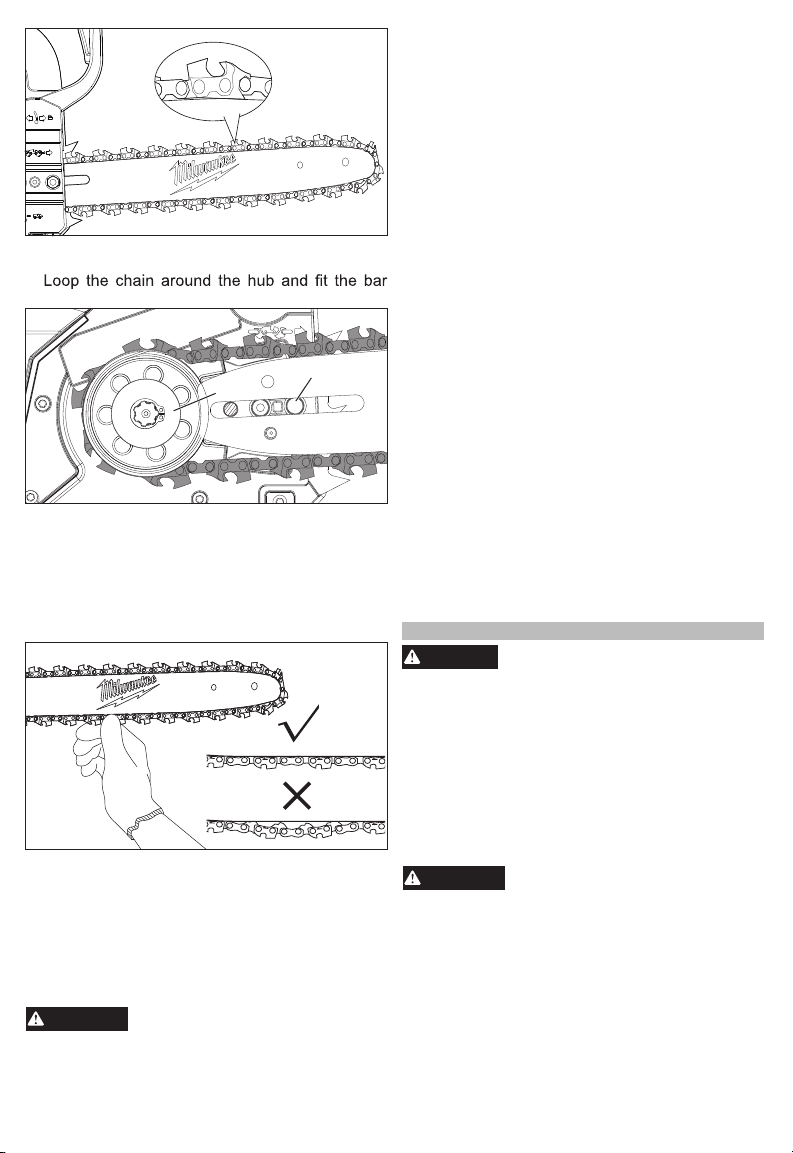
Wrap the new or sharpened chain around the
guide bar in the direction indicated on the
saw . When replacing dull chains with
sharp chains it is good practice to flip the guide
bar from bottom to top.
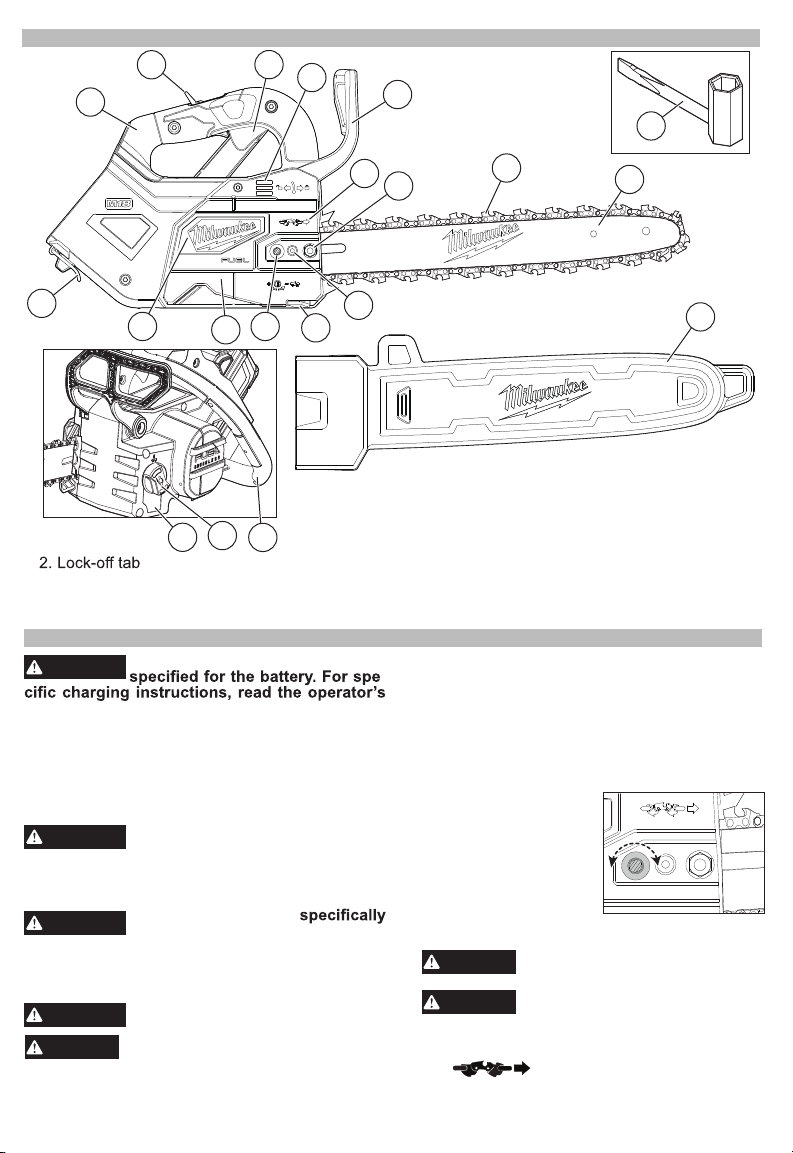
FUNCTIONAL DESCRIPTION
1. Rear handle
3. Variable speed trigger
4. Chain brake cleanout
5. Hand guard/chain brake
17 16
18
23
5
689
7
12
14
15
20
1
11
10
19
13.Chain catch
14.Chain tension screw
15.Drive cover
16.Front handle
17.Oil cap
18.Oil reservoir
19.Brake band (internal)
20.Lanyard Loop
4
13
6. Direction of rotation
indicator
7. Guide bar nut
8. Saw chain
9. Guide bar
10.Adjustment tool
11. Guide bar cover
12.Locating pin
7
8.
9.
Ensure the chain is properly set in the slot around
the entire guide bar.
around the bolts.
Hub Bolt
10. Reinstall the drive cover.
11.
• The tension is correct when the chain snaps
back after being pulled 3 mm (1/8") away from
the guide bar. No sag should be visible in the
chain.
Chain Oil
12. Tighten the guide bar nut securely.
WARNING
• Do not over-tension the chain - excess tension will
cause excessive wear and will reduce the life of
the chain and could damage the bar.
•
1. Remove the battery pack.
2. Place the saw on a flat, firm surface, drive cover
side down.
3. Unscrew the oil cap.
4. Carefully fill reservoir with chain oil.
5. Tighten oil cap securely.
accessories.
Fill oil reservoir with chain oil before starting
the chainsaw and when tank is less than 1/4 full.
Failure to oil the chain will cause damage to the
bar and chain.
Check oil level frequently and fill the oil reservoir
after each full battery discharge. Use a high quality
chain oil. The oil will keep the saw chain and guide
bar properly lubricated. Never run the saw without
chain oil. Keep the reservoir more than 1/4 full to
ensure sufficient oil is available for the job. Always
lightly oil the chain when storing to prevent rust.
Always empty the oil tank when storing to prevent
leakage.
It is recommended to use a vegetable based chain
oil when pruning trees. Mineral oil may harm trees.
Never use waste oil, automotive oil, or very thick
oils. These could damage the chainsaw.
Filling the Oil Reservoir
•
Always remove battery pack
before changing or removing
Use the scrench to rotate the chain tensioning
screw to increase tension (clockwise) until the
chain is snug around the guide bar. If the lubrication system still does not work
properly, contact a MILWAUKEE®service
facility.
6.
7. Repeat as needed during use.
8. Periodically check that the saw chain is lubricat-
ing correctly:
• With a full reservoir, hold the tool with the tip of
the guide bar pointing at a light-colored surface.
• Run the tool for approximately 30 seconds.
• An oil line should become visible on the light
surface.
• If not, remove and clean the guide bar thor-
oughly. Ensure the guide bar sprocket (at the
tip) rotates freely.
Perform a functional test of the chain brake,
lockoff tab, and variable speed trigger.
New chains could stretch and loosen during
initial use. Remove battery pack and check
chain tension frequently during the first two
hours of use.
OPERATION
DANGER
Never cut near power lines, electric
always wear proper eye
protection marked to comply with
AS/NZS 1337.1.
When working in dusty situations, wear
appropriate respiratory protection or marked to
comply with AS/NZS 1716.
cords, or other electric sources. If
bar and chain jams on any electrical cord or line,
DO NOT TOUCH THE BAR OR CHAIN! THEY CAN
BECOME ELECTRICALLY LIVE AND VERY DAN-
GEROUS. Continue to hold the chainsaw by the
insulated rear handle or lay it down and away
from you in a safe manner. Disconnect the elec-
trical service to the damaged line or cord before
attempting to free the bar and chain from the line
or cord. Contact with the bar, chain, other con-
ductive parts of the chainsaw, or live electric
cords or lines will result in death by electrocution,
electric shock, or serious personal injury.
WARNING
To reduce the risk of injury,
8
Kickback
WARNING
Kickback may occur
when the moving chain
Read and understand all instructions. Failure to
follow all instructions listed below may result in
Operating this chainsaw in a tree requires special
working techniques, which must be observed to
reduce the risk of personal injury. Never work in
-
sional training for such work, including training
in the use of safety equipment and other climb-
ing equipment, such as harnesses, ropes, belts,
climbing irons, snap hooks, carabiners, etc.
contacts an object at the upper portion
of the tip of the guide bar or when the
wood closes in and pinches the saw
chain in the cut. Contact at the upper
•
•
•Keep the chainsaw running at full speed the
entire time you are cutting.
•Allow the chain to cut for you. Exert only light
pressure. Do not put pressure on chainsaw at
end of cut.
•When not in use always have the chain brake
engaged and battery removed.
•Do not use any attachments or accessories not
recommended by the manufacturer. The use of
attachments or accessories not recommended
can result in serious personal injury.
Tethering
For tethering with dynamic climbing rope or energy
absorbing lanyards only. Do not hang tool from guide
bar cover.
•
Guard against kickback which can result in
severe injury or death. See important safety
instructions in Kickback section to avoid the
risk of kickback.
Wear approved head protection, such as a hard
hat or helmet for impact protection, that
complies with AS/NZS 1801.
•Do not overreach. Do not cut above shoulder
apart. Divide your weight evenly on both feet.
•
•Do not allow familiarity with this product to make
you careless. Remember that a careless fraction
handle and your right hand on the rear handle
so that your body is to the left of the guide bar.
•
•
•
Do not hold chainsaw by hand guard/chain
brake. Keep elbow of left arm locked so that left
arm is straight to withstand kickback.
Never use a cross-handed grip (left hand on the
rear handles and right hand on the front handle).
Never allow any part of your body to be in line
with the guide bar when operating the chainsaw.
Never operate while in any awkward position or
on a ladder or other unstable surface. You may
lose control of saw causing severe injury.
•This chainsaw is not intended for tree felling.
intended could result in serious injury to the
operator or bystanders. Cutting a limb that
has a diameter greater than the saw's cutting
capacity requires advanced techniques and
should only be performed by properly trained
professionals. Performing these types of cuts
can cause an accident and result in death or
serious personal injury.
The following precautions should be followed to
minimise kickback:
•
portion of the tip of the guide bar can cause the chain
to dig into the object and stop the chain for an instant.
The result is a lightning fast, reverse reaction which
kicks the guide bar up and back toward the operator.
If the saw chain is pinched along the top of the guide
bar, the guide bar can be driven rapidly back toward
the operator. Either of these reactions can cause loss
of saw control which can result in serious injury. Do
not rely exclusively upon the safety devices built into
the saw. As a chainsaw user, you should take sev-
eral steps to keep your cutting jobs free from accident
or injury.
left arm will help you maintain control of the saw if
kickback occurs.
hands when the unit is running. Place
your right hand on the rear handle and
your left hand on the front handle with
•Make sure that the area in which you are cutting is
free from obstructions. Do not let the nose of the
guide bar contact a log, branch, fence, or any other
obstruction that could be hit while you are operat-
ing the saw.
•Always cut with the unit running at full speed. Fully
squeeze the throttle trigger and maintain a steady
cutting speed.
•Use only the replacement guide bars and low
the saw.
Before Cutting
1.
2.
3.
Inspect the chain catch.
Check the oil level, chain tension and sharpness,
and guide bar.
Perform a functional test of the chain brake,
lockoff tab, and variable speed trigger.
With a basic understanding of kickback, you can
reduce or eliminate the element of surprise. Sud-
den surprise contributes to accidents.
Keep proper footing and balance at all times.
9
when cutting.
•Do not cut above shoulder height or overreach
•Follow the sharpening and maintenance instructions
for the saw chain.
•Push and Pull - This reaction force is always oppo-
site to the direction the chain is moving where wood
contact is made. Thus, the operator must be ready to
control the PULL when cutting on the bottom edge of
the bar, and PUSH when cutting along the top edge
.
Reaction
Direction
of rotation
Direction
Reaction
of rotation
Chain Brake
To reduce the risk of accidents, the chain brake will
stop the chain if kickback occurs. When the brake is
pushed forward, toward the tip of the guide bar, the
saw will not run. Use the chain brake when transport
ing or storing the saw.
STOP
Turning the Tool ON/OFF
WARNING
Always be sure of your
6.
5.
footing and grip the
The fingers should encircle the
handle and the thumb should be
wrapped under the handlebar to
resist kickback. Keep body to the left of the chain
line. Always keep your left hand on the fron
handle and your right hand on the rear handle so
that your body is to the left of the chain line.
Never straddle the saw or chain, or lean over pas
-
t
t
the chain line.
Wear non-slip gloves for maximum grip and
protection.
the ON position.
Proper Cutting Stance
ays use
WARNING
A
sta
lw
nce
WARNING
Never attempt to lock the trigger in
described in
pro
this
Allow tool to come to full speed before contacting
workpiece.
To stop, release the trigger. Hold saw still until
chain comes to a complete stop.
per cu
section.
the tting
Never kneel when using the chainsaw. Kneeling
could result in loss of stability and control of the
chainsaw, resulting in serious personal injury.
•Weight should be balanced with both feet on
solid ground.
•Keep left arm with elbow locked in a “straight
arm” position to withstand any kickback force.
•Your body should always be to the left of the
chain line.
•Thumb should be on underside of front handle.
Straight
Position
Chain Line
Arm
ate to full speed before entering the cut.
•Squeeze the switch trigger and let the chain acceler-
Work Area Precautions
•
•Cut only wood or materials made from wood, no
sheet metal, no plastics, no masonry, no non-wood
building materials.
•
•Begin cutting with the saw against the log.
•Keep the unit running the entire time you are cutting,
maintain a steady speed.
•Allow the chain to cut for you; exert only light down-
ward pressure. If you force the cut, damage to the
bar, chain, or unit can result.
•Release the switch trigger as soon as the cut is
completed, allowing the chain to stop. If you run the
saw without a cutting load, unnecessary wear can
occur to the chain, bar, and unit.
•Do not put pressure on the saw at the end of cut.
the saw off.
1. Insert the battery pack.
3. Grip both handles securely, keeping body out of
line with the chain.

4. Press in the lock-off button and pull the trigger.
Basic Cutting Procedure
Practise cutting a few small logs on a sawhorse or
cradle using the following technique to get the “feel”
of using the saw before you begin a major sawing
operation.
•
Take the proper stance in front of the wood with
Never allow children to operate the saw. Allow no
person to use this chainsaw who has not read this
Operator’s Manual or received adequate instructions
for the safe and proper use of this chainsaw.
When blocking a tree, keep everyone - helpers,
bystanders, children, and animals - a safe distance
from the cutting area. During blocking operations, the
safe distance should be a least twice the height of the
largest trees in the blocking area. Trees should not be
blocked in a manner that would endanger any person,
2. Pull the chain brake lever until it clicks to the
UNLOCKED position (toward the tool handle)
.
7. Push the chain brake lever until it clicks to the
LOCKED position (toward the chain bar)
.
10
strike any utility line or cause any property damage.
If the tree does make contact with any utility line,
•Do not operate a chainsaw on a ladder, rooftop, or
other unstable support.
•Do not cut above shoulder height, as a saw held
•Do not fell trees near electrical wires or buildings.
Leave this operation for professionals.
•Cut only when visibility and light are adequate for
you to see clearly.
•Check work area for hazards such as bees, rodents,
snakes, etc., that may live in trees or brush.
•Do not cut down trees having an extreme lean or
large trees with rotten limbs, loose bark, or hollow
trunks. Have these trees pushed or dragged down
with heavy equipment, then cut them up.
natural line of fall.
Blocking Trees
Hazardous Conditions
When blocking (removing sections from a standing
tree) a tree, it is important that you follow these
warnings and instructions to prevent possible seri-
ous injury.
WARNING
of
Do not
high wind
block
or
trees
heavy
during
precipitation.
periods
Wait until the hazardous weather has ended.
Closely check for broken or dead branches,
which could fall while cutting and do not cut
near buildings or electrical wires if you do not
know the direction of tree fall. Do not cut at night
or during bad weather conditions, such as rain,
snow, or strong winds, which can reduce vis-
ibility and control of the chainsaw. If the tree you
are blocking makes contact with any utility line,
you should discontinue use of the chainsaw and
immediately notify the utility company. Failure to
follow these instructions could result in death or
serious personal injury.
These basic blocking techniques are not intended
to substitute for the judgment of an experienced
professional. Your circumstance may require
exercise good professional judgment and dis-
cretion when evaluating how to safely complete
a cutting task.
•Do not cut trees near electrical wires or buildings.
•Check the tree for damaged or dead branches that
could fall and hit you during felling.
•Periodically glance at the top of the tree during
the backcut to assure the tree is going to fall in the
desired direction.
•If the tree starts to fall in the wrong direction, or if
the saw gets caught or hung up during the fall, leave
the saw and save yourself!
•Blocking a tree - When bucking and blocking opera-
tions are being performed by two or more persons,
at the same time, the blocking operation should be
separated from the bucking operation by a distance
of at least twice the height of the tree being blocked.
Trees should not be blocked in a manner that would
endanger any person, strike any utility line or cause
any property damage. If the tree does make contact
with any utility line, the utility company should be
•Before felling is started, consider the force and
direction of the wind, the lean and balance of the
tree, and the location of large limbs. These things
•Remove dirt, stones, loose bark, nails, staples, and
wire from the tree where felling cuts are to be made.
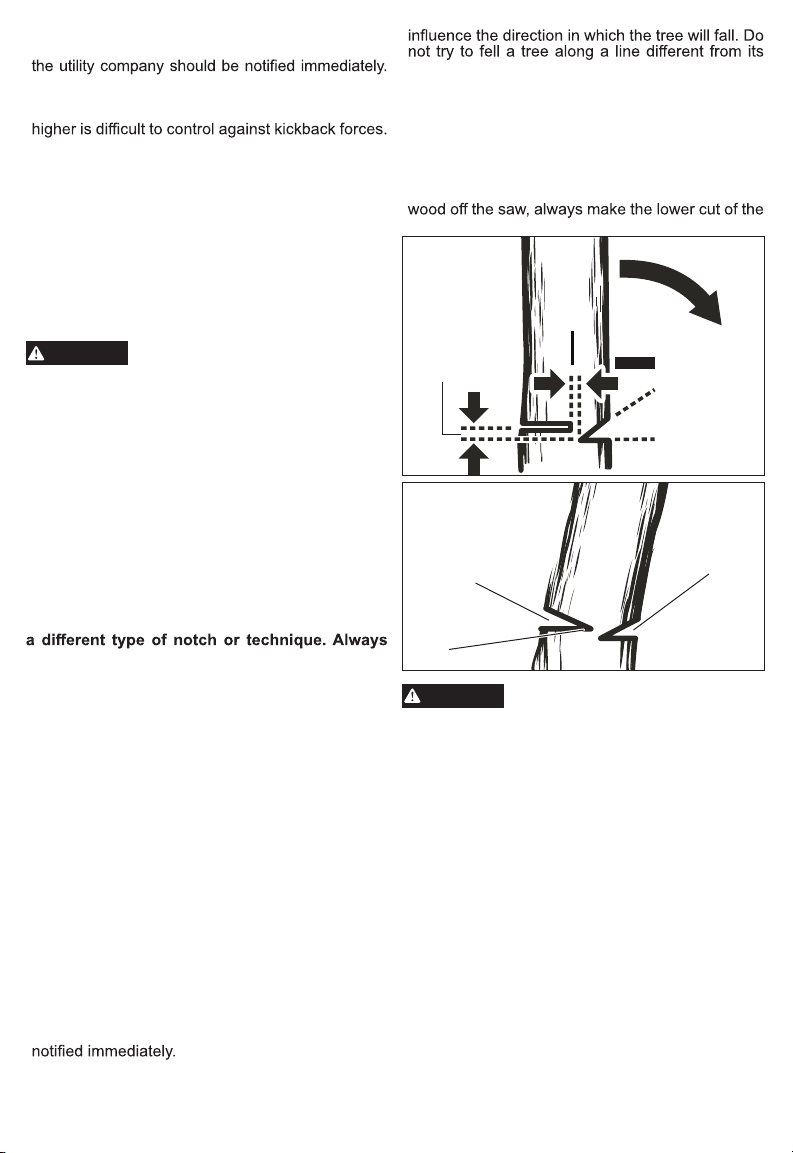
•Notched Undercut (a notch cut in a tree that directs
the tree’s fall). Cut a notch about 1/3 the diameter of
the tree, perpendicular to the direction of fall. Make
the cuts of the notch so they intersect at a right angle
to the line of fall. This notch should be cleaned out
to leave a straight line. To keep the weight of the
notch before the upper cut.
Direction of fall
Hinge
50 mm
or 1/10
dia.
50 mm
Back Cut
Notch -
Approx. 1/3
Diameter of
Trunk
Back Cut
Hinge
Notch
WARNING
Never cut through to the notch
when making a backcut. The hinge
controls the fall of the tree, this is the section of
wood between the notch and backcut. Never
position yourself directly behind the trunk of a
falling tree. There is a risk that the trunk may split
and come back towards the operator.
•
•
•On large diameter trees, stop the back cut before it is
deep enough for the tree to either fall or settle back
on the stump. Then insert soft wooden or plastic
wedges into the cut so they do not touch the chain.
The wedges can be driven in, little by little, to help
jack the tree over.
•As the tree starts to fall, stop the chainsaw and put
it down immediately. Be alert for overhead limbs
or branches that may fall and watch your footing.
Backcut (the final cut in a tree blocking operation
made on the opposite side of the tree from the
notching undercut). The backcut is always made
level and horizontal, and at a minimum of 50 mm
above the horizontal cut of the notch.
Never cut through to the notch. Always leave a
band of wood between the notch and backcut
(approximately 50 mm or 1/10 the diameter of the
tree). This is called “hinge” or “hingewood.” It
controls the fall of the tree and prevents slipping or
twisting or shootback of the tree off the stump.