MSSC Trinity 500 User manual

28
TRINITY 500
WNER’S MANUAL

2
C NTENTS
1. I TRODUCTIO page 3
1.1 TRI ITY HOUSE page 4
2. PRE-USE CHECK LIST page 6
3. THE CRAFT page 7
4. SAFETY page 9
5. HA DLI G page 16
6. CARE A D MAI TE A CE page 18
7. EC CO FORMITY page 20
8. IDE TIFICATIO page 23
9. WARRA TY page 23
10. GLOSSARY page 24

3
1. INTR DUCTI N
Congratulations on buying a Trinity 500 Class pulling boat. The boat
was designed by Jo Richards, Olympic medallist and designer of the
Pico series, in response to the requirement of the Sea Cadets for a
modern, low maintenance, purpose-designed fixed seat rowing boat
with good performance under oars and with the capacity to mount a
small outboard motor. The Sea Cadets are governed by the MSSC
(Marine Society & Sea Cadets).
This manual has been compiled to help you to operate your craft with
safety and pleasure. It contains details of the craft, the equipment
supplied or fitted and information on their operation. Please read it
carefully and familiarise yourself with the craft and its equipment before
using it.
PLEASE KEEP THIS MANUAL IN A SECURE PLACE AND HAND
IT VER T THE NEW WNER WHEN Y U SELL THE CRAFT.
Terms in blue in this manual can be found in the glossary, in Section 10.
This owner's manual is not a course on boating safety or seamanship.
If this is your first craft, or if you are changing to a type of craft you are
not familiar with, for your own comfort and safety, please ensure that
you obtain handling and operating experience before assuming
command of the craft. Your dealer, national sailing federation or
yacht club will be pleased to advise you of local sea schools or
competent instructors.
In some countries a driving licence or authorisation are required,
or specific regulations are in force.
The Trinity 500 is named to mark the quincentenary of the incorporation
of Trinity House, the statutory authority for aids to navigation in England,
Wales, the Channel Islands and Gibralter. The Trinity House Maritime
Charity, a separately funded arm of the Corporation of Trinity House,
generously funded the design and development costs of the boat.

4
1.1 TRINITY H USE
The origins of Trinity House are obscure and it is often stated that
these date back to a charitable guild established by Archbishop
Stephen Langton in the 13th Century. However, Henry VIII gave Trinity
House a charter in 1514 for the regulation of shipping.
It is widely known that Trinity House provides lighthouses for this is its
statutory duty as the General Lighthouse Authority for England, Wales,
the Channel Islands and Gibraltar, functions set out in Part VIII of the
U Merchant Shipping Act, 1995. As such Trinity House is responsible
for the provision of aids to navigation to assist the safe passage of
vessels in general navigation. These comprise nearly 600 stations
ranging from traditional aids such as lighthouses, buoys and beacons,
to a satellite-based differential global positioning service (GPS). Trinity
House is also responsible for the inspection and auditing of over
10,000 local aids to navigation provided by port and harbour
authorities and those provided on offshore structures, such as
production platforms or wind farms. It also has a responsibility for
locating and marking wrecks that are a danger to general navigation
and arranging for their dispersal to a safe depth.
Funding for these activities is raised from light dues levied on vessels
calling at ports in the United ingdom and Ireland and based on net
registered tonnage or registered length in the case of tugs and fishing
vessels. These dues are paid into the General Lighthouse Fund,
managed by the Department for Transport.
Trinity House is also a Deep Sea Pilotage Authority and currently
licenses 40 deep sea pilots for North West European waters. There is
a need by owners and operators of high risk vessels to have a highly
experienced master mariner with expert knowledge of our congested
waters join the bridge team for the European turnaround.
As the U ’s largest fully endowed maritime charity the Corporation of
Trinity House operates as a separate entity to the Lighthouse Service.
It is funded principally by its endowments and spends over £3 million
each year on the welfare of mariners, the education and training of
future seafarers as well as the promotion of safety at sea. The
Corporation runs an estate of almshouses at Walmer, in ent, for

5
retired mariners and their widows; manages the Trinity House
Merchant Navy Scholarship Scheme, selecting and sponsoring
Merchant Navy Cadets through nautical college. It supports a range of
maritime activities and other charities, including the MSSC, and funds
research into issues that will improve maritime safety. These charitable
activities complement the navigation responsibilities of Trinity House
enabling it to discharge its corporate social responsibility to the
maritime community.
The long association between Trinity House and the MSSC has been
further consolidated with the support for this pulling boat bearing the
name TRINITY 500.
Trinity House – Supporting the Mariner Past,
Present and Future.

6
2. PRE-USE CHECK LIST
1. Buoyancy chamber is free of water.
2. Buoyancy chamber access hatches at bow and stern are properly
closed.
3. Buoyancy chamber bung at stern is tightly closed.
4. No splits in hull, no scratches penetrating into foam layer of hull.
5. Equipment:
• 5 Rowlocks, secured by lanyards
• Righting lines rigged both sides and not weakened by chafe
• Rudder in place and secured by spring clip (unless using outboard)
• Bailer, secured by lanyard
• Warps for securing boat alongside or to mooring
• 5 oars, no splits or cracks in shafts or blades, spare oar secured in
boat
• Boathook, secured in boat
• Means of communication with shore
• Fenders (optional)
• Anchor and warp (optional)
• Outboard (if used) properly secured, rudder unshipped
• Fire extinguisher carried and secured in boat, if outboard motor to
be used.
6. Crew correctly dressed for conditions.
7. Crew wearing buoyancy aids/personal flotation aids correctly.
8. Crew briefed on safety precautions as laid down in this manual,
coxswain’s words of command and how to right boat in case
of capsize.
7
3. THE CRAFT
Dimensions
Length overall 5.5 m
Beam 1.76 m
Draft 0.45 m
Air draft 1 m
Mass of hull 225 kg
Mass of fully loaded boat 1017 kg
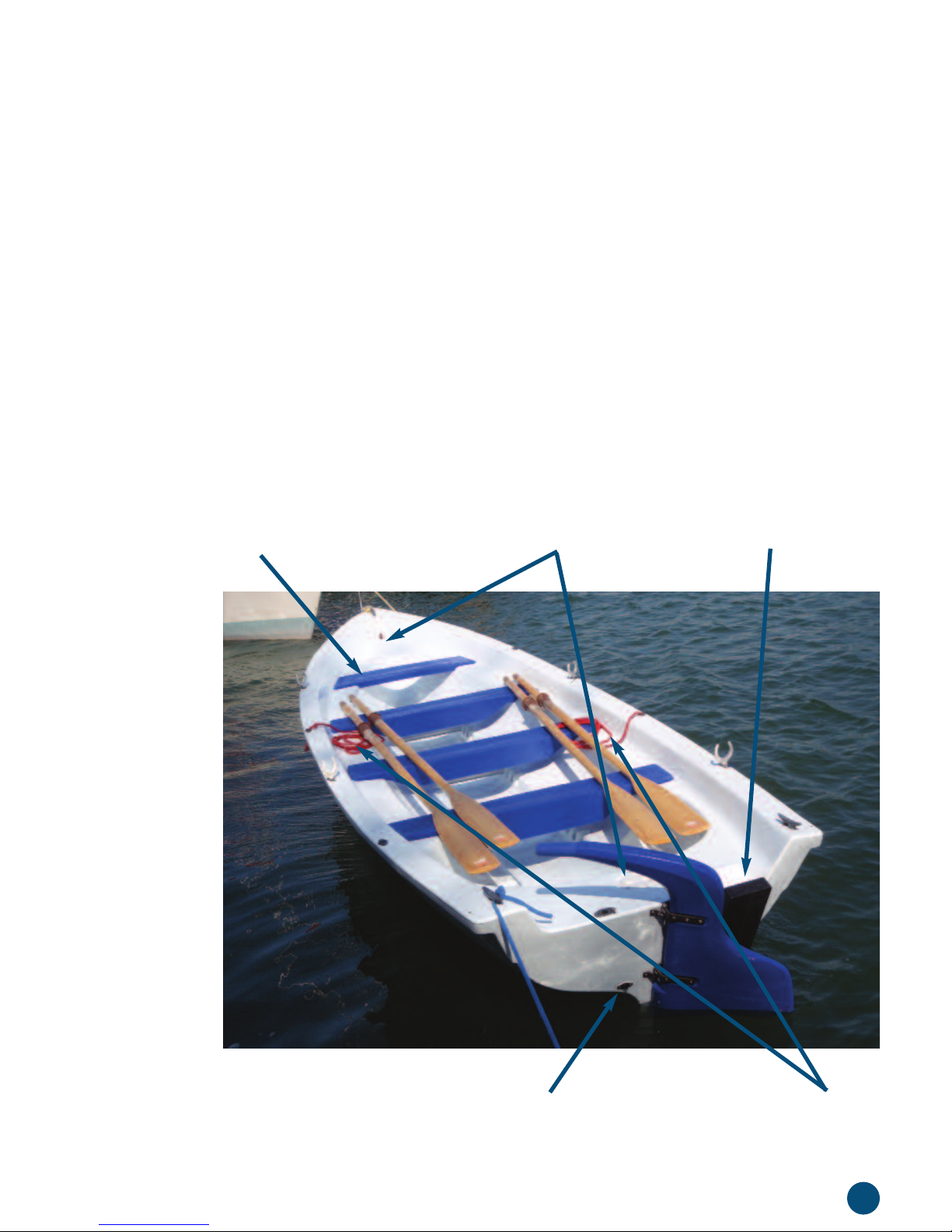
General layout
Buoyancy chamber bung
Outward motor bracket
Righting lines
Buoyancy chamber hatchesThwart

8
Rudder and tiller
The rudder and tiller are combined in a single moulding. It fits on
gudgeons and pintles on the transom. When fitted, it is held in place
by a spring clip on the upper pintle.

9
4. SAFETY
The craft should have onboard the appropriate safety equipment
(lifejackets etc.) according to the type of craft, weather conditions, etc.
This equipment is mandatory in some countries. The crew should be
familiar with the use of all safety equipment and emergency
manoeuvring (man overboard recovery, towing, etc.). Sailing schools
and clubs regularly organise drill sessions if you neef more training.
Everyone should wear a suitable buoyancy aid (life jacket/personal
floatation device) when onboard. In some countries it is a legal
requirement to wear a buoyancy aid that complies with national
regulations at all times.
4.1 WNER’S RESP NSIBILITY
The responsibility for safe operation of any boat rests with the owner.
It is the owner’s responsibility to ensure that the boat is safe to use
and that the coxswain and crew are capable of operating the boat so
they are not a hazard to themselves or other water users.
4.2 DESIGN CATEG RY
Ensure that the you and your crew are able to handle the craft in the
anticipated wind and sea conditions and that these correspond to the
design category of your craft.
Design Category D: The Trinity 500 is designed for use in waters of
Design Category D, Sheltered Waters; on small lakes, rivers and
canals where conditions up to wind force 4 and significant wave
heights up to 0.5 m may be experienced.
Always adjust the speed and direction of the craft to the sea
conditions.

10
4.3 SAFETY LABELS
The following safety labels appear on the Trinity 500 Builders Plate.
The meaning of each is:
Warning: Injury or death may occur if
proper precautions are not taken.
Risk of capsize: The boat may capsize
in certain circumstances.
Read owner’s manual: The boat’s
users should read this manual before
going afloat.
This manual suits for next models
1
Table of contents
Popular Boat manuals by other brands



PURSUIT
PURSUIT OS 335 owner's manual
Boston Whaler
Boston Whaler CONQUEST 345 owner's manual

Jeanneau
Jeanneau SUN ODYSSEY 41 DS owner's manual
Meridian
Meridian 490 Pilothouse owner's manual

Advanced Elements
Advanced Elements AdvancedFrame Expedition AE1009 owner's manual
Robo Marine Indonesia
Robo Marine Indonesia GEOMAR user manual