manuals.online logo
Brands
  1. Home
  2. •
  3. Brands
  4. •
  5. MTD
  6. •
  7. Tiller
  8. •
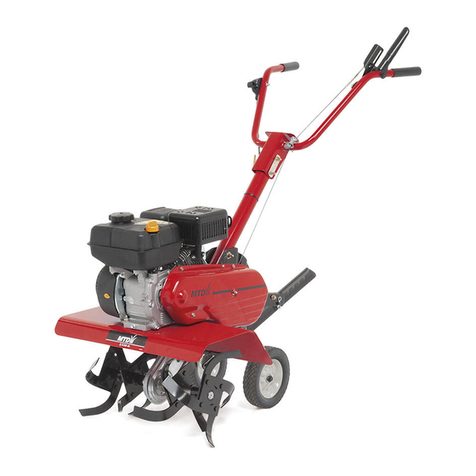
  9. MTD 300 Series User manual

MTD 300 Series User manual

Other manuals for 300 Series

8

This manual suits for next models

1

Other MTD Tiller manuals

MTD 214-031-000 User manual

MTD

MTD 214-031-000 User manual

MTD Series 200 User manual

MTD

MTD Series 200 User manual

MTD 219-100 User manual

MTD

MTD 219-100 User manual

MTD 35 User manual

MTD

MTD 35 User manual

MTD 219-320-000 User manual

MTD

MTD 219-320-000 User manual

MTD 214-200A Manual

MTD

MTD 214-200A Manual

MTD 510r User manual

MTD

MTD 510r User manual

MTD Series 410 User manual

MTD

MTD Series 410 User manual

MTD 215-390A Manual

MTD

MTD 215-390A Manual

MTD 217-100-300 User manual

MTD

MTD 217-100-300 User manual

MTD World Tiller - Series 240 User manual

MTD

MTD World Tiller - Series 240 User manual

MTD 240 Series User manual

MTD

MTD 240 Series User manual

MTD Series 410 User manual

MTD

MTD Series 410 User manual

MTD 21A-332B729 User manual

MTD

MTD 21A-332B729 User manual

MTD MTD20V100 User manual

MTD

MTD MTD20V100 User manual

MTD 428C User manual

MTD

MTD 428C User manual

MTD 21BA405C500 User manual

MTD

MTD 21BA405C500 User manual

MTD Series 250 User manual

MTD

MTD Series 250 User manual

MTD 340 Series User manual

MTD

MTD 340 Series User manual

MTD 193-984A-000 User manual

MTD

MTD 193-984A-000 User manual

MTD 21A-410-000 Setup guide

MTD

MTD 21A-410-000 Setup guide

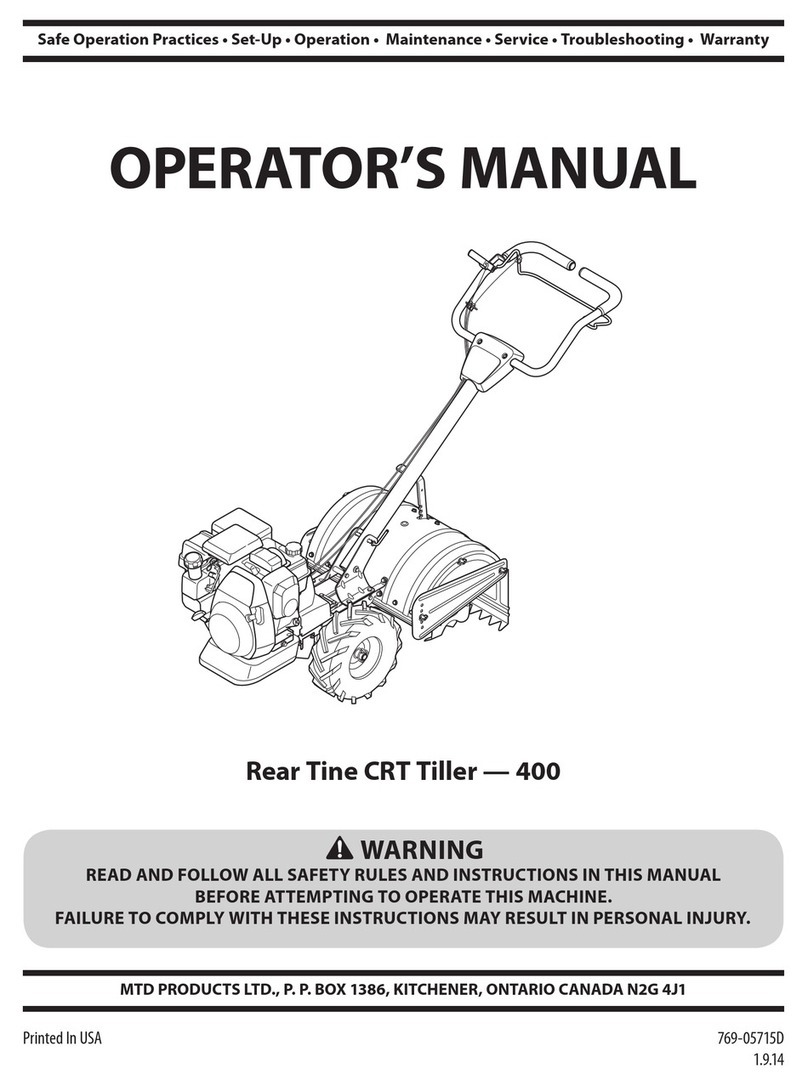
MTD Rear Tine CRT Tiller 400 User manual

MTD

MTD Rear Tine CRT Tiller 400 User manual

MTD Yard Machines 450 Series User manual

MTD

MTD Yard Machines 450 Series User manual

MTD 215-100AB2 Manual

MTD

MTD 215-100AB2 Manual

Popular Tiller manuals by other brands

Craftsman 247.29931 Operator's manual

Craftsman

Craftsman 247.29931 Operator's manual

Craftsman 917.298353 owner's manual

Craftsman

Craftsman 917.298353 owner's manual

Troy-Bilt Colt FT Operator's manual

Troy-Bilt

Troy-Bilt Colt FT Operator's manual

Ryobi 510r Operator's manual

Ryobi

Ryobi 510r Operator's manual

YAT YT5601-01 Assembly, Use, Maintenance Manual

YAT

YAT YT5601-01 Assembly, Use, Maintenance Manual

Craftsman 917.296010 owner's manual

Craftsman

Craftsman 917.296010 owner's manual

Troy-Bilt OEM-290-260 Operator's manual

Troy-Bilt

Troy-Bilt OEM-290-260 Operator's manual

Scheppach MTP560 Translation from the original instruction manual

Scheppach

Scheppach MTP560 Translation from the original instruction manual

GARDEN WAY 12194 owner's manual

GARDEN WAY

GARDEN WAY 12194 owner's manual

Classen STAND-AER SA-25 Operator's manual and parts list

Classen

Classen STAND-AER SA-25 Operator's manual and parts list

Craftsman 850 Series owner's manual

Craftsman

Craftsman 850 Series owner's manual

DR PILOT 2 Safety & Operating Instructions

DR

DR PILOT 2 Safety & Operating Instructions

Altrad ATIKA BH 1400 N Original instructions, safety instructions, spare parts

Altrad

Altrad ATIKA BH 1400 N Original instructions, safety instructions, spare parts

WIL-RICH 2500 Operator's manual

WIL-RICH

WIL-RICH 2500 Operator's manual

Viking HB 685 instruction manual

Viking

Viking HB 685 instruction manual

SMASH TLG415 instruction manual

SMASH

SMASH TLG415 instruction manual

FarmBoy FB-IC-209P user manual

FarmBoy

FarmBoy FB-IC-209P user manual

Mantis SV-5C/2 owner's manual

Mantis

Mantis SV-5C/2 owner's manual

manuals.online logo
manuals.online logoBrands
  • About & Mission
  • Contact us
  • Privacy Policy
  • Terms and Conditions

Copyright 2025 Manuals.Online. All Rights Reserved.

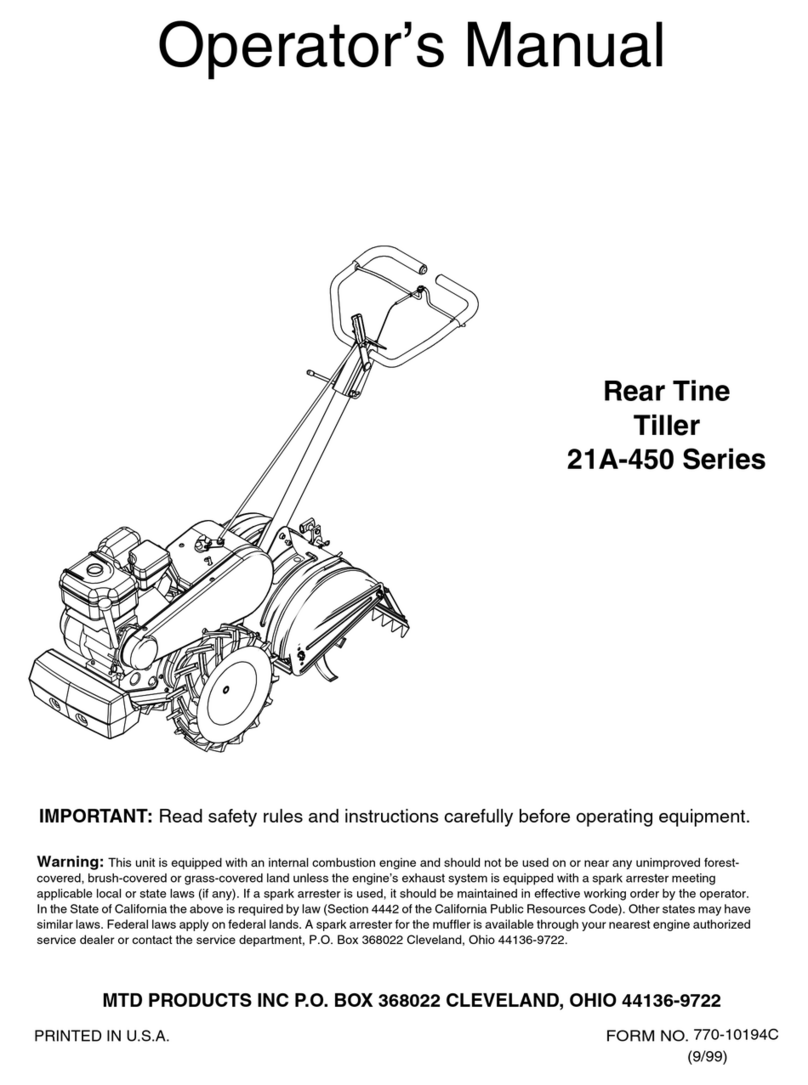
Operator's Manual
Front Tine Tiller
Model Series
300 & 330
IMPORTANT: Read safety rules and instructions carefully before operating equipment.
Warning: This unit is equipped with an internal combustion engine and should not be used on or near any unimproved forest-covered, brush-
covered or grass-covered land unless the engine's exhaust system is equipped with a spark arrester meeting applicable local or state laws (if
any). If a spark arrester is used, it should be maintained in effective working order by the operator. In the State of California the above is required
by law (Section 4442 of the California Public Resources Code). Other states may have similar laws. Federal laws apply on federal lands. A spark
arrester for the muffler is available through your nearest engine authorized service dealer or contact the service department, P.O. Box 361131
Cleveland, Ohio 44136-9722.
MTDLLC, P.O.BOX361131CLEVELAND,OHIO44136-9722
PRINTED IN U.S.A. FORM NO. 770-10564E
(11/30/2004)
Content
ImportantSafeOperationPractices
AssemblingYourTiller
KnowYourTiller
OperatingYourTiller
MakingAdjustments
TABLEOFCONTENTS
Page Content Page
3 Maintaining You rTiller 10
5 Troubleshooting 11
6 Illustrated Parts List 12
7 Warranty 16
9
FINDINGMODELNUMBER
This Operator's Manual is an important part of your new tiller. It will help you assemble, prepare and maintain the
unit for best performance. Please read and understand what it says.
Before you start assembling your new equipment, please locate the model plate on the equipment
and copy the information from it in the space provided below. A sample model plate is also given below.
You can locate the model plate by looking at the rear of the tine shield. This information will be necessary
to use the manufacturer's web site and/or help from the Customer Support Department or an authoriJed
service dealer.
"-_ Copy the model number here:
MT,D _ P._TDo._OXLL_'3_3_] Copy the serial number here:
CLEVELAND,OH 44136
330_220-4683
www.mtdproducts.com 8_Q-8_O-731Q
CUSTOMERSUPPORT
PleasedoNOTretum theunit totheretailer without first contactingCustomerSupport.
If you have difficulty assembling this product or have any questions regarding the controls, operation or
maintenance of this unit, you can seek help from the experts. Choose from the options below:
Visit mtdproducts.com for many useful suggestions. Click on Customer Support button andyou will get the four options reproduced here. Click on the appropriate button and help is
immediately available.
\En ine
vEAn_dAnswers
The answe_ _you am
_lle_lif_ yeIH i_l _ll[_ies e[ _[ _81e yell _e_$e_a_ a mouse_c#ck away!
_ice gooato[
If you prefer to reach a Customer Support Representative, please call (330) 220-4MTD or
1(800) 800-7310.
The engine manufacturer is responsible for all engine-related issues with regard to
performance, power-rating, specifications, warranty and service. Please refer to the engine
manufacturer's Owner's/Operator's Manual, packed separately with your unit, for more
information.
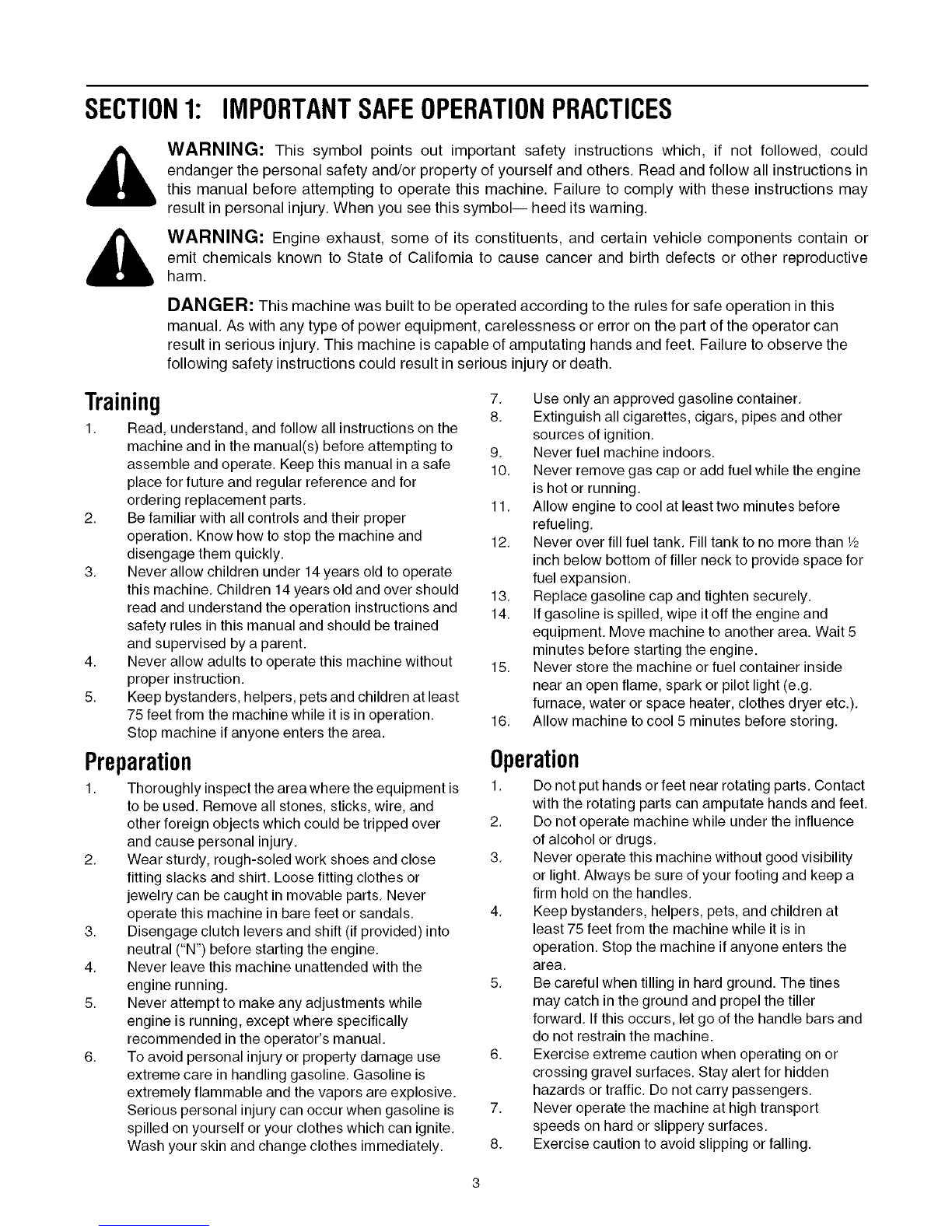
SECTION1: IMPORTANTSAFEOPERATIONPRACTICES
WARNING: This symbol points out important safety instructions which, if not followed, could
endanger the personal safety and/or property of yourself and others, Read and follow all instructions in
this manual before attempting to operate this machine, Failure to comply with these instructions may
result in personal injury, When you see this symbol-- heed its warning,
WARNING: Engine exhaust, some of its constituents, and certain vehicle components contain or
emit chemicals known to State of California to cause cancer and birth defects or other reproductive
harm.
DANGER: This machine was built to be operated according to the rules for safe operation in this
manual, As with any type of power equipment, carelessness or error on the part of the operator can
result in serious injury, This machine is capable of amputating hands and feet. Failure to observe the
following safety instructions could result in serious injury or death,
Training
1, Read, understand, and follow all instructions on the
machine and in the manual(s) before attempting to
assemble and operate. Keep this manual in a safe
place for future and regular reference and for
ordering replacement parts,
2, Be familiar with all controls and their proper
operation. Know how to stop the machine and
disengage them quickly.
3. Never allow children under 14years old to operate
this machine, Children 14years old and over should
read and understand the operation instructions and
safety rules in this manual and should be trained
and supervised by a parent,
4. Never allow adults to operate this machine without
proper instruction,
5. Keep bystanders, helpers, pets and children at least
75 feet from the machine while it is in operation,
Stop machine if anyone enters the area.
Preparation
1, Thoroughly inspect the area where the equipment is
to be used, Remove all stones, sticks, wire, and
other foreign objects which could be tripped over
and cause personal injury,
2, Wear sturdy, rough-soled work shoes and close
fitting slacks and shirt. Loose fitting clothes or
jewelry can be caught in movable parts, Never
operate this machine in bare feet or sandals,
3, Disengage clutch levers and shift (if provided) into
neutral CN") before starting the engine.
4, Never leave this machine unattended with the
engine running.
5, Never attempt to make any adjustments while
engine is running, except where specifically
recommended in the operator's manual,
6, To avoid personal injury or property damage use
extreme care in handling gasoline, Gasoline is
extremely flammable and the vapors are explosive,
Serious personal injury can occur when gasoline is
spilled on yourself or your clothes which can ignite,
Wash your skin and change clothes immediately,
7, Use only an approved gasoline container,
8, Extinguish all cigarettes, cigars, pipes and other
sources of ignition,
9, Never fuel machine indoors.
10, Never remove gas cap or add fuel while the engine
is hot or running.
11, Allow engine to cool at least two minutes before
refueling,
12, Never over fill fuel tank. Fill tank to no more than 1/2
inch below bottom of filler neck to provide space for
fuel expansion.
13, Replace gasoline cap and tighten securely,
14, Ifgasoline is spilled, wipe it off the engine and
equipment, Move machine to another area. Wait 5
minutes before starting the engine.
15, Never store the machine or fuel container inside
near an open flame, spark or pilot light (e.g,
furnace, water or space heater, clothes dryer etc,),
16, Allow machine to cool 5 minutes before storing,
Operation
1. Donot put hands or feet near rotating parts. Contact
with the rotating parts can amputate hands and feet.
2. Do not operate machine while under the influence
of alcohol or drugs.
3, Never operate this machine without good visibility
or light. Always be sure of your footing and keep a
firm hold on the handles.
4, Keep bystanders, helpers, pets, and children at
least 75 feet from the machine while it is in
operation, Stop the machine if anyone enters the
area,
5, Be careful when tilling inhard ground, The tines
may catch in the ground and propel the tiller
forward, If this occurs, let go of the handle bars and
do not restrain the machine.
6. Exercise extreme caution when operating on or
crossing gravel surfaces, Stay alert for hidden
hazards or traffic, Do not carry passengers,
7. Never operate the machine at high transport
speeds on hard or slippery surfaces,
8. Exercise caution to avoid slipping or falling,

9, Lookdownandbehindandusecarewhenin
reverseorpullingmachinetowardsyou,
10, Starttheengineaccordingtotheinstructionsfound
inthismanualandkeepfeetwellawayfromthe
tinesatalltimes,
11, Afterstrikingaforeignobject,stoptheengine,
disconnectthesparkplugwireandgroundagainst
theengine,Thoroughlyinspectthemachineforany
damage,Repairthedamagebeforestartingand
operating,
12, Disengageallclutchleversandstopenginebefore
youleavetheoperatingposition(behindthe
handles),Waituntilthetinescometoacomplete
stopbeforeuncloggingthetines,makingany
adjustments,orinspections.
13, Neverrunanengineindoorsorinapoorly
ventilatedarea.Engineexhaustcontainscarbon
monoxide,anodorlessanddeadlygas.
14, Mufflerandenginebecomehotandcancausea
burn.Donottouch,
15, Usecautionwhentillingnearfences,buildingsand
undergroundutilities,Rotatingtinescancause
propertydamageorpersonalinjury.
16, Donotoverloadmachinecapacitybyattemptingto
tillsoiltodeepattofastofarate.
17, Ifthemachineshouldstartmakinganunusualnoise
orvibration,stoptheengine,disconnectthespark
plugwireandgrounditagainsttheengine.Inspect
thoroughlyfordamage,Repairanydamagebefore
startingandoperating,
18, Keepallshields,guardsandsafetydevicesinplace
andoperatingproperly.
19, Neverpickuporcarrymachinewhiletheengineis
running,
20, Useonlyattachmentsandaccessoriesapprovedby
themanufacturer.Failuretodoso,canresultin
personalinjury.
21, Ifsituationsoccurwhicharenotcoveredinthis
manual,usecareandgoodjudgment.Contactyour
dealerortelephone1-800-800-7310forassistance
andthenameofyournearestservicingdealer.
Maintenance& Storage
1. Never tamper with safety devices, Check their
proper operation regularly.
2. Check bolts and screws for proper tightness at
frequent intervals to keep the machine in safe
working condition, Also, visually inspect machine for
any damage,
3. Before cleaning, repairing, or inspecting, stop the
engine and make certain the tines and all moving
parts have stopped, Disconnect the spark plug wire
and ground it against the engine to prevent
unintended starting.
4, Do not change the engine governor settings or over-
speed the engine, The governor controls the
maximum safe operating speed of the engine,
5, Maintain or replace safety and instruction labels, as
necessary,
6, Follow this manual for safe loading, unloading,
transporting, and storage of this machine.
7, Never store the machine or fuel container inside
where there is an open flame, spark or pilot light
such as a water heater, furnace, clothes dryer etc,
8, Always refer to the operator's manual for proper
instructions on off-season storage,
9, If the fuel tank has to be drained, do this outdoors,
10, Observe proper disposal laws and regulations for
gas, oil, etc. to protect the environment.
YourResponsibility
1. Restrict the use of this power machine to persons
who read, understand and follow the warnings and
instructions in this manual and on the machine.
2. The safety label on the tiller is reproduced below for
your review. To ensure safe operation of the tiller,
follow the instructions on all labels closely,
TO AVOID SERIOUS INJURY
READTHEOPERATOR'SMANUAL.
KNOWLOCATIONANDFUNCTIONS
OFALLCONTROLS.
KEEPALLSAFETYDEVICESAND
SHIELDSINPLACEANDWORKING.
NEVERALLOWCHILDRENOR
UNINSTRUCTEDADULTSTO
OPERATETILLER.
SHUTOFFENGINEBEFORE
UNCLOGGINGTINESORMAKING
REPAIRS.
KEEPBYSTANDERSAWAYFROM
MACHINE.
KEEPAWAYFROMROTATING
PARTS.
USEEXTREMECAUTIONWHEN
REVERSINGORPULLINGTHE
MACHINETOWARDSYOU.
,S30159
SECTION2: ASSEMBLINGYOURTILLER
NOTE: This operator's manual covers various models
of riflers. The units illustrated may vary slightly from
your unit. Follow only those instructions which pertain
to your model number.
NOTE: References to right or left side of the tiller are
determined from behind the unit in the operating
position.
IMPORTANT:This unit is shipped without gasoline or oil
in the engine. Be certain to service engine with gasoline
and oil as instructed in the separate engine manual
before operating your machine.
LoosePartsInCarton
Tailpiece and Depth Stake
NOTE: All hardware needed for assembly is attached
to the loose parts or the tiller.
BeforeAssembly
WARNING: Disconnect the spark plug wireand ground it against the engine to prevent
unintended starting.
AssemblingTheHandle
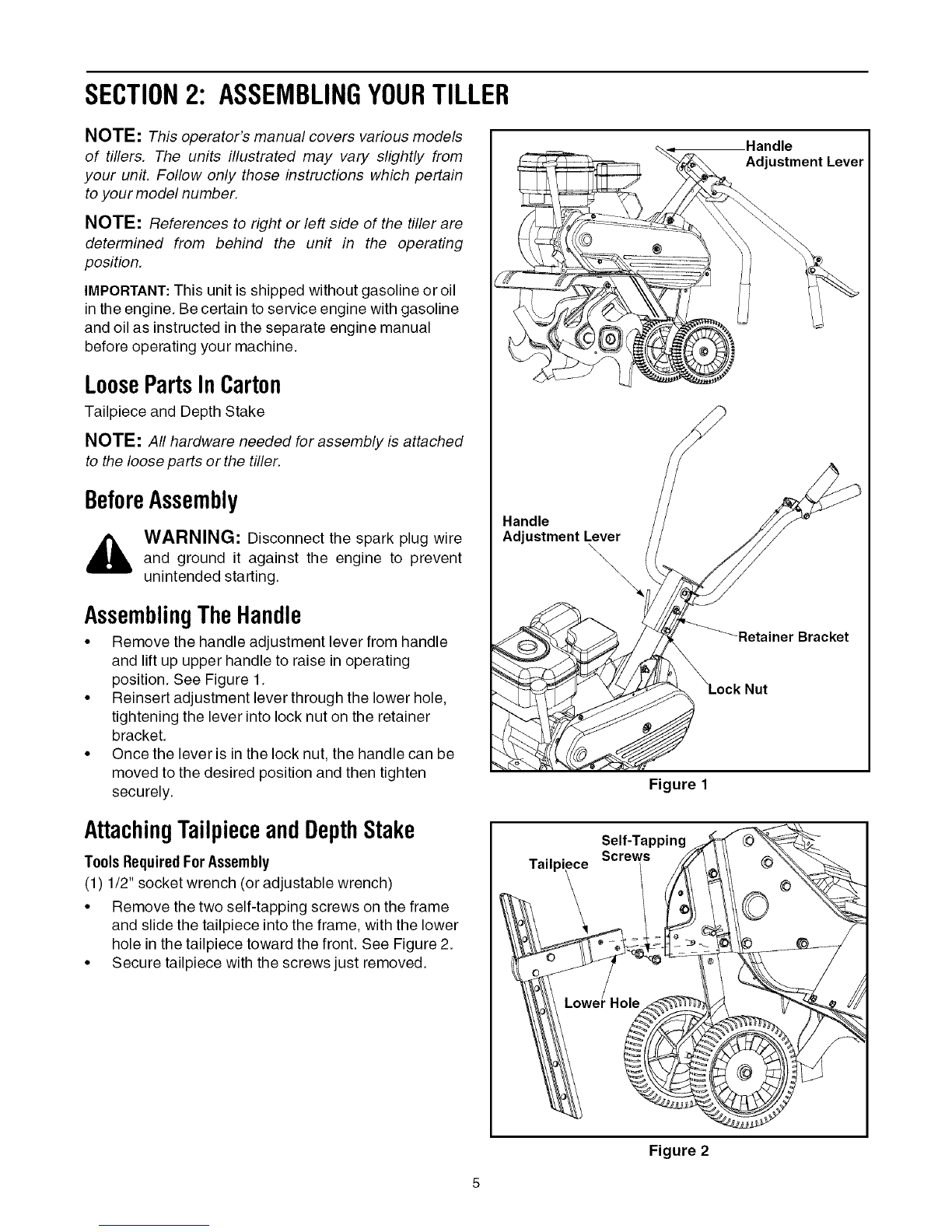
• Remove the handle adjustment lever from handle
and lift up upper handle to raise in operating
position. See Figure 1.
• Reinsert adjustment lever through the lower hole,
tightening the lever into lock nut on the retainer
bracket.
• Once the lever is in the lock nut, the handle can be
moved to the desired position and then tighten
securely.
Handle
Adjustment Lever
\\
\
AttachingTailpieceandDepthStake
ToolsRequiredForAssembly
(1) 1/2" socket wrench (or adjustable wrench)
• Remove the two self-tapping screws on the frame
and slide the tailpiece into the frame, with the lower
hole in the tailpiece toward the front. See Figure 2.
• Secure tailpiece with the screws just removed.
Tailpiece
Figure 1
Self-Tapping
Screws
Handle
Adjustment Lever
-Retainer Bracket
Figure 2
CheckCableAdjustment
•With the clutch lever disengaged, pull starter rope
slowly several times. The tines should not turn. If
they turn, the cable is not adjusted properly.
• To adjust the cable, loosen the nut near the top of
the cable and unscrew the cable to provide
additional slack in wire. See Figure 3.
• Tighten the nut and check again for proper
adjustment.
Clutch Lever_.__
Loosen Nut
Figure 3
SECTION3: KNOWYOURTILLER
Tine Clutch Control
Handle Adjustment Lever
Depth Stake
Tines
Figure 4
WARNING: Read, understand, and
follow all instructions and warnings on
the machine and in this manual before
operating.
Tine ClutchControl
The clutch control lever is located on the left handle.
Squeezing the lever against the handle engages the
tine drive. Release the lever to stop the tines from
turning. See Figure 4.
DepthStake
The depth stake is located in the rear of the tiller and it
controls the tilling depth. See Figure 4.
HandleAdjustmentLever
The handle may be adjusted to the height desired.
Loosen the handle adjustment lever a few turns and
pivot handle up or down to desired position. Tighten
lock. See Figure 4.
ThrottleControl
The throttle control lever islocated on the engine. It
controlsthe engine's speed and stops the engine.
•With the throttle control pushed completely forward,
the carburetor isin START or FAST position. Use
maximum engine speed for deep tilling.
• Pull the throttle control back to reduce engine
speed to IDLE. Throttle control should be at IDLE
for transporting the tiller.
• Pull the throttle completely back to stop the engine.
ChokeLever
The choke lever is located near the throttle control. It is
used to enrich the fuel mixture when starting a cold
engine.
StarterHandle
The starter handle is located on the engine and is
used to manually start the engine.
EngineControls
See the separate engine manual for additional
information and functions of the engine controls.
SECTION4: OPERATINGYOURTILLER
WARNING: Read, understand, and
follow all instructions and warnings on
the machine and in this manual before
operating.
BeforeStarting
GasAndOilFill-Up
Service the engine with gasoline and oil as instructed in
the separate engine manual packed with your tiller.
Read instructions carefully.
l_ WARNING: Use extreme care when
handling gasoline. Gasoline is extremely
flammable and the vapors are explosive.
Never fuel machine indoors or while the
engine is hot or running.
NOTE: See your engine manual packed with your unit
for more detailed instructions.
StoppingEngine
•Move throttle control lever to STOP or OFF
position.
• Disconnect spark plug wire from spark plug and
ground against the engine.
UsingYourTiller
Your tiller (also known as a cultivator) is a precision
built machine designed for seed bed preparation,
cultivating, furrowing and mulching. It is engineered to
minimize the hardest work in the vegetable or flower
garden, to till the soil for planting and cultivating, and to
perform many other useful labor saving tasks in the
garden.
StartingEngine
_ WARNING: Be sure no one is standing
in front of the tiller while the engine is
running or being started.
• Attach spark plug wire to spark plug. Make sure the
metal cap on the end of the spark plug is fastened
securely over the metal tip on the spark plug.
• Make sure that the tine clutch control is
disengaged.
• Place the throttle control in the FAST position.
• Move choke lever to CHOKE position. A warm
engine requires little or no choke.
• Grasp starter handle and pull rope out slowly until
engine reaches start of compression cycle (rope
will pull slightly harder at this point). Let the rope
rewind slowly.
• Pull rope with a rapid, continuous, full arm stroke.
Keep a firm grip on starter handle. Let rope rewind
slowly. Do not let starter handle snap back against
starter. Repeat until engine starts.
• When engine starts, move choke lever on engine
halfway between CHOKE and RUN. As the engine
warms up, move the lever to RUN position.
WheelPosition
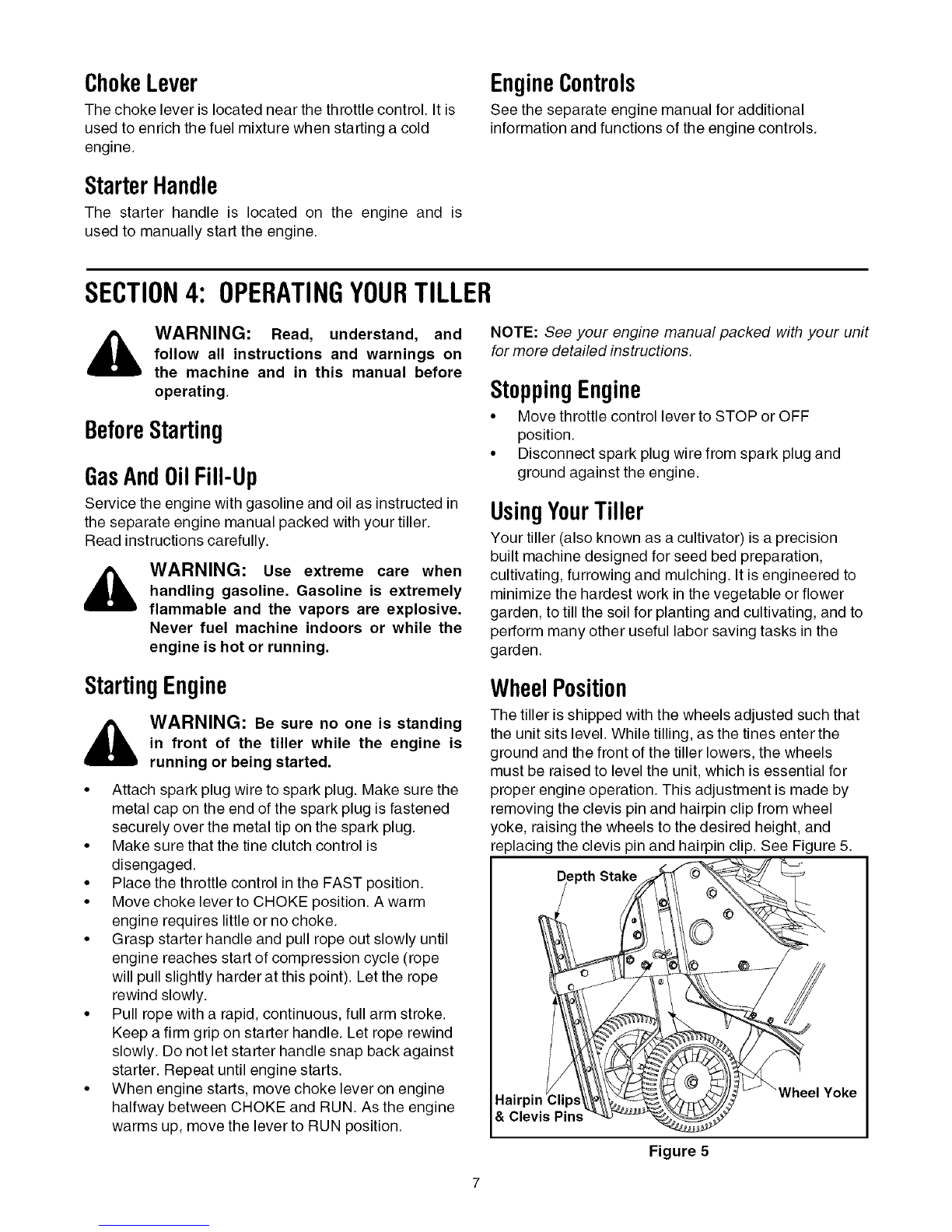
The tiller is shipped with the wheels adjusted such that
the unit sits level. While tilling, as the tines enter the
ground and the front of the tiller lowers, the wheels
must be raised to level the unit, which is essential for
proper engine operation. This adjustment is made by
removing the clevis pin and hairpin clip from wheel
yoke, raising the wheels to the desired height, and
replacing the clevis pin and hairpin clip. See Figure 5.
Stake
Hairpi_
& Clevis Pins
Figure 5
ControllingSpeedAndTillingDepth
WheelYokeAdjustment
Place wheel yoke so that the wheels are forward
(nearest point between wheels and tines) for shallow
tilling, cultivating and transport. The forward speed will

increase. Turn yoke around (farthest point between
wheels and tines) for deep tilling. Forward speed will
decrease. See Figure 6.
Yoke _ition Wheel
For Deep Tilling ForShallow Tilling
Figure 6
DepthStakeAdjustment
The depth stake acts as a brake for the tiller and
controls the depth and speed at which the machine will
operate. Remove the clevis pin and hairpin clip to raise
or lower depth stake. Refer to Figure 5.
By increasing the depth of the depth stake, the forward
speed of the machine is reduced and the working depth
is increased. When the depth stake is raised, the
working depth of the machine is reduced and the
forward speed is increased. The working depth of the
machine may be predetermined by setting the depth
stake and wheels so that the wheels are about four
inches from the ground when the tines and depth stake
are resting on the ground. This setting will permit a
working depth of about four inches. When presetting
the working depth, the handles should be adjusted so
the hand grips are a little above waist. The tiller will be
lower when the tines and depth stake penetrate the
ground. See Figure 7.
Transport De
Position
Shallow
Tilling S
Deep
Deep Tilling
Figure 7
When tilling, leave approximately 8 inches of untilled
soil between the first and second tilling paths, then
make the third path between the first and second. In
some soils, the desired depth is obtained the first time
over the garden. In other soils, the desired depth is
obtained by going over the garden two or three times. In
the latter case, the depth stake should be lowered
before each succeeding pass over the garden. Passes
should be made across the length and width of the
garden alternately. Rocks which are turned up should
be removed from the garden area. See Figure 8.
Figure 8
HandlePressure
Further control of tilling depth and travel speed can be
obtained by variation of pressure on the handles.
• A downward pressure on the handles will reduce
the working depth and increase the forward speed.
• An upward pressure on the handles will increase
the working depth and reduce the forward speed.
The type of soil and working conditions will determine
the actual setting of the depth stake and the handle
pressure required.
TransportingtheTiller
• To transport the tiller to or from the garden, pivot
the depth stake forward and out of the way. With
the throttle control in SLOW position, the unit will
walk freely on the lawn. If the operator does not
allow the tiller to move freely, the unit will start to till
the surface. Refer to Figure 7.
Cultivating
For cultivating, a two to three inch depth is desirable.
Setting the wheels and depth stake so that the wheels
are about two inches above the ground while the tiller is
resting on the tines and depth stake will allow the
machine to work at cultivating depth. The throttle
should be set to control forward movement to a slow
walking speed. With the outer tines installed, the
working width of the machine is 22 or24 inches.
Forcultivation,thismaybereducedto13inchesby
removingtheoutertines.RefertotheAdjustment
Section.Whenlayingoutplantrows,besuretoallow
enoughwidthtopermitcultivationbetweentherows.In
growingcornorsimilarcrops,check-rowplantingwill
permitcrosscultivationandpracticallyeliminatehand
hoeing.SeeFigure9.
Figure 9
The tiller has many uses other than tilling and
cultivating a garden. One of these is the preparation of
lawn area for seeding. The tiller will prepare a deep
seed bed which will be free of hard untilled spots,
allowing a better stand of grass to grow. The tiller is
very useful for loosening hard soil for excavation with a
shovel. No tedious handwork will be necessary. Your
tiller may be used for mixing compost inthe pile, or for
mixing it with the soil in your garden. This should be
done after the soil has been broken to the full working
depth. The compost should be worked in to a depth of
six to seven inches. This may be done by working the
length of the garden and then by making separate
passes across its width. The addition of decayed
organic matter will substantially increase the fertility of
your garden. For proper decaying action, fertilizer
should be applied and worked in with the mulch
materials. Breaking up leaves and straw and mixing it
with several inches of soil causes the soil to hold
moisture longer and allows proper aeration of the plant
root system. This also retards the growth of weeds.
SECTION5: MAKINGADJUSTMENTS
WARNING: Disconnect the spark plugwire and ground it against the engine
before performing any adjustments.
EngineAdjustment
Refer to the separate engine manual for engine
adjustment instructions.
WheelAdjustment
To adjust the wheel yoke and wheel position, refer to
the Operating Section.
DepthStakeAdjustment
To adjust the depth stake to a desired position, refer to
the Operating Section.
ClutchControlAdjustment
Periodic adjustment of the belt tension may be required
due to normal stretch and wear on the belt. To adjust
the clutch control lever, refer to the Assembly Section.
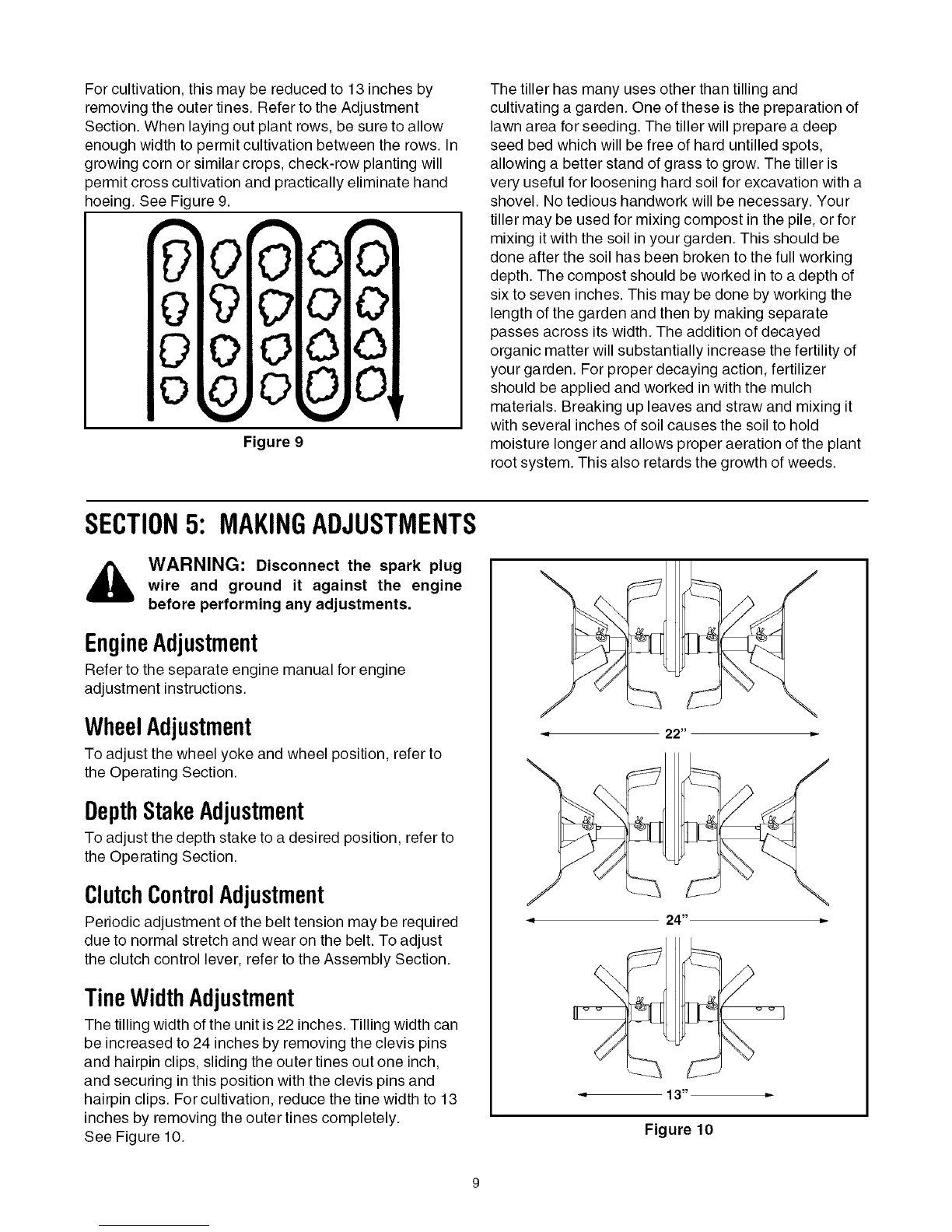
TineWidthAdjustment
The tilling width of the unit is22 inches. Tilling width can
be increased to 24 inches by removing the clevis pins
and hairpin clips, sliding the outer tines out one inch,
and securing in this position with the clevis pins and
hairpin clips. For cultivation, reduce the tine width to 13
inches by removing the outer tines completely.
See Figure 10.
24"
13"
Figure 10
SECTION6: MAINTAININGYOURTILLER
WARNING: Disconnect the spark plug
wire and ground it against the engine
before performing any repairs or
maintenance.
Engine
Refer to the separate engine manual for engine
maintenance instructions.
Maintain engine oil as instructed in the separate
engine manual packed with your unit. Read and follow
instructions carefully.
Service air cleaner every ten hours under normal
conditions. Clean every hour under extremely dusty
conditions. Poor engine performance and flooding
usually indicates that the air cleaner should be
serviced. To service the air cleaner, refer to the
separate engine manual packed with your unit.
IMPORTANT: Never run your engine without air cleaner
completely assembled.
The spark plug should be cleaned and the gap reset
every 25 hours of engine operation. Spark plug
replacement is recommended at the start of each tiller
season; check engine manual for correct plug type and
gap specification.
Clean the engine regularly with a cloth or brush. Keep
the cooling system (blower housing area) clean to
permit proper air circulation which is essential to engine
performance and life. Be certain to remove all dirt and
combustible debris from muffler area.
Lubrication
Transmission
The transmission is pre-lubricated and sealed at the
factory. It requires no checking. See an authorized
service dealer for any service issues.
ClutchHandle
Lubricate the pivot point on the clutch handle and the
cable at least once a season with light oil. The control
must operate freely in both directions.
Pivot Points
Lubricate all pivot points and linkages at least once a
season with light oil.
TineShafts
Remove tine assemblies and lubricate the tine shafts at
least once a season.
WheelShafts
Remove wheel assemblies and lubricate the axle shafts
at least once a season.
CleaningTineArea
Clean the underside of the tine shield after each use.
The dirt washes off the tines easier if rinsed off
immediately instead of after it dries. Always towel dry
the tiller afterwards and apply a light coat of oil or
silicone to prevent rusting or water damage.
IMPORTANT:Never use a "pressure washer" to clean
your tiller. Water can penetrate tight areas of the tiller
and its chain case and cause serious damage to the
unit.
BeltReplacement
Your tiller has been engineered with a belt made of
special material for longer life and better performance.
It should not be replaced with an off-the-shelf belt. See
the retailer from which you purchased your tiller, an
authorized MTD Service Dealer or phone 1-800-800-
7310 for information regarding price and availability.
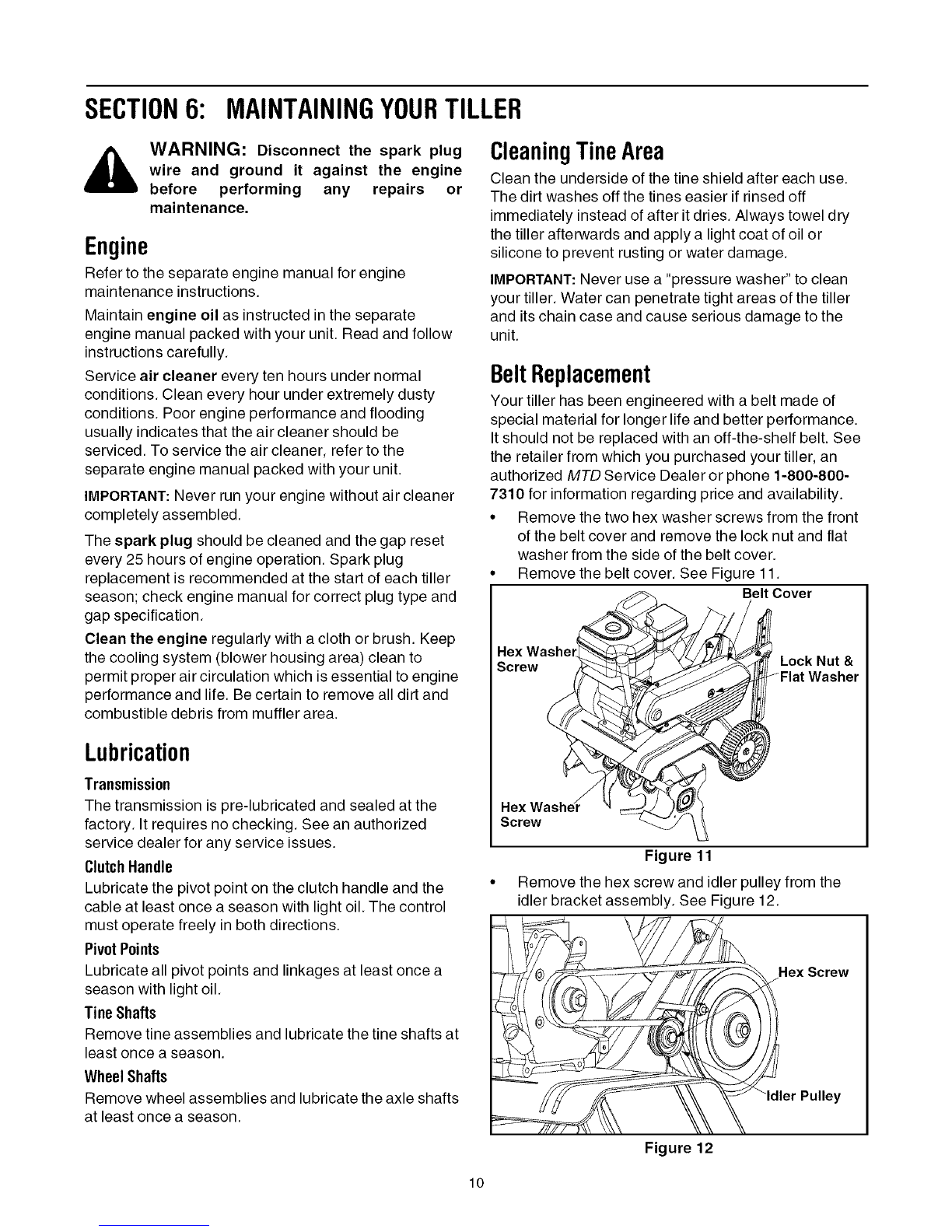
• Remove the two hex washer screws from the front
of the belt cover and remove the lock nut and flat
washer from the side of the belt cover.
Remove the belt cover. See Figure 11.
Belt Cover
Hex Washel
Screw Lock Nut &
"Flat Washer
Screw
Figure 11
Remove the hex screw and idler pulley from the
idler bracket assembly. See Figure 12.
Hex Screw
Pulley
Figure 12
lO