www.SteamPoweredRadio.Com
ENGLISH
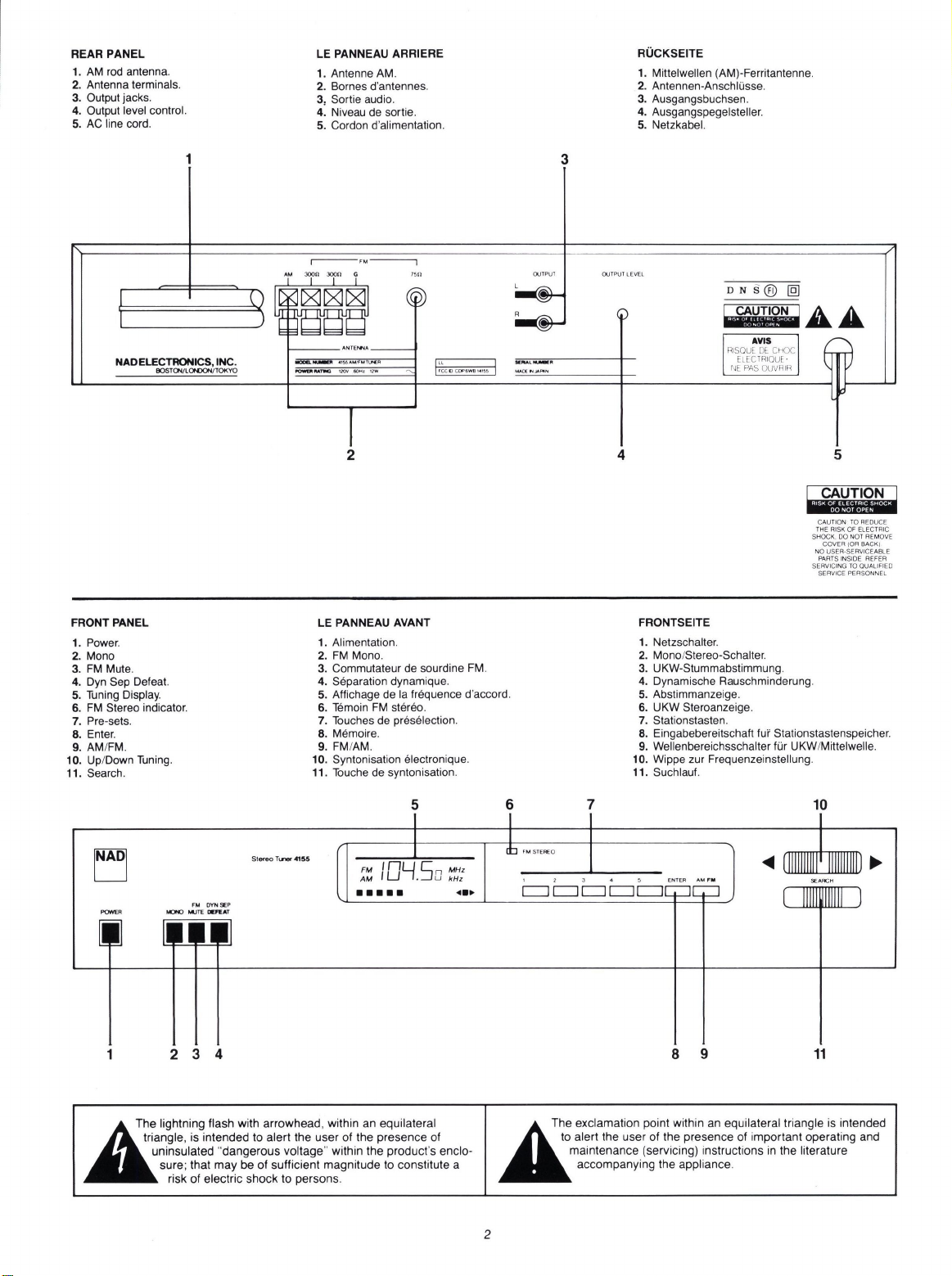
REAR PANEL CONNECTIONS
1.
AM ROD ANTENNA
The ferrite rod antenna provides effective reception
of local medium-wavelength AM radio stations. The rod
is
mounted on a pivot. For best reception, swing it away from
the metal chassis of the receiver.
2.
ANTENNA TERMINALS
If
you are using an external
FM
antenna
with_a
coaxial
cable,
it
should be connected to the 75-ohm coaxial socket.
Other types of antenna wires may be attached to the four
antenna terminals.
In
order to make connections to the four antenna
terminals, remove any connectors that may be fitted on
the antenna wires. Strip off 1 cm of insulation from each
wire,
and
in
each conductor twist together the exposed
wire strands.
Press down the plastic tab below the appropriate termi-
nal. Insert the bared wire into the small hole
in
the terminal,
and pull the tab up. The terminal will grasp the wire and hold
it
in
place.
AM
Antenna. Since the tuner
is
equipped with a ferrite
rod
antenna,
no
external antenna will be needed for satisfac-
tory reception of most local broadcasting stations. But if you
wish
to
improve reception of distant
AM
stations, attach a
long-wire outdoor antenna to the
AM
terminal. As its name
implies, a "long-wire" antenna
is
a simple, straight wire
whose length may be anything from a few feet up to about
100
feet (30 meters), mounted parallel to the earth and as
high as
is
convenient.
In
some cases the effectiveness of a long-wire antenna
will be improved by connecting a second wire from the
Ground
(G)
terminal to a true earth-ground, i.
e.
a copper-
plated rod driven several feet into the earth. A substitute
electrical ground may also prove effective: a cold-water
pipe, a steam radiator, or the third hole of a modern elec-
trical wall socket.
FM
Antennas.
An
antenna must
be
connected to the
tuner for effective reception of stereo
FM
broadcasts. A
ribbon-wire "folded dipole" antenna
is
included to get you
started. When you stretch out the ribbon-wire antenna you
will note that
it
is
in
the form of a T The "crossbar" portion
of the T should be stretched out horizontally and tacked
in
place-on
a wall, on the back of a cabinet, or on the floor.
The "vertical" section of the T goes to the tuner's antenna
terminals. Connect its two wires to the two
3000
input terminals.
In
view of the exceptional sensitivity of NAO tuner
circuits, you may find that the ribbon-wire dipole anten_na
is
all
you need for reception of strong local stations. But
11
Is
not very efficient at rejecting "multipath" and other forms of
FM
interference, and
it
cannot easily be rotated to optImIze
its pickup pattern for best reception of stations
in
different
directions. Therefore,
in
most cases you should use a better
antenna. The recommended options,
in
order of increasing
cost, are as follows:
(1)
A basic "rabbitcears" indoor TV antenna without
auxiliary coils or tuning switches. Electrically, such an_
antenna
is
just another dipole (similar to the ribbon-wire
antenna) with its tuned elements made of solid metal, but
with the advantage that it can
be
rotated. Stretch out each
of its two arms to a length of 30 inches (75 cm), and orient
them horizontally or at a shallow angle less than 45 degrees
upward. The ribbon wire emerging from the antenna's base
should be connected to the tuner's two
3000
terminals
In
place of the supplied ribbon-wire antenna.
Now,
for each
station
in
turn, after you tune the station you can rotate the
antenna for best reception.
3
(2) A more elaborate "rabbit-ears" indoor TV antenna
with a tuning switch. This type of antenna does NOT have
greater sensitivity than the simpler rabbit-ears unit, so
if
your
problem
is
that the signals you want to receive are weak
(as shown on the signal-strength meter), then_an outdoor
antenna
is
the only effective solution. But
In
cItIes and
In
large buildings where signals are strong but are contami-
nated by reflected "multipath" signals that interfere with
good reception, the tuning switch on an
e_laborate
indoor
antenna may improve reception by reducing the interference.
(3)
An
electrically tuned indoor antenna, such as the
Technics Wing or B.I.C. Beam Box. Again, such antennas
usually do not provide any advantage over the simplest type
of "rabbit-ears" unit for receiving weak signals. But where
strong signals are contaminated with interference, the
antenna's aiming and tuning controls can reject the
interference and yield cleaner reception.
(4)
An
outdoor antenna. Even the finest indoor
ante_n
_
na
,
no
matter how elaborate, cannot fully exploit the capab1
1it1es
of a good
FM
tuner. For the lowest noise, minimum distor-
tion, and largest choice of well-received broadcasts,
an
outdoor antenna
is
the best complement to a fine tuner.
A roof-mounted antenna has three fundamental ad-
vantages. First, its large size yields better sensitivity (pulling
in
a stronger signal from the desired station) and a narrower
directional pattern for more effective rejection of multipath
reflections arriving from other directions. Second, its loca-
tion on a roof or tall mast places
it
above many sources of
i
nterference-passing
cars and buses, other buildings, etc.
Third, the strength of received
FM
signals is directly pro-
portional to the height of any antenna above the ground.
If
you already have an outdoor television antenna, using
a splitter to extract
FM
signals from
it
may produce excellent
results. However, many TV antennas are deliberately de-
signed to be relatively weak at
FM
frequencies
in
order to
minimize potential interference with TV signals at nearby
frequencies (Channel 6
in
the U.S.
).
You
may
be
able to use
a splitter to extract
FM
signals from an apartment building's
master TV antenna system, but usually this yields poor
results because many master antenna systems have
"traps"
to
stop
FM
signals.
The best choice
is
a directional FM-only antenna,
mounted as high above ground as
is
practical, and sepa-
rated by at least two meters
(7
feet) from other antennas,
vertically and horizontally.
If
desired stations are located
in
different directions (more than 90 degrees apart), the
antenna should be mounted on a rotor for aiming. Brand
names of good
FM
antennas
in
the U.S. include Jerrold,
Finco, Wineguard, Antennacraft, and Archer (Radio Shack).
Use shielded lead-in cable rather than plain "twin-lead"
wire both to minimize interference and to preserve strong
sign~ls during years of weathering. The cable may be either
75-ohm coaxial or a shielded 300-ohm type. Disconnect
any indoor antenna before connecting the cable from the
outdoor antenna.
If
you are using a 75-ohm coaxial antenna cable that
lacks a connector, you may attach its center conductor to
either
3000
antenna terminal and connect the cable shield
to
the ground (G) antenna terminal. This unbalanced connec-
tion provides the required
750
impedance for the cable. But
the
3000
antenna terminals are connected,
to
the
FM
tuner
circuit through
an
internal "balun" transformer. The
750
coaxial socket is wired directly to the tuner circuit, bypassing
the balun transformer, so to obtain the best possible sensitiv-
ity,
the coaxial cable should be connected to the
750
socket.
If
you install an outdoor antenna yourself, observe these
important CAUTIONS:
1.
Do not mount the antenna close to electric power
lines. Plan the installation so that the antenna mast cannot