Wire Type
The PVD system operates well with Category Unshielded Twisted-Pair
(UTP) wire, 24-22 AWG (0,5-0,6mm). NVT signals may reside near
electromagnetic fields (in accordance with National Electrical Code, and
other local safety requirements).
ow voltage camera power, video and RS-422 or RS485 may be sent
within same wire bundle as datacom signals not telecom.
Do NOT use shielded twisted-pair wire unless it is Category rated. Multi-
pair wire with an overall shield (6 or more pairs) is OK.
Do NOT use un-twisted wire.
Wire in underground conduit or wet locations must be polyethylene-
jacketed, gel-filled.
Do not run 24/28 VAC within same wire bundle with telecom or other
datacom signals.
NVT recommends the use of factory-crimped RJ45 patch cables rather
than unreliable field-crimped RJ45s to connect between the NVT device
and an adjacent female RJ45 jack.
Measure Your Wire Distance
All NVT quoted distance specifications include any coax in the run. It is
recommended that the wire distance be measured to ensure that the
capability of the NVT product is correct.
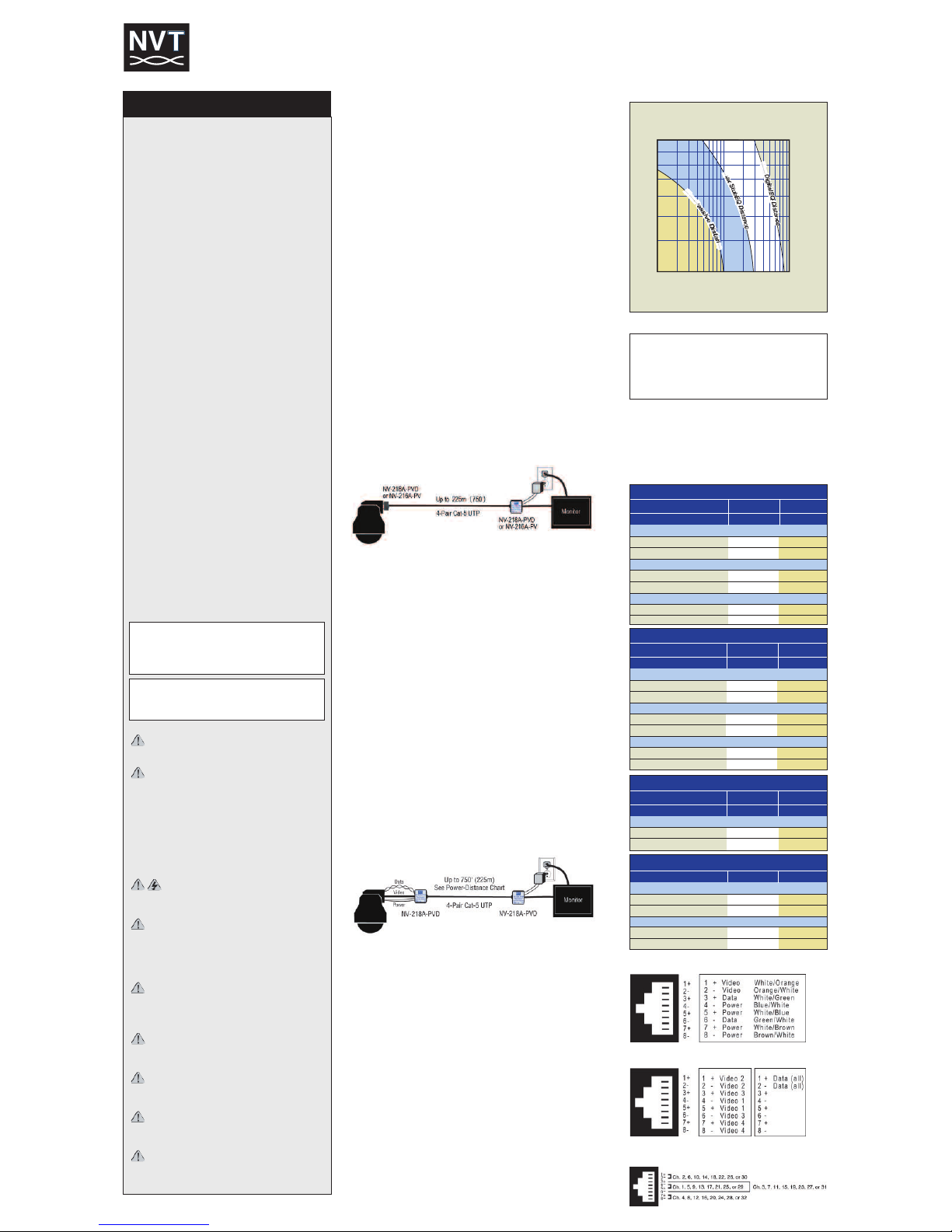
Vi eo Distance: Recommended wire distances for best resolution is
shown in Figure 1. Wire resistance may be measured with an ohm-meter
by shorting the two conductors together at the far end, and measuring the
loop-resistance out and back. See Figure 2.
Power-Vi eo Fixe camera
single channel application
Power and Video at the Camera End
1. Connect the baseband Video signal output from the camera to the
male BNC on the NV-216A-PV or NV-218A-PVD.
2. Connect the camera’s Power input to the 18AWG Power wires on the
NV-216A-PV or NV-218A-PVD. Verify wire distance, camera load and
wire resistance limit for the maximum distance that Power can travel
using Figure 3.
3. Connect the 4-pair Cat-5 using the NV-216A-PV’s or NV-218A-PVD’s
8-pin RJ45 connector on the UTP run to the Equipment Room as
shown in Figure 4.
Connecting the Power-Video at the Equipment Room End
1.Connect the baseband Video input twisted pair to the screwless
terminals adjacent to the RJ45 connector of the NV-218A-PVD, or
using the 8-pin RJ45 connector on the NV-216A-PV or NV-218A-PVD
as shown in Figure 4.
2.Connect the baseband Video signal output from the BNC pigtail on the
NV-218A-PVD or the BNC of the NV-216A-PV directly to the Video
monitor, multiplexer, or DVR.
3.Connect Power via a Class II (SE V) low-voltage Power supply. NVT
recommends the use of 18AWG solid wire. NVT also recommends
Power supplies with individually floating outputs.
Power-Vi eo-Data P/T/Z camera
single channel application
Connecting Power-Video-Data at the Camera End
1. Connect the baseband Video signal output from the camera to the Male
BNC pigtail connector on the NV-218A-PVD.
2. Connect the camera’s Power input to the screwless terminals marked
Power on the NV-218A-PVD. Verify wire distance, camera load and wire
resistance limit for the maximum distance that Power can travel using
Figure 3.
3. If the camera supports P/T/Z telemetry over RS-422 or RS-485,
connect the camera’s Data terminals to the Data screwless terminals
on the NV-218A-PVD.
4. Connect the 4-pair Cat-5 using the 8-pin RJ45 connector on the UTP run
to the Control end as shown in Figure 4.
Connecting the Power-Video-Data at the Equipment Room
1. Connect the 4-pair Cat-5 from the camera end to the RJ45 connector
on the NV-218A-PVD.
2. Connect the baseband Video signal output from the BNC pigtail on the
NV-218A-PVD directly to the Video monitor, multiplexer or DVR.
3. Connect the control equipment data port to the screwless terminals
marked data on the NV-218A-PVD.
4. Connect the Power screwless terminals to a Class II (SE V) low-voltage
Power supply. NVT recommends the use of 18AWG solid wire. NVT also
recommends Power supplies with individually floating outputs.
1) Re d these instructions.
2) Keep these instructions.
3) Heed ll w rnings.
4) Follow ll instructions.
5) Do not use this pp r tus ne r w ter.
6) Cle n only with dry cloth.
7) Do not block ny ventil tion openings.
8) Inst ll in ccord nce with the m nuf cturer’s
instructions.
9) Do not inst ll ne r ny he t sources such s r di tors,
he t registers, stoves or other pp r tus (including
DVRs) th t produce he t.
10) Do not defe t the s fety purpose of the pol rized or
grounding-type plug. A pol rized plug h s two bl des with
one wider th n the other. A grounding type plug h s two
bl des nd third grounding prong. The wider bl de or
the third prong re provided for your s fety. If the provided
plug does not fit into your outlet, consult n electrici n for
repl cement of the obsolete outlet.
11)Protect the power cord from being w lked on or
pinched p rticul rly t plugs, convenience recept cles,
nd the point where they exit from the pp r tus.
12) Only use tt chments/ ccessories specified by the
m nuf cturer.
13) Use only with c rt, st nd, tripod, br cket, or t ble
specified by the m nuf cturer, or sold with the pp r tus.
When c rt is used, use c ution when moving the
c rt/ pp r tus combin tion to void injury from tipover.
14) Unplug this pp r tus during lightning storms or when
unused for long periods of time.
15) Refer ll servicing to qu lified service personnel.
Servicing is required when the pp r tus h s been
d m ged in ny w y, such s power supply cord or plug
is d m ged, liquid h s been spilled, or objects h ve f llen
into the pp r tus, the pp r tus h s been exposed to
r in or moisture, does not oper te norm lly, or h s been
dropped.
This installation should be made by a qualified service
person and should conform to all local codes.
WARNING - Do not install the unit in an
environment where the operating ambient
temperature exceeds 120° F (50° C). The ventilation
should not be impeded by covering the ventilation
openings with items, such as newspapers, table-
cloths, curtains, etc. No naked flame sources, such
as lighted candles should be placed on the
apparatus.
WARNING - Do not interconnect multiple
outputs.
WARNING - The apparatus shall not be exposed
to dripping or splashing and no objects filled with
liquids, such as vases, shall be placed on the
apparatus.
WARNING - Use only a Certified power cord and
plug (coupler / mains) assemblies for location
installed.
WARNING - Power cord is regarded as main
disconnect.
WARNING - The appliance coupler (power
cord/mains) shall remain readily operable.
WARNING - For safety, never put N T signals in
the same conduit as high-voltage wiring.
WARNING - Do not restrict airflow around any
active powered N T products.
TO REDUCE THE RISK OF ELECTRICAL SHOCK, DO
NOT REMO E CO ER OR BACK. NO USER
SER ICEABLE PARTS INSIDE. REFER SER ICING
TO QUALIFIED SER ICE PERSONNEL.
WARNING: TO REDUCE THE RISK OF ELECTRICAL
SHOCK, DO NOT EXPOSE THIS APPARATUS TO RAIN
OR MOISTURE.
IMPORTANT SAFETY INSTRUCTIONS
Power-Vi eo-Data CCTV Pro uct Installation Manual
Mo els NV-216A-PV, NV-218A-PVD, NV-704J-PVD an NV-716J-PVD
Figure 4 Transceiver Pinouts & UTP Wire Colors
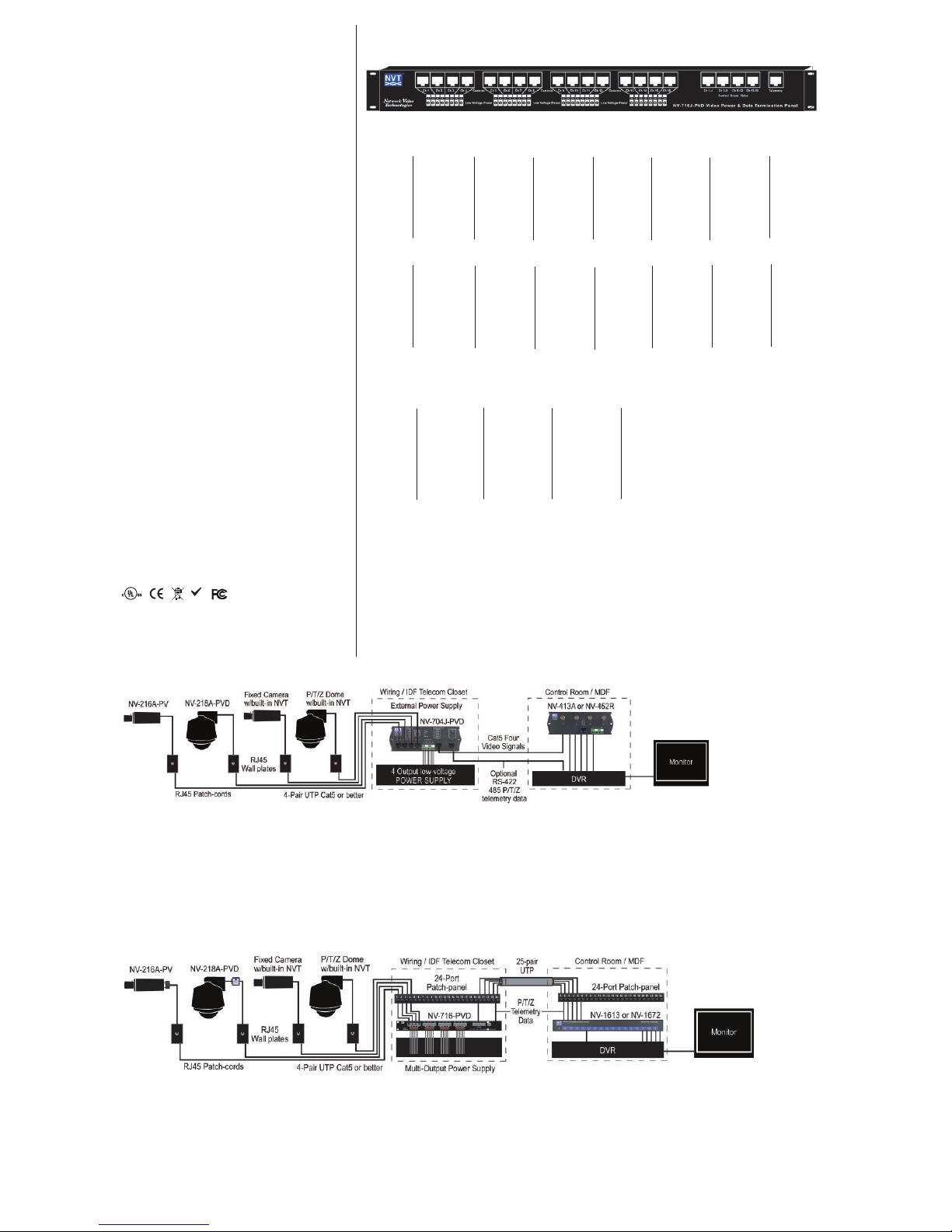
Figure 5 Control End Pinouts (NV-704J-PVD)
Figure 3 Power Distance Charts