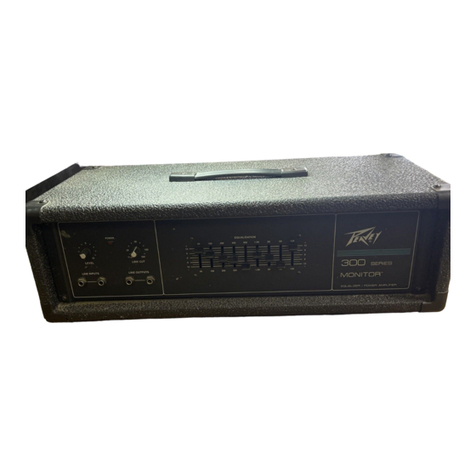
1. Amplifier Input: Connect your
instrument with a proper instrument
cable to the Amplifier Input jack.
2. Tone Selector Switch: This switch
is used to couple the tone circuit to
the main amplifier circuit. In the
DOWN position the tone control
circuit is defeated and turning the
tone control knob will not affect the
amplifier tone with the switch in this
position. When the switch is flipped
UP the tone control circuit becomes
active and the tone control knob can
be used to vary the amplifier tone.
There is a small bump up in volume
when the tone switch is UP as well.
The tone control is more or less a
treble cut with the most cut applied
when the knob is turned completely
counter clockwise.
3. Boost Selector Switch: This switch
is used to engage or dis-engage the
bypass capacitor across the power
tube cathode resistor. The net result
is a boost in volume and an increase
in harmonic distortion content. UP is
engaged and DOWN is dis-engaged.
4. NFB Selector Switch: NFB stands
for negative feedback and this switch
is used to engage or dis-engage the
negative feedback circuit in the
amplifier. UP is engaged and DOWN
is dis-engaged.
5. Tone Control: Treble cut when the
tone selector switch is in the UP
position with the most cut applied
when the knob is turned completely
counter clockwise.
6. Volume Control: Controls the
amplifier volume.
7. Pilot Light: Indicates the amplifier
is powered on.
8. On / Off Switch: DOWN is off and
UP allows the amplifier to be powered
up.