10
however, solves the nicky balance problem. The spring coils
pull the tube down onto the base, thereby increasing the fric-
tion on the altitude bearing pads. With CorrecTension, the
added weight of small front-end loads will not adversely affect
the balance of the telescope.
If you install an array of heavier accessories onto your
SkyQuest’s optical tube, you may need at some point to coun-
terbalance the telescope with a counterweight system.
Carrying the Telescope
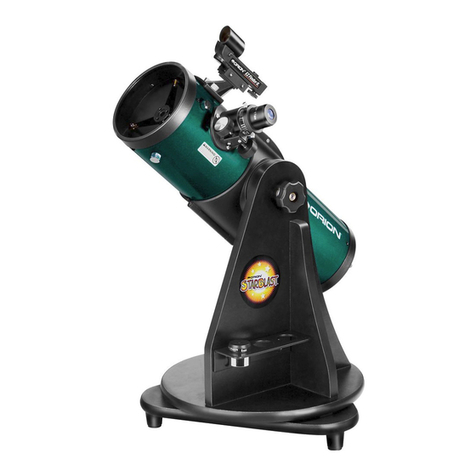
Because the springs of the CorrecTension system hold the opti-
cal tube captive on the base, the entire telescope can be car-
ried as one unit. This requires some caution, however. If the tele-
scope is lifted improperly, the front of the tube could swing down
and hit the ground.
First, point the optical tube straight up (vertical). Grasp the han-
dle on the front of the base with one hand while supporting the
telescope tube vertically with the other. Now, lift the telescope
from the handle. Once the telescope is in the horizontal position,
you can carry the entire unit with one hand.
If you wish to carry the optical tube and base separately, simply
disengage the CorrecTension springs by unhooking them from
the posts on the base, using the pull loops. The springs remain
captive on the telescope side bearings. Now the base and tube
are disengaged and can be transported separately.
Note:The SkyQuest XT Classic may be too heavy for some
users to lift and carry as one unit. Do not strain yourself! If
the load seems too heavy, disengage the springs and carry
the base and tube separately.
When putting the telescope into a vehicle, common sense pre-
vails. It is especially important that the optical tube does not
knock around; this can cause the optics to become misaligned,
and could dent the tube. We recommend transporting and stor-
ing the tube assembly in a padded case for proper protection.
4. Astronomical Observing
For many, this will be your rst foray into the exciting world of
amateur astronomy. The following information and observing
tips will help get you started.
Choosing an Observing Site
When selecting a location for observing, get as far away as
possible from direct articial light such as street lights, porch
lights, and automobile headlights. The glare from these lights
will greatly impair your dark-adapted night vision. Set up on
a grass or dirt surface, not asphalt, because asphalt radiates
more heat. Heat disturbs the surrounding air and degrades the
images seen through the telescope. Avoid viewing over roof-
tops and chimneys, as they often have warm air currents rising
from them. Similarly, avoid observing from indoors through an
open (or closed) window, because the temperature difference
between the indoor and outdoor air will cause image blurring
and distortion.
If at all possible, escape the light-polluted city sky and head for
darker country skies.You’ll be amazed at how many more stars
and deep-sky objects are visible in a dark sky!
“Seeing” and Transparency
Atmospheric conditions vary signicantly from night to night.
“Seeing” refers to the steadiness of the Earth’s atmosphere at a
given time. In conditions of poor seeing, atmospheric turbu-
lence causes objects viewed through the telescope to “boil.”
If you look up at the sky and stars are twinkling noticeably,
the seeing is poor and you will be limited to viewing at lower
magnications. At higher magnications, images will not focus
clearly. Fine details on the planets and Moon will likely not be
visible.
In conditions of good seeing, star twinkling is minimal and
images appear steady in the eyepiece. Seeing is best over-
head, worst at the horizon. Also, seeing generally gets better
after midnight, when much of the heat absorbed by the Earth
during the day has radiated off into space.
Especially important for observing faint objects is good
“transparency”—air free of moisture, smoke, and dust. All
tend to scatter light, which reduces an object’s brightness.
Transparency is judged by the magnitude of the faintest stars
you can see with the unaided eye (5th or 6th magnitude is
desirable).
Cooling the Telescope
All optical instruments need time to reach “thermal equilibri-
um.” The bigger the instrument and the larger the temperature
change, the more time is needed. Allow at least 30 minutes for
your telescope to acclimate to the temperature outdoors before
you start observing with it.
Let Your Eyes Dark-Adapt
Don’t expect to go from a lighted house into the darkness of
the outdoors at night and immediately see faint nebulas, galax-
ies, and star clusters—or even very many stars, for that matter.
Your eyes take about 30 minutes to reach perhaps 80% of their
full dark-adapted sensitivity. As your eyes become dark-adapt-
ed, more stars will glimmer into view and you’ll be able to see
fainter details in objects you view in your telescope.
To see what you’re doing in the darkness, use a red-ltered
ashlight rather than a white light. Red light does not spoil your
eyes’ dark adaptation like white light does. A ashlight with a
red LED light is ideal. Beware, too, that nearby porch, street-
lights, and car headlights will ruin your night vision.
What to Expect
So what will you see with your telescope? You should be able
to see bands on Jupiter, the rings of Saturn, craters on the
Moon, the waxing and waning of Venus, and many bright
deep-sky objects. Do not expect to see color as you do in
NASA photos, since those are taken with long-exposure cam-
eras and have “false color” added. Our eyes are not sensitive
enough to see color in deep-sky objects except in a few of the
brightest ones. But as you become more experienced and your
observing skills get sharper, you will be able to ferret out more
and more subtle details and structure.
Objects to Observe
Now that you are all set up and ready to go, what is there to
look at in the night sky?
A. The Moon