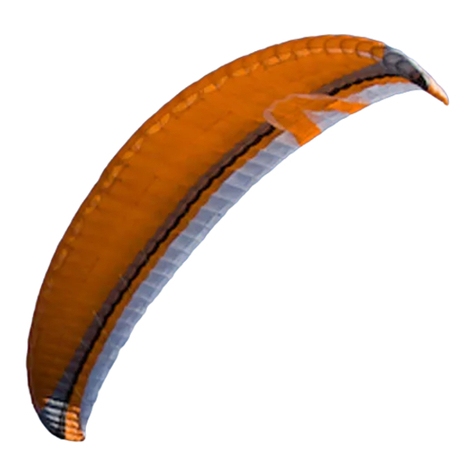
Flying the ALLEGRO in the upper half of the weight range increases the dynamics and stability of the glider. The trim speed
increases slightly. The dynamics on extreme maneuvers are slightly higher.
In flight with the ALLEGRO
It is recommended to do the first flights with a new glider in calm conditions to get used to the flight behavior. Also, a few
launches on the training hill or ground handling are recommended to get a feel for the wing and its reactions.
Start
The pilot must make sure that all equipment is in good condition before take-off. In particular, the wing, the harness and the
rescue system. The type table must be checked. It is important to make sure that you are in the legal weight range.
Necessary start check:
1. Strapped in (leg straps and chest strap on the harness closed, chin strap on the helmet closed)
2. Hooked in correctly (risers not twisted, hooked in carabiner, accelerator connected correctly, carabiners locked)
3. Lines (A-line above, all lines sorted, brake line runs freely to the brake pulley)
4. Canopy (canopy is prepared in a bow with open leading edges)
5. Wind and airspace (wind direction from the front, airspace free)
The pilot performs the control look up and makes sure that the wing is completely open above him, with no knots in the lines.
The final decision to start has to be made only in the case there are no faults.
Otherwise, the start should be stopped immediately for security reasons!
The ALLEGRO is characterized by a very simple forward as well as reverse start behavior. The glider rises constantly without strong
forward shooting. Overall, the starting behavior is very simple and forgiving and requires no further knowledge than the standard
forward and reverse launch techniques taught in flight schools.
Generally it is advisable to practice regularly on the training hill or by ground handling in the wind.
Straight flight
The ALLEGRO has the best glide performance at trim speed (with fully released brakes). In calm air, like this the glider is reaching
the greatest distance at a given altitude.
In headwinds or sinking air masses you fly with the best glide when you push the accelerator. In turbulent air you should consider
the more dynamic reactions on a collapse in accelerated flight and therefore choose a greater safety altitude to the ground.
Attention!
Never push the accelerator with too little safety altitude over the ground!
The safety height allows the glider to open by itself aer a large collapse, or the pilot to actively recover the wing. There should
also be enough reserve altitude to use the rescue system, in the case of unsolvable problems.
In strong turbulence, a light brake input on both sides is recommended to increase stability and to get the feedback on the brakes
necessary for active flying.
Active flying is the constant control and correction of the angle of attack and airspeed in turbulent air.
With a perfected active flying style you can prevent most collapses. Part of the necessary reactions can also be learned and
practiced during ground handling, for example by trying to stabilize the glider without looking at the wing above you.
Turning
A turn is an interaction of inner brake, outer brake and weight shiing. The art is the right dosage. The ALLEGRO is characterized
by a sensitive handling. Small brake inputs are enough to fly precise turns.
The ALLEGRO loves a modern, dynamic thermal style. It is recommended not to pull too much outer brake and to keep speed
turning. The ALLEGRO "carves" very efficiently around the turn and climbs dynamically. Tight and controlled turns, or swing-free
turns, require practice and should be the goal of every pilot.
Attention!
Should it happen that the wing is no longer controllable by the brake lines, e.g. the brake lines are tangled due to a poor starting
check, the ALLEGRO can be controlled to a limited extent via the C-risers. In combination with weight shi, relatively good