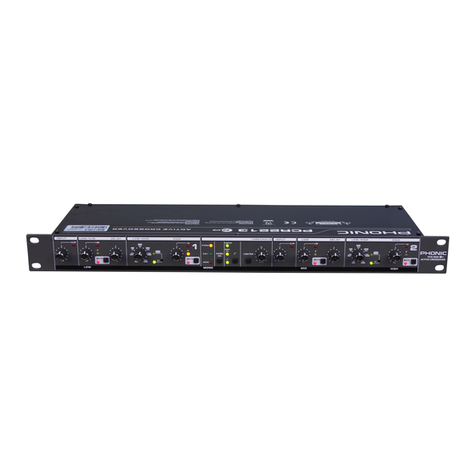
Phonic PCR2213 User manual

PHONIC PCR2213PHONIC PCR2213
PHONIC PCR2213PHONIC PCR2213
PHONIC PCR2213
USER MANUAL

1. Read these instructions before operating this
apparatus.
2. Keep these instructions for future reference.
3. Heed all warnings to ensure safe operation.
4. Follow all instructions provided in this document.
5. Do not use this apparatus near water or in locations
where condensation may occur.
6. Clean only with dry cloth. Do not use aerosol or liquid
cleaners. Unplug this apparatus before cleaning.
7. Do not block any of the ventilation openings. Install
in accordance with the manufacturer
’
s instructions.
8. Do not install near any heat sources such as radiators,
heat registers, stoves, or other apparatus (including
.
9. Do not defeat the safety purpose of the polarized or
grounding-type plug. A polarized plug has two blades
with one wider than the other. A grounding type plug
has two blades and a third grounding prong. The wide
blade or the third prong is provided for your safety. If
the provided plug does not into your outlet, consult
an electrician for replacement of the obsolete outlet.
10. Protect the power cord from being walked on or
pinched particularly at plug, convenience receptacles,
and the point where they exit from the apparatus.
11. Only use attachments/accessories by the
manufacturer.
12. Use only with a cart, stand, tripod, bracket, or
table by the manufacturer, or sold with
the apparatus. When a cart is used, use caution
when moving the cart/apparatus
combination to avoid injury from tip-
over.
13. Unplug this apparatus during lighting
storms or when unused for long
periods of time.
14. Refer all servicing to service personnel.
Servicing is required when the apparatus has been
damaged in any way, such as power-supply cord or
plug is damaged, liquid has been spilled or objects
have fallen into the apparatus, the apparatus has
been exposed to rain or moisture, does not operate
normally, or has been dropped.
IMPORTANT SAFETY INSTRUCTIONS
CAUTION: TO REDUCE THE RISK OF ELECTRIC SHOCK,
DO NOT REMOVE COVER (OR BACK)
NO USER SERVICEABLE PARTS INSIDE
REFER SERVICING TO QUALIFIED PERSONNEL
The lightning flash with arrowhead symbol, within an
equilateral triangle, is intended to alert the user to the
presence of uninsulated
“
dangerous voltage
”
within the
product
’
magnitude to constitute a risk of electric shock to persons.
The exclamation point within an equilateral triangle is in-
tended to alert the user to the presence of important operat-
ing and maintenance (servicing) instructions in the literature
accompanying the appliance.
WARNING: To reduce the risk of or electric shock, do
not expose this apparatus to rain or moisture.
CAUTION: Use of controls or adjustments or performance
of procedures other than those may result in
hazardous radiation exposure.
The apparatus shall not be exposed to dripping or splashing and that no objects with liquids, such as vases,
shall be placed on the apparatus. The MAINS plug is used as the disconnect device, the disconnect device shall
remain readily operable.
Warning: the user shall not place this apparatus in the area during the operation so that the mains switch
can be easily accessible.
CAUTION
RISK OF ELECTRIC SHOCK
DO NOT OPEN

2
CONTENTS
1.0 PREFACE ................................................................................................ 4
1.1 MULTIPLE-WAY SPEAKER SYSTEMS .............................................................. 4
1.2 PCR2213 THE ULTIMATE CROSSOVER FOR ADVANCED SPEAKER ........... 4
2.0 DESIGN YOUR SPEAKER SYSTEM WITH PCR2213 ........................... 6
2.1 2-WAY SYSTEM .................................................................................................. 6
2.2 3-WAY SYSTEM .................................................................................................. 7
2.3 PASSIVE FULL RANGE WITH ACTIVE-CROSSOVER SUB-WOOFER ...........
2.4 STEREO ACTIVE 2-WAY WITH SUB-WOOFER ................................................ 9
2.5 STEREO ACTIVE 3-WAY WITH SUB-WOOFER .............................................. 10
2.6 4-WAY, 5-WAY ................................................................................................... 10
3.0 INSTALLATION...................................................................................... 11
3.1 RACK MOUNTING ............................................................................................ 11
3.2 CONNECTORS ................................................................................................. 11
3.2.1 IMPEDANCE ................................................................................................................... 11
3.2.2 UNBALANCED/BALANCED CONNECTION ................................................................. 11
3.2.3 THE CORRECT WIRING FOR BALANCED OPERATION ............................................. 12
3.2.4 UNBALANCED OPERATION ......................................................................................... 12
3.2.5 BALANCED OPERATION .............................................................................................. 12
3.3 MAINS CONNECTION ...................................................................................... 13
3.3.1 SAFETY FUSE REPLACEMENT ................................................................................... 13
4.0 CONTROLS ........................................................................................... 14
4.1 FRONT PANEL .................................................................................................. 14
4.2 REAR PANEL .................................................................................................... 17

3
5.0 HOW TO SET UP A MULTI-WAY SPEAKER SYSTEM ........................ 18
5.1 EQUIPMENT AND INSTRUMENTS .................................................................. 1
5.1.1 MEASUREMENT MICROPHONE
(CALIBRATED AND MATCHED WITH RTA OR ETF/TEF) ........................................... 18
5.1.2 REAL TIME ANALY ER (RTA), ENERGY-TIME-FREQUENCY (ETF OR TEF), FFT,
OR MLSSA INCLUDING A SOUND PRESSURE LEVEL METER................................. 18
5.1.3 FUNCTION GENERATOR WITH FREQUENCY DISPLAY ............................................ 18
5.1.4 AC VOLTMETER ........................................................................................................... 18
5.1.5 YOUR FAMILIAR CDS.................................................................................................... 18
5.2 2-WAY SYSTEM LEVEL SETTING ................................................................... 19
5.3 3-WAY SYSTEM LEVEL SETTING ................................................................... 20
5.4 DELAY TIME ..................................................................................................... 21
5.5 LIMITER SETTING ............................................................................................ 21
5.6 SUB ............................................................................................................... 22
5.7 HORN EQ .......................................................................................................... 22
6.0 TYPICAL CONNECTING LEADS.......................................................... 23
.0 SPECIFICATIONS ................................................................................. 24
8.0 SYSTEM BLOCK DIAGRAM................................................................. 25
9.0 REFERENCE BOOKS ........................................................................... 26

4
1.0 PREFACE
In most of the professional audio applications, multiple speakers are employed for covering the whole audi-
ence area as well as frequency band. When sound waves are generated with multiple speakers, proper ar-
rangement is a standard and recommended practice by audio design engineers and installation technicians.
Phonic provides this active crossover as part of the speaker system, which work together with speaker drivers,
highs or lows, and amplifiers, big or small. This crossover will be successful if you carefully design and align
the whole speaker system according to the following explanation and recommended practice.
1.1 MULTIPLE-WAY SPEAKER SYSTEMS
Full bandwidth covering 20Hz to 20KHz as human audible band, no single speaker driver can cover this range
with wave length differ by 1000 times with good quality and sufficient sound pressure level. To deal with this
limit, audio engineers need to use multiple speaker drivers for different frequency band, and we call these
designs as multiple-way system. Multiple-way means different speakers covering different frequency band,
and multiple speakers could be in the same band.
For professional applications, 2-way and 3-way designs are most popular configuration. To build a 2-way or 3-
way speaker system, crossover network is needed to divide the frequency band into high and low (or high, mid,
low) section. Crossover can be passive or active. Passive crossover can be found in smaller speaker system
that is assembled with inductors, capacitors, and resistors. Amplifier send in the signal to the passive cross-
over network and then to the high and low frequency speakers accordingly.
Active crossover did this differently, it is positioned before the power amplifiers. Then, the power amplifier
send the signal directly to the high or low frequency speakers directly without the passive crossover inserted.
The benefit are:
!More solid bass for lower resistance between speaker and amplifier that maintain effective damping factor.
!Lower inter-modulation distortion (IMD).
!ave the insertion loss, normally in the range of 1 to 3 dB. That means save the lost from 20% to 50%.
!Increase power efficiency for less composite signal that will demand lower voltage swing of power amplifiers,
and still provide the same sound pressure level.
!ave the high frequency drivers from damage by large low frequency signal clipping the power amplifiers
which generate high level harmonic signal. This is the phenomenon that underpower amplifier will burn
tweeter when clipping.
If the user doesnt follow the exact procedure to set-up the speaker system with active crossover, the result is
always very bad and worst than passive crossover speakers. Because the passive crossover was already
properly adjusted by the designer and maker.
OK, lets see how we can get the best of the system performance with Phonic PCR2213.
1.2 PCR2213 THE ULTIMATE CROSSOVER FOR ADVANCED SPEAKER
SYSTEM
The PCR2213 is a very high quality active crossover. It is designed with 2, 3 or more way speaker systems in
mind with 1, 2 or more PCR2213 to achieve it. The PCR2213 may be used with large sound systems in
auditoriums, theaters, pubs, amusement parks, or touring concerts. Also for high quality bi-amp stage monitors,
or adding a mono sub-woofer for studio monitors in a control room.
The Phonic PCR2213 is a high precision tool with a lot of advanced features:
!tereo 2-way or mono 3-way operation.
!Reasonable ways speaker system with multiple PCR2213.
!Industrial standard state variable 24 dB/octave Linkwitz-Riley filters with zero phase error at crossover

5
frequencies.
!Perfect flat summed amplitude response at all Crossover frequencies.
!Independent limiters on all outputs with pre-defined time parameters.
!Latching mute push buttons on all outputs. It is a vital function during setting up and troubleshooting.
!LED indication on all important switching functions for easy status identification.
!Crossover frequencies continuously variable from 80 - 8000 Hz
!Time/phase alignment via polarity switches and 4 msec time delay controls
!witchable horn EQ curve to compensate the HF roll-off.
!RF and ubsonic input filters.
!High precision components and potentiometers ensure excellent quality and accuracy of settings
!ervo-balanced XLR inputs and outputs

6
2.0 DESIGN YOUR SPEAKER SYSTEM WITH PCR2213
When designing the speaker system, first determine the frequency bandwidth you want to cover and the
maximum sound pressure level you want to achieve. elect those components that meet your demand. Care-
fully note the frequency range each driver covered.
Following are some most popular configuration, PCR2213 is not limited within the listed application. Multiple
PCR2213 can form even more than 10-way speaker system, although it is not practical. The recommended
crossover points are listed for your reference, your components will fall in the recommended range mostly, but
exception exists!
2.1 2-WAY SYSTEM (Ref:Figure 1)
PCR2213 is capable of dual 2-way system in stereo mode. The crossover frequency can be anywhere be-
tween 80 to 8000Hz. Most 2-way system crossover between 500 to 5000Hz. Following are the table of popular
2-way configuration and recommended crossover frequency:
tinUssaBtinUFHnoitacilppAtnioPtsewoLtnioPtsehgiH
"51nroHFH"2~"1egat 0050002
"21nroHFH"2~"1egat 0080052
"01emoD"2~"1rotinoM00210005
"8emoD"2~"1rotinoM00510005
Figure 1:Typical Active 2-way System

7
ssaBdiMhgiHnoitacilppAdiM/woLhgiH/diM
"81"01nroH"2~"1egat 005~0020005~0002
"51"01~5.6nroH"2~"1rotinoM/egat 008~0020005~0002
"21"5.6~4emoD"2~"1rotinoM0001~0030008~0003
"01"5.6~3emoD"2~"1rotinoM0001~0050008~0003
2.2 3-WAY SYSTEM (Ref:Figure 2)
PCR2213 is capable of single 3-way speaker system with one unit. The low/mid and mid/high crossover fre-
quency can be set between 80 to 8000Hz. Most 3-way system have low/mid crossover point at 200~2000Hz,
and mid/high at 800~8000Hz. Following are the table of popular 3-way configuration and recommended cross-
over frequency:
Figure 2:Typical Active 3-way System

8
refoowbu egnarlluffossaBnoitacilppAtnioPrevossorC
"81"51rotinoM/egat 001~08
"81~"51"21rotinoM/egat 021~08
"81~"51"01rotinoM/egat 051~08
"51"8rotinoM021~08
"51~"21"8rotinoM051~08
"21~"01"8~"5.6rotinoM051~001
"01~"8"5.6~"5rotinoM081~001
2.3 PASSIVE FULL RANGE WITH ACTIVE-CROSSOVER SUB-WOOFER
(Ref:Figure 3)
PCR 2213 is very suitable for sub-woofer application and is capable of this system with one unit. The cross-
over frequency is always low at 80~200Hz. Following a table to list some popular configuration:
PCR 2213 has a sub- switch in the rear panel. This switch will sum the low frequency part of both channels
and send it out from both low outputs. When you are using this type of speaker system with one or more sub-
woofer boxes, it is recommended to engage the switch and put all the woofer boxes together in the center line
between the stereo speakers.
Figure 3:Typical Passive 2-way Subwoofer

9
2.4 STEREO ACTIVE 2-WAY WITH SUB-WOOFER (Ref:Figure 4)
ome people will regard this as 3-way, and it really is. There are 2 configuration you can achieve:(1)Treat it as
3-way and do it as the same as 2.2. (2)Treat it as 2-way plus sub-woofer as the same as 2.1 + 2.3.
The later configuration benefit the summed sub-woofer output from both channels, and thus better than pure 3-
way configuration. No matter which configuration, you need two PCR2213 for this system.
Figure 4:Typical Active 2-way Subwoofer
Table of contents
Other Phonic Crossover manuals