TIPS ON FAULT FINDING, FUNCTIONAL IRREGULARITIES
AND THEIR ELIMINATION
.~.~.
1. . Engine
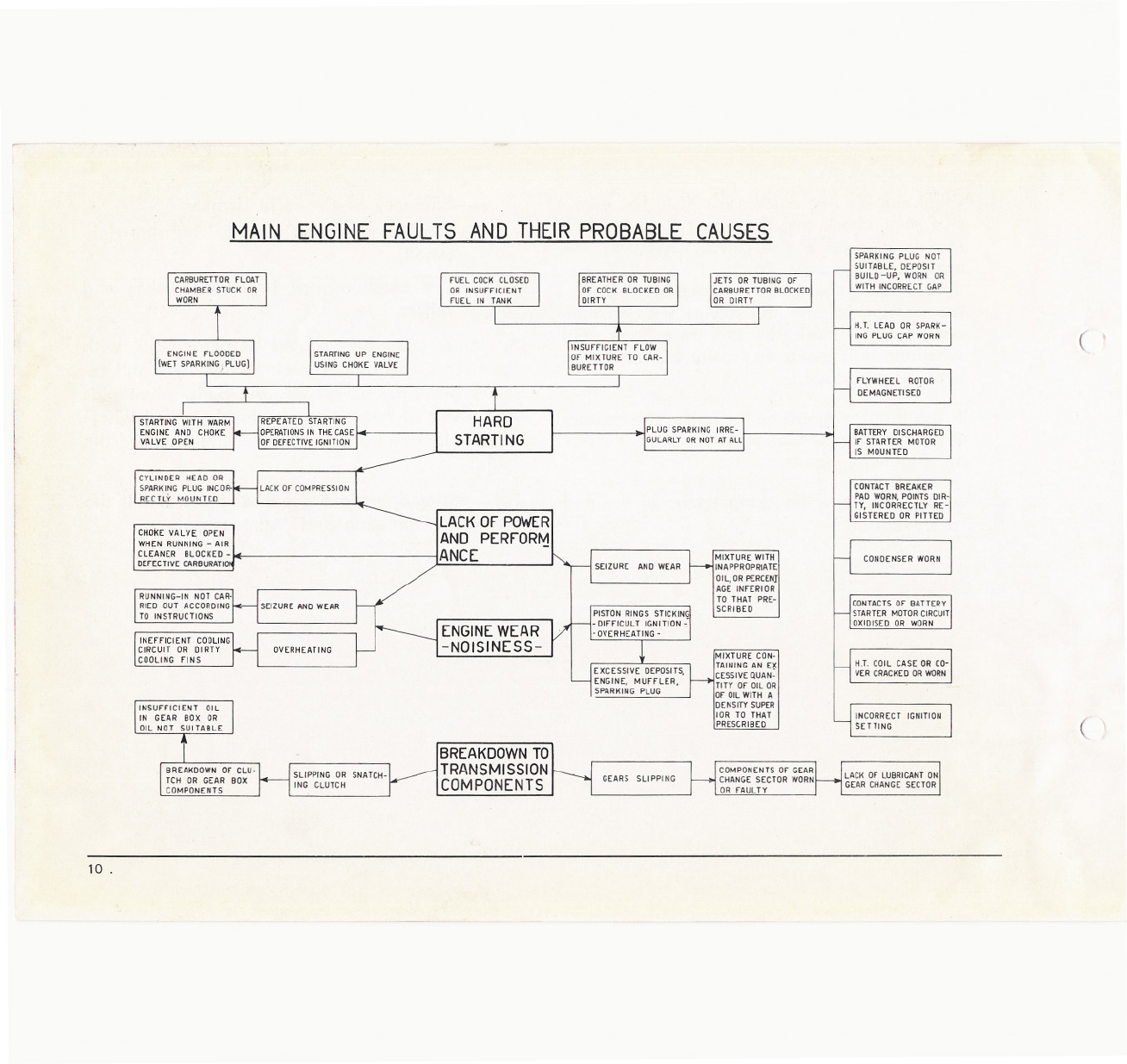
a) On page 10 is a summary of the engine faults
- most commonly verified during operation: ie,
ignition, fuel feed, carburation and lubrication.
For a normal adjustment or registration pro-
ceed according to the following instructions:
- In the case of poor performance, low com-
pression and pressure losses, check that the
engine groups in question are well secured
in position.
- On changing sparking plugs ensure that
the type prescribed in the booklet « Ope-
ration and Maintenance» are used. The
spark gap between the electrodes should
always be set at 0.6 mm (0."023).
- The gap between contact breaker points
should always come between the limits of
0.4 and 0.5 mm (0".015 and 0".019).
Spark advance: For for mods AC 1 and
AC 2; 28° :t: 1° for Mod. AC 3 25° :t: 1°.
- Groups clutch, gear change, should be ac-
curately checked for play with respect to
their relative cables (see pages 38 -;- 39
and control levers. In the case of clutch
slipping, check springs and plates and for
the gear box, control the parts comprising
the transmission in correspondence to the
selector quadrant.
r)
b) On stripping down or overhauling engine
groups, always use new split pins and gaskets
on re-assembly.
c) In the case where faults are verified which do
not enter under those indicated on the chart
at pag. 10, eg: abnormal engine noises, brea-
kages or premature wear to moving parts etc.)
it is necessary to localize the fault and substi-
tute or overhaul the part according to the con-
ditions prevailing: please note that the as-
sembly play of the main engine components
(piston-cylinder, piston rings etc.) should cor-
respond to those indicated on the table from
page 29 onwards.
)
6.